
A property may look attractive on paper. It may have a modern design, a convenient location, and a price that seems difficult to resist. But does it offer genuine investment potential?
Buying property is a major financial decision. A promising location does not always guarantee strong returns. Rental demand can change, maintenance costs can reduce profits, and regulatory issues can delay a project.
This is where real-estate consulting companies can add value. They help investors look beyond the asking price and assess whether a property fits their financial goals, risk tolerance, and long-term plans.
From location analysis and rental yield calculations to market research and due diligence, a structured assessment can help investors make better-informed decisions before committing capital.
1. Location and Demand Analysis
Location is one of the first factors investors should consider. However, a well-known address alone does not make a property a good investment.
Consultants examine the conditions that influence demand in the surrounding area. These may include population growth, employment opportunities, transport links, schools, hospitals, shopping facilities, and access to business districts.
They also study the types of people and businesses likely to occupy the property.
For example, a residential apartment near a university may attract students and academic staff. A property close to a major commercial district may appeal to professionals.
Meanwhile, warehouses near transport corridors may attract logistics and distribution businesses.
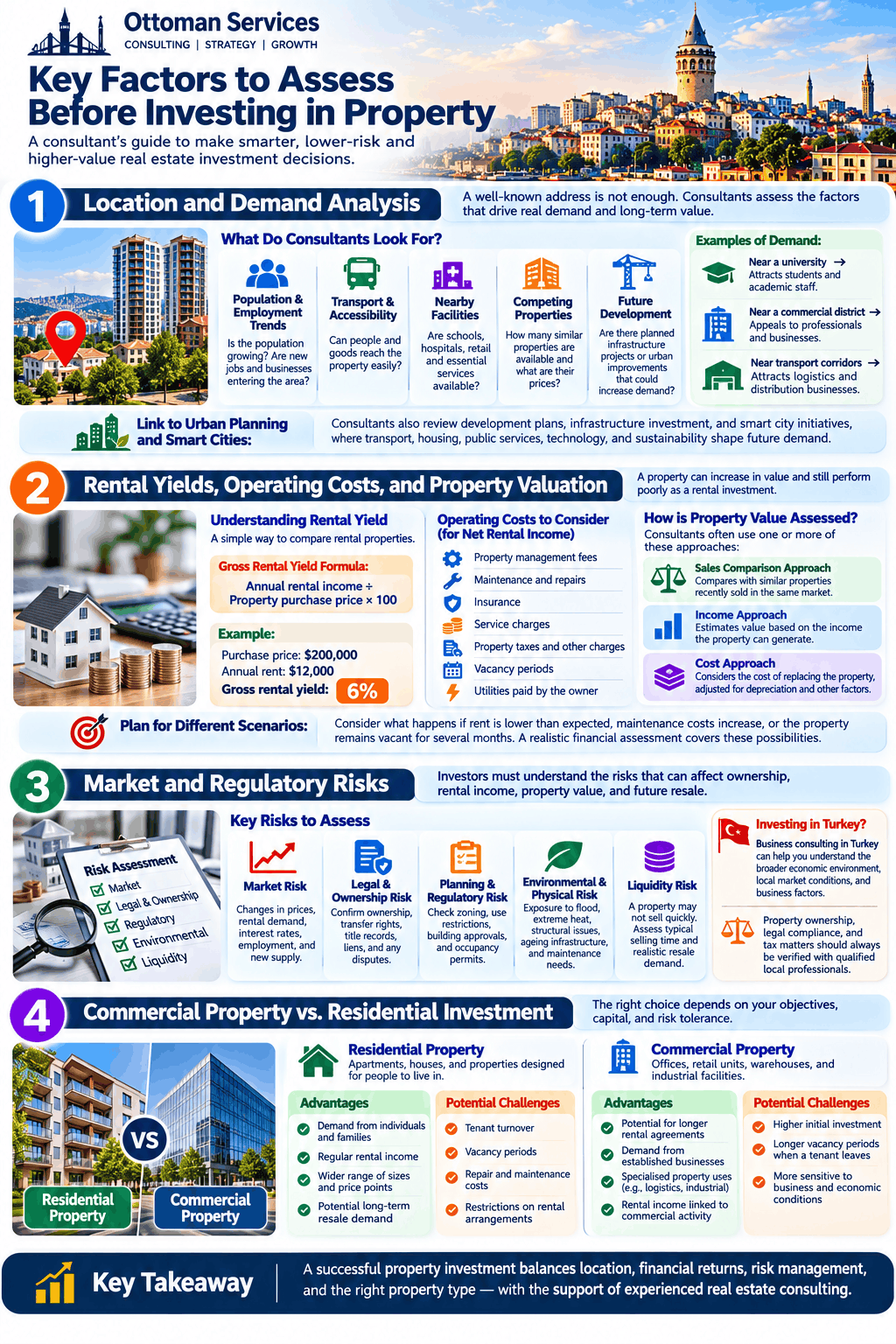
What do consultants look for?
-
Population and employment trends: Is the local population growing? Are new businesses and jobs entering the area?
-
Transport and accessibility: Can residents, employees, customers, and suppliers reach the property easily?
-
Nearby facilities: Are essential services, schools, healthcare facilities, and retail options available?
-
Competing properties: How many similar properties are available, and how do their prices compare?
-
Future development: Are infrastructure projects or urban improvements likely to influence demand?
Consultants may also assess local development plans and infrastructure investment.
This connects property research with urban planning and smart cities, where transport, housing, public services, technology, and sustainable development influence how neighbourhoods grow.
Investors should distinguish between current demand and future expectations.
A planned road or commercial district may create opportunities, but delays or changes to development plans can affect projected returns.
2. Rental Yields, Operating Costs, and Property Valuation
A property can increase in value and still perform poorly as a rental investment. Investors need to understand both income potential and the costs of ownership.
Real-estate consulting companies often compare expected rental income with the property’s purchase price and ongoing expenses.
Understanding rental yield
Gross rental yield provides a basic way to compare rental properties.
Gross rental yield formula:
Annual rental income ÷ Property purchase price × 100
For example, consider a property purchased for $200,000 that generates $12,000 in annual rent.
Its gross rental yield is 6%.
However, this figure does not include operating expenses. A more useful assessment considers net rental income after relevant costs.
These may include:
-
Property management fees
-
Maintenance and repairs
-
Insurance
-
Service charges
-
Property taxes and other applicable charges
-
Vacancy periods
-
Utilities paid by the owner
Consultants may also examine expected capital expenditure, such as major repairs or building upgrades.
How is property value assessed?
Property valuation is not based on the asking price alone. Consultants may review comparable property sales, current rental income, replacement costs, and the property’s condition.
Three common valuation approaches are:
-
Sales comparison approach: Compares the property with similar properties recently sold in the same market.
-
Income approach: Estimates value based on the income the property can generate.
-
Cost approach: Considers the cost of replacing the property, adjusted for depreciation and other relevant factors.
The most suitable method depends on the property type, available information, and investment purpose.
Investors should also consider different scenarios. What happens if rent is lower than expected? What if maintenance costs increase? What if the property remains vacant for several months?
A realistic financial assessment considers these possibilities rather than relying on the most optimistic forecast.
3. Market and Regulatory Risks
Property investment involves more than financial calculations. Investors must understand the risks that could affect ownership, rental income, property value, and future resale.
Consultants assess several types of risk before recommending an investment.
- Market risk: Property prices and rental demand can change due to economic conditions, interest rates, employment trends, and new developments. An area with strong demand today may face oversupply if too many similar properties enter the market.
- Legal and ownership risk: Investors need to confirm who owns the property and whether the seller has the legal right to transfer it. They should also check title records, outstanding mortgages, liens, disputes, and restrictions on ownership.
- Planning and regulatory risk: A property may have restrictions on its permitted use, renovation, construction, or future development. Investors should verify zoning, building approvals, occupancy permissions, and other applicable requirements.
- Environmental and physical risk: Flood exposure, extreme heat, structural defects, ageing infrastructure, and poor building maintenance can affect property value and operating costs. Climate-related risks can also influence insurance availability and long-term financial performance.
- Liquidity risk: Property cannot always be sold quickly. A specialist may assess how long similar properties take to sell and whether demand exists at the expected resale price.
These checks are particularly important when investing in unfamiliar markets.
For example, investors exploring Turkey may benefit from business consulting in Turkey to understand the wider economic environment, local market conditions, and business considerations connected with a property investment.
However, property ownership, legal compliance, and tax matters should always be verified with qualified local professionals.
4. Commercial Property Versus Residential Investment
Should you invest in a residential apartment or a commercial property? The answer depends on your objectives, available capital, and willingness to manage risk.
Residential property
Residential investments include apartments, houses, and other properties designed for people to live in.
Their demand is often influenced by population growth, household income, employment, affordability, and access to essential services.
Potential advantages include:
-
Demand from individuals and families
-
Opportunities to earn regular rental income
-
A wider range of property sizes and price points
-
Potential long-term resale demand
However, residential properties can experience tenant turnover, vacancy periods, repair costs, and restrictions on rental arrangements.
Commercial property
Commercial investments include offices, retail units, warehouses, and industrial facilities.
Their performance often depends on business activity, location, transport access, customer traffic, and demand from companies.
Potential advantages include:
-
Opportunities to secure longer rental agreements
-
Demand from established businesses
-
Potential for specialised property uses
-
Rental income linked to commercial activity
However, commercial properties may require higher initial investment. They can also face longer vacancy periods when a tenant leaves or business demand weakens.
| Factor | Residential | Commercial |
|---|---|---|
| Main tenants | Individuals and families | Businesses and organisations |
| Demand drivers | Housing needs and employment | Business activity and accessibility |
| Lease arrangements | Often shorter | Can be longer |
| Vacancy risk | Depends on local housing demand | Can be higher when specialised space is difficult to re-let |
| Operating needs | Repairs and tenant management | Building services and specialised maintenance |
Neither category is automatically better. A consultant compares expected income, costs, risks, and exit options before identifying which investment better matches the investor’s goals.
5. Due Diligence Questions Before Committing Capital
Due diligence is the process of checking a property and its supporting information before making a financial commitment.
It helps investors identify problems that may not be obvious during a viewing or initial discussion.
Before purchasing, investors should ask:
-
Is the ownership documentation clear? Verify title records, ownership rights, and any existing claims or disputes.
-
Does the property have the required approvals? Check building permits, permitted use, occupancy approvals, and relevant planning restrictions.
-
Is the asking price supported by market evidence? Compare recent sales and similar available properties.
-
Are the rental estimates realistic? Review comparable rents, vacancy levels, tenant demand, and lease conditions.
-
What costs will arise after purchase? Include taxes, service charges, insurance, management fees, maintenance, and potential renovation.
-
Are there outstanding obligations? Check unpaid charges, mortgages, liens, contractual commitments, and other liabilities.
-
What could affect future resale? Consider market liquidity, competing developments, location changes, and possible restrictions.
Investors should also understand who is responsible for each part of the transaction.
A property consultant can coordinate research and commercial assessments, but independent lawyers, surveyors, valuers, and tax advisers may be needed for specialist verification.
This approach is similar to the checks businesses perform when they evaluate distributors in the UAE.
Before entering a commercial relationship, they investigate financial standing, reputation, operating capacity, and contractual risks. Property investors should apply the same discipline before committing significant capital.
For further research and market insights, explore the Ottoman Services Research Papers. These resources can help readers understand wider economic, infrastructure, and investment considerations.
The World Bank’s Transit-Oriented Development Implementation Resources and Tools also explains how property demand, occupancy, land use, and potential yields can inform development decisions.
6. How Do Real-Estate Consulting Companies Help Investors Make Better Decisions?
The value of real-estate consulting companies is not simply in identifying properties for sale. Their role is to help investors understand the opportunity behind the property.

A structured assessment brings together market research, financial analysis, risk evaluation, and due diligence. It can also help investors compare several opportunities using consistent criteria.
For investors considering mixed-use developments or large projects, urban planning and smart cities are important areas of consideration.
Infrastructure, public transport, digital services, sustainability, and access to essential facilities can influence the long-term appeal of a location.
Similarly, investors entering unfamiliar markets may need wider strategic support. This is where advisory experience across property, infrastructure, and business consulting in Turkey can help connect individual investment decisions with broader market conditions.
No consultant can guarantee rental income, capital appreciation, or a profitable exit. A good assessment instead provides evidence, highlights uncertainties, and helps investors make decisions with a clearer understanding of the risks.
Frequently Asked Questions
1. What do real-estate consulting companies do?
They help investors assess property opportunities through market research, location analysis, financial modelling, valuation reviews, risk assessment, and due diligence. Their work supports informed investment decisions.
2. How do you evaluate whether a property is a good investment?
Consider its purchase price, rental demand, expected income, operating expenses, physical condition, legal status, and resale potential. Compare these factors with your investment goals and risk tolerance.
3. What is a good rental yield for an investment property?
There is no universal rental yield that makes a property a good investment. Suitable returns depend on the location, property type, financing, expenses, vacancy risk, and market conditions. Compare net returns rather than relying only on gross yield.
4. Is commercial property a better investment than residential property?
Not necessarily. Commercial property may offer longer leases, but it can involve higher costs and longer vacancy periods. Residential property may have a broader tenant market, but it also involves maintenance and tenant turnover. The right choice depends on the investor’s objectives.
5. What documents should I check before buying an investment property?
Review ownership and title documents, sale agreements, building approvals, occupancy permissions, outstanding liabilities, tax records where relevant, and service charge statements. Use qualified local professionals to verify the documents.
6. Why is location analysis important in real estate investment?
Location influences tenant demand, rental income, accessibility, operating costs, and resale potential. Transport links, employment opportunities, public facilities, and future development plans can all affect a property’s long-term appeal.
Make Your Next Property Investment an Informed Decision
A promising property should stand up to more than a visual inspection or an attractive sales presentation. It needs a clear investment case supported by reliable market information, realistic financial projections, and proper due diligence.
Whether you are assessing residential property, commercial developments, or opportunities connected with wider urban growth, the right advisory approach can help you identify potential risks and make more confident decisions.
Planning your next investment? Book a consultation with Ottoman Services to discuss market opportunities, strategic considerations, and the factors that matter before committing your capital.
Related insights and services
Explore these related Ottoman Services resources to understand the wider market, compare options, and plan your next steps: