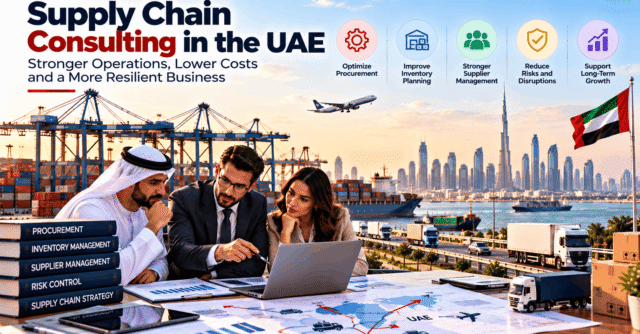

A single supply chain disruption can affect an entire business. A delayed shipment may interrupt production. Poor inventory planning can tie up valuable cash. Unreliable suppliers can leave customers waiting and increase operating costs.
For businesses operating in the UAE, these challenges deserve careful attention. The country is an important gateway for international trade, connecting markets across Asia, Europe, Africa, and the Middle East. However, access to strong transport infrastructure alone does not guarantee an efficient supply chain.
Organizations also need effective procurement, inventory planning, supplier management, and risk controls.
This is where supply chain consulting becomes valuable. With the right strategy, businesses can improve daily operations, control costs, prepare for disruptions, and build supply chains that support long-term growth.
What Is Supply Chain Consulting?
Supply chain consulting helps organizations assess and improve how they purchase, store, transport, and distribute goods. It examines the activities connecting suppliers, manufacturers, warehouses, distributors, and customers.
A supply chain consultant reviews existing processes, identifies weaknesses, and recommends improvements based on the company’s objectives and operating conditions.
Consulting may cover several areas:
- Procurement strategy and supplier selection
- Inventory planning and demand forecasting
- Warehouse operations and storage
- Transportation and distribution networks
- Supply chain technology and data management
- Cost control and operational efficiency
- Supplier risk and business continuity
- Performance measurement and process improvement
The goal is to connect these activities instead of treating each department separately.
A purchasing decision, for example, can affect inventory levels, warehouse capacity, transportation costs, and customer delivery times.
Why Is Supply Chain Consulting Important in the UAE?
The UAE has developed an extensive trade and logistics ecosystem. Its ports, airports, roads, free zones, and international business connections support companies involved in imports, exports, manufacturing, retail, and distribution.
However, businesses still face operational challenges. These may include changing customer demand, international shipping delays, supplier concentration, customs requirements, storage costs, and fluctuations in transport expenses.
The UAE’s National Programme to Strengthen Supply Chain Resilience highlights the importance of diversifying import sources, supporting local production, and building international partnerships to protect access to essential goods.
These priorities demonstrate why resilience is an important part of supply chain planning.
For businesses, the lesson is clear: supply chains should be designed to handle uncertainty, not just operate under ideal conditions.
A supply chain consultant can help management understand where disruptions may occur and develop practical strategies to reduce their impact.
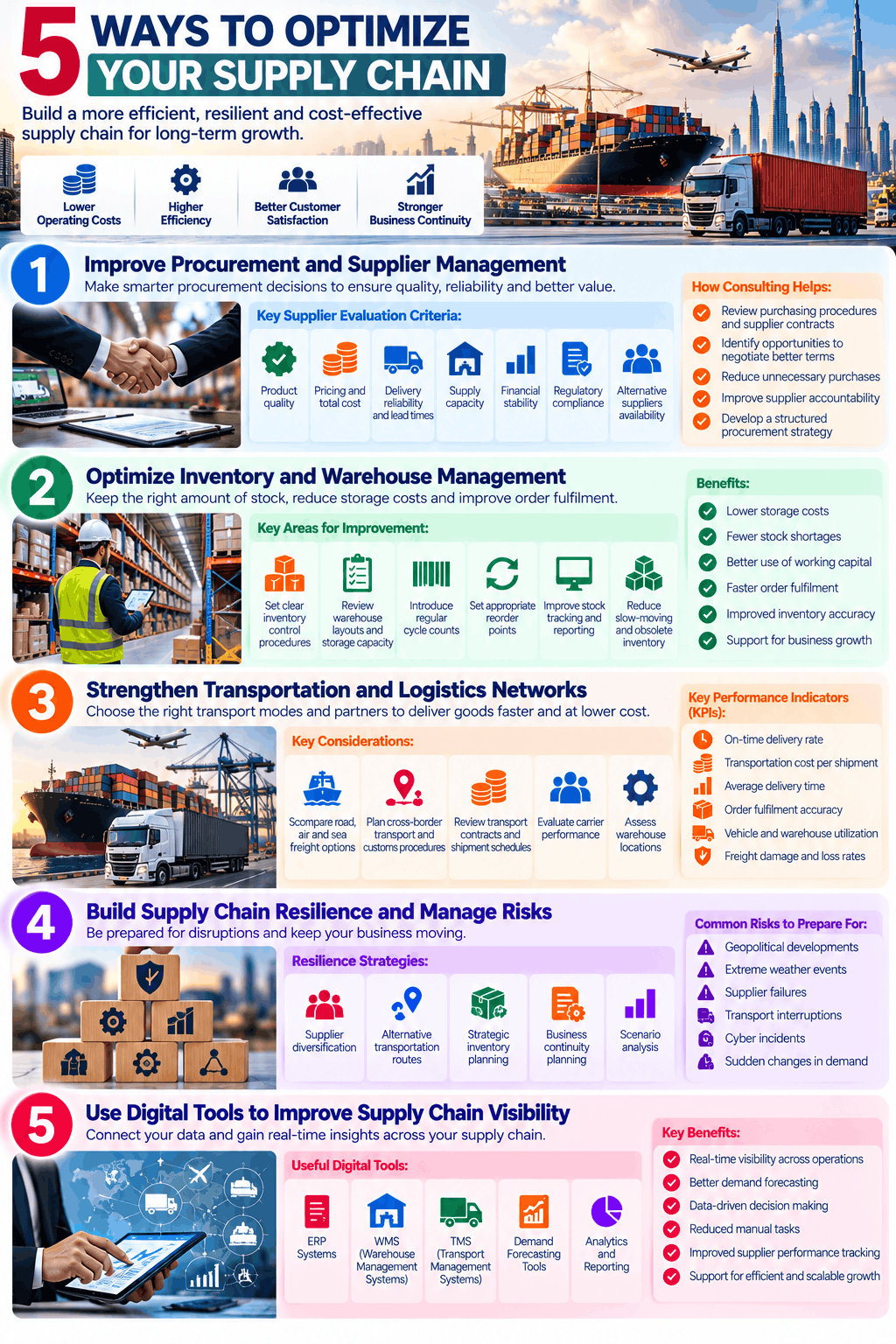
Improving Procurement and Supplier Management
Procurement decisions influence product quality, operating costs, delivery schedules, and business continuity.
Choosing a supplier based only on the lowest quotation can create problems if that supplier cannot meet quality standards or delivery commitments.
Supply chain consulting helps organizations develop a more structured procurement strategy.
A consultant may review purchasing procedures, supplier contracts, sourcing arrangements, and approval processes.
The assessment can reveal opportunities to negotiate better terms, reduce unnecessary purchases, and improve supplier accountability.
Supplier evaluation should consider:
- Product or service quality
- Pricing and total purchasing cost
- Delivery reliability and lead times
- Production or supply capacity
- Financial and operational stability
- Regulatory and compliance requirements
- Availability of alternative suppliers
For example, a UAE-based retailer that depends on one overseas supplier may face serious problems if production or shipping is interrupted. Developing relationships with alternative suppliers can reduce this dependency.
The objective is to balance cost, quality, reliability, and continuity.
Optimizing Inventory and Warehouse Management
Holding too much inventory can increase storage costs and tie up working capital. Holding too little can lead to stock shortages, missed sales, and production delays.
Effective inventory management requires businesses to understand how much stock they need, when to reorder, and how demand changes throughout the year.
A supply chain consultant can examine historical sales, supplier lead times, seasonal patterns, and inventory turnover. These insights help businesses make better purchasing and replenishment decisions.
Warehouse operations also need attention. Poor storage layouts, inaccurate stock records, and inefficient picking processes can slow down order fulfilment.
Practical improvements may include:
- Establishing clear inventory control procedures
- Reviewing warehouse layouts and storage capacity
- Introducing regular cycle counts
- Setting appropriate reorder points
- Improving stock tracking and reporting
- Reducing slow-moving and obsolete inventory
Technology such as warehouse management systems can improve visibility and accuracy.
However, software should support well-designed processes rather than replace the need for proper planning and staff training.
Strengthening Transportation and Logistics Networks
Transportation connects suppliers, warehouses, production facilities, and customers. Inefficient delivery routes, poor carrier selection, and unnecessary handling can increase costs and reduce service quality.
Supply chain consulting helps organizations assess their transportation networks and identify ways to improve performance.
A consultant may compare road, air, and sea freight options based on cargo type, delivery deadlines, cost, and destination. Businesses can also review transport contracts, shipment schedules, carrier performance, and warehouse locations.
For UAE businesses serving regional markets, cross-border transport planning is especially important.
Companies need to consider customs procedures, documentation, delivery requirements, and the reliability of logistics partners.
Useful performance indicators include:
- On-time delivery rate
- Transportation cost per shipment
- Average delivery time
- Order fulfilment accuracy
- Vehicle and warehouse utilization
- Freight damage and loss rates
Tracking these indicators helps managers identify recurring problems and measure the results of operational changes.
Building Supply Chain Resilience and Managing Risks
Efficiency is important, but a supply chain must also be able to respond when something goes wrong.

Disruptions can result from geopolitical developments, extreme weather, supplier failures, transport interruptions, cyber incidents, or sudden changes in demand.
Depending on the industry, even a short interruption may affect production and customer commitments.
A supply chain consultant can help businesses identify critical dependencies and assess their exposure to disruption.
Resilience strategies may include:
- Supplier diversification: Avoid relying too heavily on a single supplier or sourcing location.
- Alternative transportation routes: Identify other ways to move goods if a preferred route becomes unavailable.
- Strategic inventory planning: Maintain appropriate safety stock for critical products without creating excessive storage costs.
- Business continuity planning: Establish responsibilities and response procedures for unexpected disruptions.
- Scenario analysis: Evaluate how different events could affect supply, costs, and delivery commitments.
These measures help organizations prepare before problems occur. They also give management a clearer basis for making decisions during uncertain conditions.
Using Digital Tools to Improve Supply Chain Visibility
Modern supply chains generate large amounts of information. When purchasing, inventory, warehouse, and transport data are stored in separate systems, managers may struggle to understand what is happening across the operation.
Digital tools can connect these activities and provide better visibility.
Examples include enterprise resource planning (ERP) systems, warehouse management systems (WMS), transport management systems (TMS), and demand forecasting tools.
Analytics can help businesses identify purchasing patterns, monitor supplier performance, track inventory, and forecast demand. Automation can also reduce repetitive administrative tasks.
However, digital transformation should begin with clear business requirements. Organizations need reliable data, defined processes, appropriate technology, and trained employees to gain meaningful value from these systems.
Connecting UAE Supply Chain Strategy With International Business Operations
Many organizations operating in the UAE also trade with Turkey and other international markets.
These businesses may need to coordinate suppliers, customs procedures, transportation, warehousing, and financial requirements across different jurisdictions.
A business consultant in Turkey can support broader market-entry and operational planning for companies exploring opportunities in the Turkish market.
Supply chain planning can complement this work by assessing sourcing options, distribution arrangements, logistics costs, and operational requirements.
Businesses should also understand the regulatory responsibilities connected to their international activities.
For example, digital taxation in Turkey may be relevant to certain digital services and online commercial activities, depending on the business model and applicable tax rules.
It is important to assess these obligations separately with qualified tax professionals rather than assume that supply chain arrangements determine tax treatment.
When selecting the best management consultant firm, organizations should look beyond general promises.
They should evaluate relevant industry experience, knowledge of the markets involved, practical recommendations, transparent methodologies, and the ability to connect strategy with implementation.
People Also Ask: Common Questions About Supply Chain Consulting
How does supply chain consulting improve business efficiency?
It identifies weaknesses in procurement, inventory, warehousing, transportation, and supplier management. Consultants recommend improvements that can reduce waste, improve coordination, and strengthen operational performance.
What does a supply chain consultant do in the UAE?
A supply chain consultant assesses an organization’s purchasing, storage, logistics, distribution, and risk management processes. The consultant develops recommendations based on the company’s industry, operating model, and business goals.
Why is supply chain resilience important for UAE businesses?
Businesses in the UAE often depend on international suppliers and cross-border transportation. Resilience planning helps them prepare for disruptions, reduce supplier dependency, and maintain the flow of essential goods.
Frequently Asked Questions (FAQs)
1. Which businesses benefit from supply chain consulting?
Manufacturers, retailers, wholesalers, e-commerce companies, distributors, importers, and exporters can benefit. Any organization that purchases, stores, or moves goods can review its supply chain for improvement opportunities.
2. How can a supply chain consultant reduce procurement costs?
A consultant can review supplier contracts, purchasing patterns, sourcing strategies, and approval processes. The findings may help businesses negotiate better terms and reduce unnecessary spending.
3. Can supply chain consulting improve inventory management?
Yes. Consultants can assess demand patterns, stock levels, supplier lead times, and warehouse procedures to recommend more effective inventory planning and control.
4. How does supply chain consulting help businesses manage disruptions?
It identifies critical suppliers, transport routes, and operational dependencies. Businesses can then develop alternative sourcing arrangements, contingency plans, and appropriate inventory strategies.
5. Is supply chain consulting useful for companies expanding into the UAE?
Yes. It can help companies assess suppliers, warehousing requirements, distribution networks, transportation options, and operating costs before entering the market.
6. How can businesses measure the success of supply chain consulting?
They can monitor procurement savings, inventory turnover, delivery reliability, order fulfilment time, warehouse utilization, and supplier performance. Comparing these indicators over time helps evaluate improvements.
Build a More Resilient Supply Chain With Ottoman Services
A strong supply chain does more than move products from one location to another. It supports customer satisfaction, financial performance, business continuity, and long-term competitiveness.
For organizations operating in the UAE or managing international business activities, effective planning can make the difference between reacting to disruptions and preparing for them.
Ottoman Services provides strategic advisory and research to help organizations evaluate business challenges, assess opportunities, and make informed decisions across international markets. Whether you are reviewing procurement processes, improving operational efficiency, or preparing for business growth, a clear strategy is an important starting point.
Book a free consultation with Ottoman Services to discuss your business objectives and explore practical ways to improve supply chain efficiency, strengthen resilience, and support sustainable growth.
Related insights and services
Explore these related Ottoman Services resources to understand the wider market, compare options, and plan your next steps: