
A small business can be busy every day and still struggle to grow. Sales may be coming in, customers may be asking for more, and the team may be working hard — yet cash flow stays tight, costs keep rising, and important decisions are made without a clear plan. Growth becomes sustainable only when the business knows where it is going, what is holding it back, and how to use its limited resources wisely. That is why small business consulting can make a real difference.
A good consultant helps business owners’ step back from daily demands, understand their numbers, spot realistic opportunities, and turn ideas into practical actions.
In Turkey, this support can be especially useful for local firms preparing to expand and international entrepreneurs building a presence in a new market.
Turkey’s small and medium-sized enterprises form a major part of its economy.
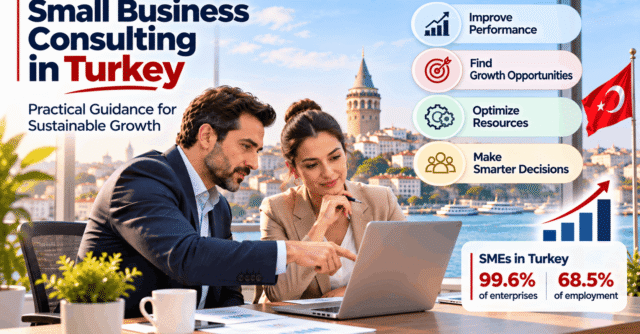
The Turkish Statistical Institute reported that SMEs made up 99.6% of enterprises in 2024 and accounted for 68.5% of employment. These figures show why stronger, better-managed smaller businesses matter to the wider economy.
This guide explains where consulting can help, how to plan for steady growth, and what to look for when comparing small business consulting firms in Turkey.
What Is Small Business Consulting?
Small business consulting is professional support that helps owners solve business problems and improve performance. A consultant reviews the company’s goals, finances, customers, operations, and market position.
They then suggest steps that fit the business’s needs, budget, and stage of development.
The work does not have to involve a major change. A small retailer might need a better way to track stock and profit.
A family-owned manufacturer may want to find new distributors. A service company may need clearer pricing, a stronger sales process, or a plan to enter another city.
The best advice is specific and useful. It should explain what to do, why it matters, who should take responsibility, and how the business will measure progress.
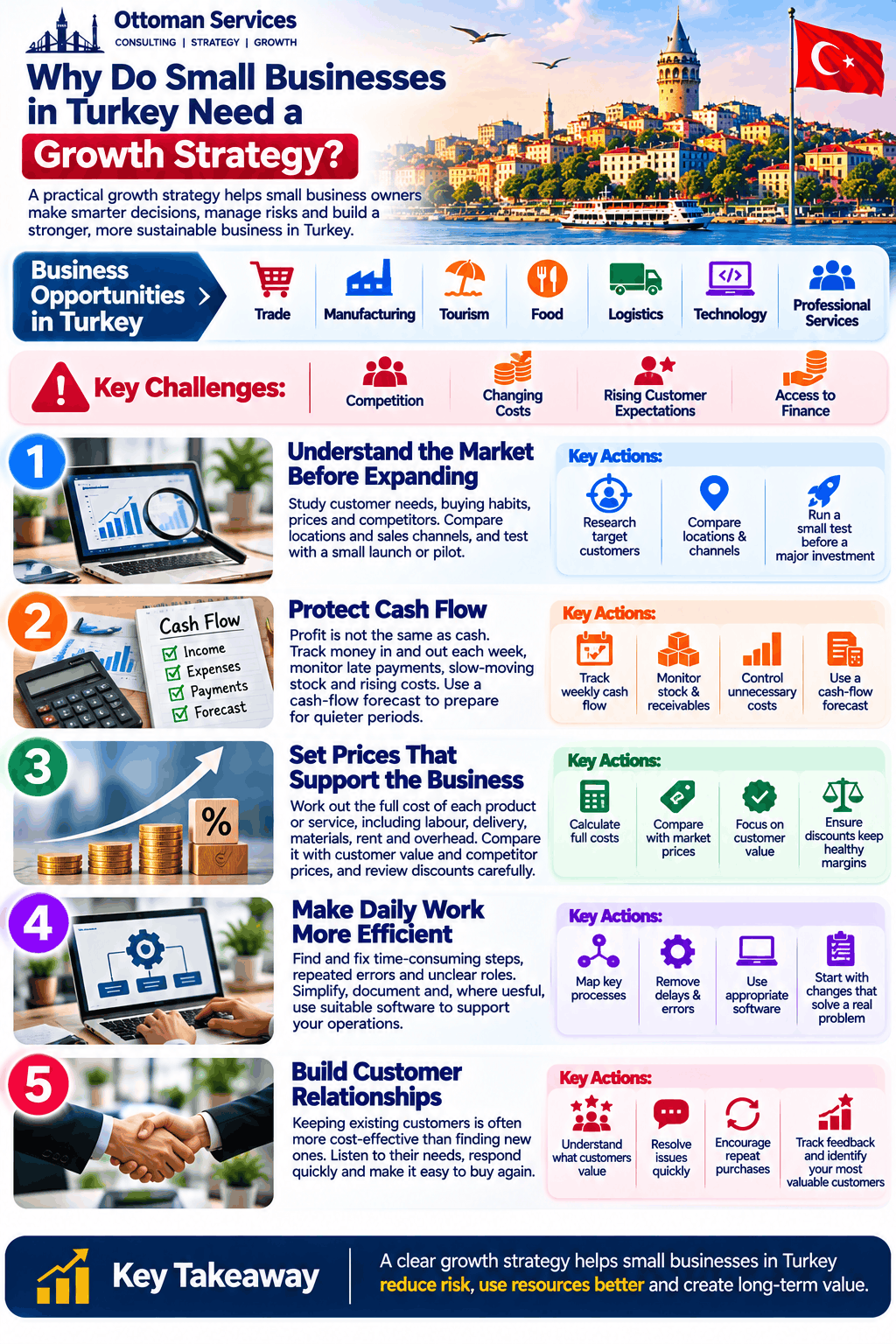
Why Do Small Businesses in Turkey Need a Growth Strategy?
Turkey offers opportunities in trade, manufacturing, tourism, food, logistics, technology, and professional services.
But competition, changing costs, customer expectations, and access to finance can make growth difficult.
A business plan helps owners make choices before committing money or adding pressure to the team.
1. Understand the Market Before Expanding
Do not assume that strong demand in one area means the same product will sell elsewhere. Study the customers you want to reach, their buying habits, the prices they accept, and the competitors already serving them.
For expansion, compare locations and sales channels. A small test, such as a limited product launch or pilot partnership, can reveal problems before a large investment.
2. Protect Cash Flow
Profit and cash are not the same. A business can make sales on paper but still lack cash to pay suppliers, rent, wages, or taxes when bills fall due.
Review cash coming in and going out each week. Track late customer payments, stock that moves slowly, and costs that rise without adding value. A simple cash-flow forecast can help owners prepare for quiet periods and avoid rushed borrowing.
3. Set Prices That Support the Business
Low prices may attract customers but can leave too little to cover costs and fund future investment. Work out the full cost of providing each product or service, including labour, delivery, materials, rent, and overhead.
Then compare the result with customer value and competitor prices. Review discounts carefully so that sales growth does not come at the cost of healthy margins.
4. Make Daily Work More Efficient
Repeated errors, unclear roles, slow approvals, and manual paperwork waste time. Map the steps involved in serving a customer or producing an order.
Find delays and decide which tasks can be simplified, documented, or supported by suitable software. Start with changes that solve a clear problem rather than buying technology because it is popular.
5. Build Customer Relationships
Winning a new customer often costs more effort than keeping an existing one. Ask customers what they value, respond to complaints quickly, and make it easy to buy again.
Keep a record of enquiries, repeat orders, and feedback. These simple habits help a business improve its service and identify which products or customer groups are most valuable.
Business Consulting Services in Turkey: What Can a Small Firm Use?
Not every small company needs a large transformation project.
The right business consulting services in Turkey should match a real business need. Common areas include:
- Business planning: Setting clear goals, priorities, budgets, and measures of success.
- Market and competitor research: Understanding demand, customer groups, competitors, and possible sales channels.
- Business development: Finding potential customers, distributors, partners, and new routes to market.
- Operations improvement: Reducing waste, clarifying responsibilities, and improving how work gets done.
- Digital and data planning: Choosing useful tools and using sales, customer, and operating data to make better decisions.
- Growth and export planning: Assessing whether the business is ready to serve new regions or international buyers.
For example, a small food producer considering exports may need to check overseas demand, buyer requirements, product standards, packaging, logistics, and the cost of reaching each market.
A consultant can help organise this assessment and identify questions that should be taken to customs, legal, tax, or certification specialists.
How to Choose a Business Consulting Firm in Turkey
Choosing a consultant is an important business decision. The lowest fee is not always the best value, and a long presentation is not proof of useful expertise.
When deciding how to choose a business consulting firm in Turkey, consider these points:
- Relevant experience: Ask whether the firm has worked with businesses of a similar size, industry, or challenge. Request examples of the type of work it has delivered.
- Knowledge of the local market: For work in Turkey, the consultant should understand local customer behaviour, business practices, and the wider commercial environment.
- A clear scope: Agree on the problem to solve, the work included, the timeline, and the final deliverables before starting.
- Evidence-based advice: Ask what information will be reviewed and how recommendations will be tested. Be careful with promises of guaranteed revenue or funding.
- Transparent fees: Understand the fee structure, extra costs, payment stages, and what happens if the project scope changes.
- Practical support: A useful report should include priorities, owners, next steps, and measures. Ask whether the firm can support implementation or only provide advice.
Also check whether specialist work needs a licensed professional.
Business consultants can help coordinate a project, but legal opinions, tax advice, audits, and regulated financial services should be provided by properly qualified experts.
A Practical 90-Day Plan for Sustainable Growth
Consulting becomes useful when it leads to action. A small company can begin with a simple 90-day plan:
- Days 1–30: Understand the position. Review sales, costs, cash flow, customer feedback, operations, and the main competitors. Choose one or two problems with the biggest impact.
- Days 31–60: Test improvements. Set a clear target, assign an owner, and test a practical change. Examples include improving follow-up with new leads, reducing slow-moving stock, or simplifying an order process.
- Days 61–90: Measure and decide. Compare results with the starting point. Keep what works, adjust what does not, and set the next priorities based on evidence.
Useful measures may include gross margin, cash available, time to fulfil an order, repeat purchase rate, customer complaints, and qualified enquiries.
Choose a few indicators the team can review regularly. Too many targets can distract from the work that matters most.
Support and Resources for SMEs in Turkey

Small businesses should also learn about official support and guidance available to them.
KOSGEB publishes programmes and information for entrepreneurs and SMEs, including guidance and consultancy-related support in areas such as finance, internationalisation, technology, digitalisation, and growth.
Eligibility, application periods, and support conditions can change, so businesses should always check the current programme details directly with KOSGEB before making financial plans.
Read the official KOSGEB guidance on mentoring and consultancy services for information about its framework.
A consultant can help a business understand its needs and prepare questions, but no adviser should promise that an application will be approved.
People Also Ask: Small Business Consulting
What does a small business consultant do?
A small business consultant reviews a company’s goals, finances, customers, and operations. They identify problems and opportunities, then recommend practical steps to improve performance, manage risk, and support growth.
How much does small business consulting cost?
Fees depend on the consultant’s experience, the work involved, project length, and deliverables. Some firms charge a fixed project fee, while others use hourly rates or monthly retainers. Ask for a written scope and fee breakdown before agreeing.
Is hiring a business consultant worth it for a small business?
It can be worthwhile when the business has a clear problem or decision that needs outside expertise. The value should be judged against the expected benefit, the cost of the engagement, and whether the recommendations can be put into practice.
What should I look for in small business consulting firms?
Look for relevant experience, local market knowledge, clear fees, evidence-based recommendations, and practical deliverables. The firm should understand your goals and explain how it will measure progress.
Frequently Asked Questions
1. Can a startup use small business consulting?
Yes. A startup may need help testing its business idea, understanding customers, preparing a business plan, setting prices, or planning its first sales activities. The work should be focused on the decisions the founders need to make next.
2. When should a small business hire a consultant?
Consider consulting when growth has stalled, costs are hard to control, the business is entering a new market, or the owner lacks time or specialist knowledge to solve an important problem. It is better to define the issue before hiring support.
3. Can a consultant help a Turkish business reach international markets?
A consultant can help research target markets, compare competitors, assess routes to market, and plan distributor or partner outreach. Export rules, customs, contracts, and product compliance should be checked with the relevant authorities and qualified specialists.
4. Do small business consulting firms work with family-owned companies?
Many consultants work with family-owned firms. Support may include clarifying roles, planning succession, improving reporting, setting business goals, and preparing the company for its next stage of growth.
5. How long does a small business consulting project take?
A focused review may take a few weeks. A market-entry plan, operational improvement programme, or growth project may take several months. The duration should be agreed according to the scope and the information available.
6. What information should I prepare before the first consultation?
Prepare a short business overview, your main goals, current challenges, basic sales and cost information, and any plans for expansion. You do not need perfect records to start, but honest and accurate information helps the consultant give useful advice.
Build a Stronger Small Business with Ottoman Services
Sustainable growth is not simply about selling more. It means building a business that can serve customers well, manage its costs, make sound decisions, and adapt when market conditions change.
For a small company, clear priorities and steady improvements can be more valuable than trying to do everything at once.
Ottoman Services works with organisations on business consulting, strategic planning, and advisory needs.
If your company is reviewing its next stage of growth, exploring opportunities in Turkey, or looking for a more structured way to address business challenges, a focused conversation can help clarify the next steps.
Book a consultation with Ottoman Services to discuss your business goals and explore a practical approach to sustainable growth in Turkey and beyond.