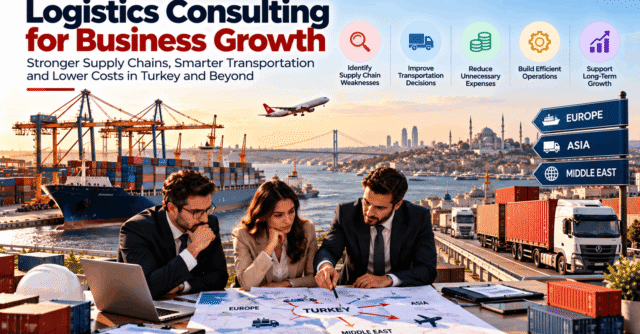
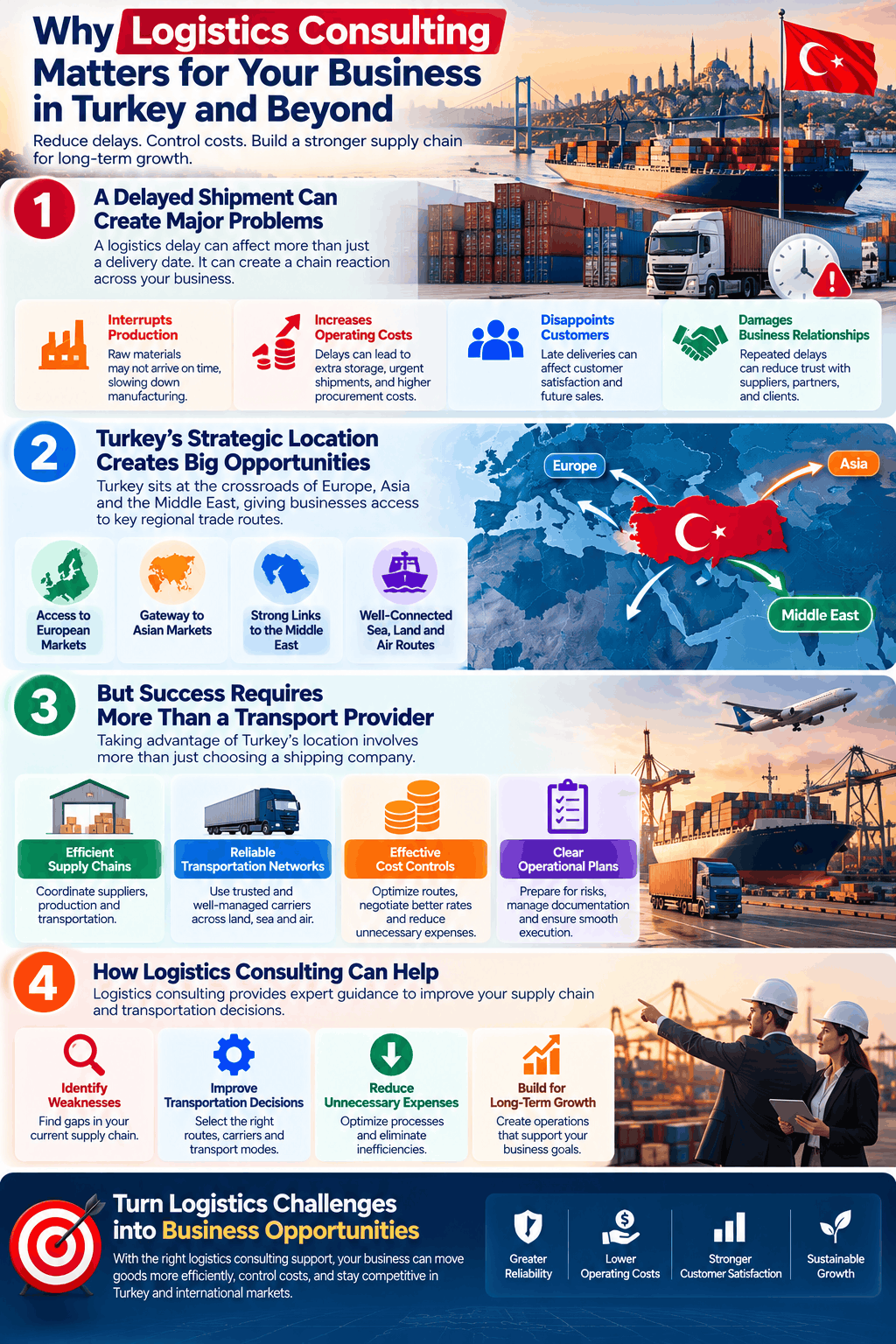
A delayed shipment can affect more than a delivery date. It can interrupt production, increase operating costs, disappoint customers, and damage business relationships. For companies moving goods across Turkey or trading with international markets, even a small logistics problem can create significant financial pressure.
Turkey’s location between Europe, Asia, and the Middle East gives businesses access to important regional trade routes. However, taking advantage of this position requires more than choosing a transport provider.
Companies need efficient supply chains, reliable transportation networks, effective cost controls, and clear operational plans. This is where logistics consulting becomes valuable.
With the right guidance, organizations can identify supply chain weaknesses, improve transportation decisions, reduce unnecessary expenses, and build operations that support long-term growth.
What Is Logistics Consulting?
Logistics consulting helps organizations plan, assess, and improve the movement, storage, and distribution of goods. It examines how products travel from suppliers to warehouses, production facilities, distributors, and final customers.
A logistics consultant reviews the full supply chain to identify delays, unnecessary costs, and operational risks.
Based on these findings, the consultant recommends practical improvements.
In Turkey, logistics consulting may cover several areas:
- Transportation planning and route optimization
- Supply chain assessment and improvement
- Warehouse and inventory management
- Procurement and supplier coordination
- Freight and distribution cost analysis
- Import and export logistics planning
- Risk assessment and operational controls
- Logistics performance measurement
The objective is not simply to move goods faster. It is to make the entire process more reliable, cost-effective, and suitable for the organization’s business goals.
Why Is Logistics Consulting Important in Turkey?
Turkey connects major commercial markets across Europe, Asia, and the Middle East. Its road, rail, air, and maritime transport networks support domestic distribution and international trade.
However, businesses must consider factors such as transport capacity, customs procedures, delivery schedules, fuel expenses, warehouse locations, and cross-border requirements. These factors can affect the time and cost involved in moving goods.
For example, a manufacturer exporting products from Istanbul may need to coordinate road transportation, port operations, customs documentation, and overseas delivery. A weakness in any part of this process can delay the entire shipment.
The World Bank’s Logistics Performance Indicators assess areas such as supply chain connectivity, speed, and reliability.
These indicators show why logistics performance should be evaluated across the entire movement of goods rather than through transport costs alone. Businesses can explore the World Bank Logistics Performance Indicators for further information.
Professional logistics consulting helps organizations understand these challenges and make informed decisions based on their products, markets, and operational requirements.
How Logistics Consulting Improves Transportation Networks
Transportation is one of the largest considerations in many supply chains. Poor route planning, underused vehicles, inefficient delivery schedules, and unsuitable transport methods can increase costs.
This is why transportation and logistics consulting plays an important role in helping businesses build more reliable and cost-effective distribution networks.
In Turkey, transportation and logistics consulting helps organizations evaluate how goods move between suppliers, production facilities, warehouses, ports, and customers.
Consultants can compare available transport options, review existing routes, and identify opportunities to improve delivery performance while controlling operational expenses.
Key areas include:
- Route optimization: Reviewing delivery routes to reduce unnecessary distance, travel time, and fuel consumption.
- Transport mode selection: Comparing road, rail, air, and maritime options based on cost, urgency, cargo type, and delivery requirements.
- Distribution planning: Evaluating warehouse and distribution locations to improve access to suppliers and customers.
- Carrier performance: Reviewing transport providers against delivery reliability, service quality, pricing, and capacity.
For instance, a company shipping products to several European markets may benefit from reviewing whether its current road-based approach is still suitable.
A combination of transport modes could offer better cost and delivery performance, depending on the shipment.
The best solution depends on actual routes, infrastructure, cargo requirements, and commercial priorities.
Strengthening Supply Chains Through Better Planning
An efficient supply chain requires coordination between suppliers, manufacturers, logistics providers, distributors, and customers.
When these parties operate without clear communication or planning, businesses may experience stock shortages, excess inventory, and delivery delays.
Logistics consulting helps organizations examine the full supply chain and identify where coordination can improve.
A consultant may assess supplier reliability, procurement schedules, inventory levels, warehouse processes, and delivery planning. The findings can support better purchasing decisions and reduce unnecessary stockholding.
For example, a business that frequently experiences production delays may discover that its procurement schedule does not match actual supplier lead times.
Adjusting order quantities, delivery schedules, and supplier arrangements can help reduce interruptions.
Consultants can also recommend performance indicators, such as:
- On-time delivery rate
- Order fulfilment time
- Inventory turnover
- Transportation cost per shipment
- Warehouse utilization
- Order accuracy
- Supplier lead time
Monitoring these indicators helps management understand whether operational changes are producing measurable improvements.
Reducing Logistics Costs Without Compromising Quality
Reducing expenses is important, but choosing the cheapest transport provider is not always the best decision. Low prices may come with longer delivery times, inconsistent service, or additional handling costs.
Effective logistics consulting considers the total cost of moving and storing goods.
This may include freight charges, fuel, customs-related expenses, warehousing, packaging, inventory holding, insurance, and delays.
Reviewing these costs together can reveal expenses that are difficult to identify when each department works separately.
For example, a business may reduce warehouse expenses by holding less inventory. However, if this results in frequent emergency shipments, total logistics costs could increase.
Consultants help organizations evaluate these trade-offs and develop cost strategies that balance efficiency, service quality, and risk.
They may also review contracts with suppliers and transport providers, assess procurement practices, and identify opportunities to improve resource utilization.
Managing Logistics Risks and Improving Operational Efficiency
Supply chains are exposed to different risks. These may include supplier disruptions, transport delays, changing fuel prices, customs issues, damaged goods, and unexpected changes in customer demand.
A logistics strategy should identify these risks before they affect daily operations.

Consultants can help businesses assess their dependence on individual suppliers, transport routes, warehouses, and service providers. They can then recommend contingency plans, alternative suppliers, backup routes, and clearer responsibilities.
Technology can also support better operational control. Shipment tracking, warehouse management systems, transport management software, and demand forecasting tools can improve visibility across the supply chain.
However, technology should solve a defined business problem. Implementing software without clear processes, trained employees, and reliable data may create additional complexity.
The goal is to build an operation where managers can monitor performance, identify problems early, and respond with confidence.
Logistics Consulting for International Business Expansion in Turkey
Companies planning international business expansion in Turkey need to understand more than market demand.
They must also determine how products will enter the country, reach customers, and move through regional or international distribution networks.
A business entering Turkey may need to evaluate local suppliers, import procedures, warehouse requirements, transport partners, and distribution costs.
Companies based in Turkey and targeting overseas markets face similar questions when planning exports.
A business consultant in Turkey can help assess the wider commercial strategy, including market opportunities, operating models, partnerships, and expansion risks.
Logistics consulting complements this work by examining how the supply chain will support the proposed business activity.
Businesses may also consider business valuation in Turkey when assessing an acquisition, investment, or potential partnership involving logistics operations.
Valuation can help stakeholders understand the financial position and commercial worth of a business.
Logistics performance, asset utilization, operating costs, and supplier relationships may provide useful context for that assessment.
These activities are connected, but they serve different purposes. Logistics consulting improves the movement and management of goods, while business consulting and valuation support broader strategic and financial decisions.
People Also Ask: Common Questions About Logistics Consulting
How can logistics consulting reduce transportation costs?
It reviews routes, transport modes, delivery schedules, carrier agreements, and vehicle utilization. These assessments can reveal unnecessary expenses and opportunities to improve efficiency without reducing service quality.
Why is supply chain management important for businesses in Turkey?
Effective supply chain management helps businesses coordinate suppliers, transportation, inventory, and distribution. This is particularly important for organizations involved in manufacturing, imports, exports, and cross-border trade.
What should companies consider when choosing a logistics strategy in Turkey?
Companies should consider their cargo type, target markets, delivery requirements, transport options, customs obligations, warehouse needs, supplier reliability, and total operating costs.
Can logistics consulting support international business expansion in Turkey?
Yes. It can help businesses evaluate import and export requirements, distribution networks, transport partners, warehouse locations, and supply chain costs before entering new markets.
Frequently Asked Questions (FAQs)
1. What does a logistics consultant do?
A logistics consultant evaluates transportation, warehousing, inventory, procurement, and distribution processes. The consultant identifies inefficiencies and recommends improvements to reduce costs and strengthen supply chain performance.
2. Which businesses benefit from logistics consulting in Turkey?
Manufacturers, exporters, importers, retailers, wholesalers, e-commerce companies, and international investors can benefit. Any organization that moves or stores goods may find opportunities to improve its logistics operations.
3. How does logistics consulting improve supply chain efficiency?
It identifies delays, poor coordination, excess inventory, and inefficient processes. Recommendations may include better supplier planning, improved inventory controls, route optimization, and performance monitoring.
4. Can logistics consulting help reduce delivery delays?
Yes. Consultants can review delivery routes, carrier performance, supplier lead times, warehouse processes, and transport schedules. These improvements can help make deliveries more predictable.
5. Is logistics consulting useful for foreign companies entering Turkey?
Yes. It can help foreign companies understand local distribution requirements, transport options, supplier arrangements, import procedures, and operational costs before establishing their supply chains.
6. How do businesses measure the success of logistics consulting?
Businesses can monitor delivery performance, transportation costs, inventory turnover, order fulfilment time, warehouse utilization, and supplier reliability. Comparing these indicators before and after improvements helps measure progress.
Build a More Efficient Logistics Strategy with Ottoman Services
Efficient logistics can strengthen a company’s competitiveness, improve customer satisfaction, and support sustainable business growth.
However, achieving these results requires a clear understanding of transportation networks, supply chain processes, operational risks, and long-term commercial priorities.
Ottoman Services, based in Istanbul, Turkey, supports organizations through strategic advisory and research, business consulting, and operational planning.
Whether your company is reviewing its supply chain, evaluating logistics opportunities, or preparing for international business expansion in Turkey, informed planning can help you make better decisions.
Book a free consultation with Ottoman Services to discuss your business objectives and explore practical strategies for optimizing supply chains, improving transportation networks, and building more efficient operations.
Related insights and services
Explore these related Ottoman Services resources to understand the wider market, compare options, and plan your next steps: