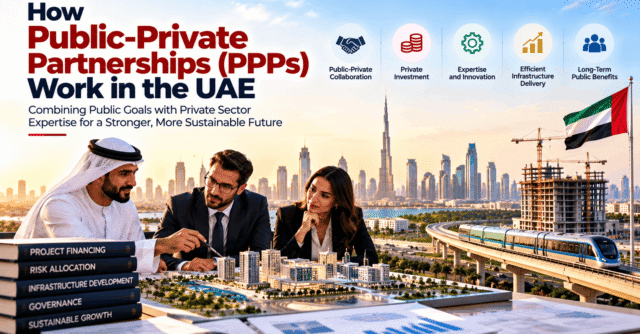
Imagine a government authority planning a new transport network, healthcare facility, or sustainable water infrastructure project. The project could deliver long-term public benefits, but financing, construction, and maintenance require significant resources. How can the government attract private investment without placing unnecessary pressure on public finances? Public-private partnerships (PPPs) offer one possible solution. By combining public-sector objectives with private-sector capital, expertise, and operational capabilities, PPPs can help deliver infrastructure and public services through carefully structured, long-term agreements.
In the United Arab Emirates (UAE), public-private partnerships form part of the broader approach to infrastructure development, economic diversification, and private-sector participation.
However, successful projects require more than funding. They need clear objectives, realistic financial models, balanced risk allocation, and effective governance.
Understanding how PPP works can help UAE public authorities and private investors identify suitable projects, evaluate commercial opportunities, and build partnerships that create lasting value.
What Are Public-Private Partnerships?
Public-private partnerships are contractual arrangements in which government entities collaborate with private-sector organizations to develop infrastructure or provide public services.
Depending on the project, the private partner may design, finance, build, operate, or maintain an asset.
The government typically establishes public-service requirements, oversees performance, and ensures that the project meets its intended objectives.
PPPs are used in areas such as transportation, education, healthcare, energy, water management, and waste management.
Unlike conventional procurement, where a government may pay a contractor primarily to construct an asset, a PPP can connect private-sector responsibilities to long-term service performance.
For example, a private consortium might finance and build a public facility before operating and maintaining it under a contract with a government authority. Payments could depend on agreed service standards, availability, or other contractual conditions.
The structure varies according to the project’s objectives, financial model, and legal framework.
How Do Public-Private Partnerships Work in the UAE?
The UAE has established a federal framework for PPP projects through Federal Law No. 12 of 2023, which came into force on 1 December 2023. The federal framework applies to relevant federal government entities, while individual emirates may have their own applicable rules and procedures.
For an overview of the framework, consult the UAE Government’s official public-private partnership guidance.
Although project procedures differ, the PPP process generally involves several stages.
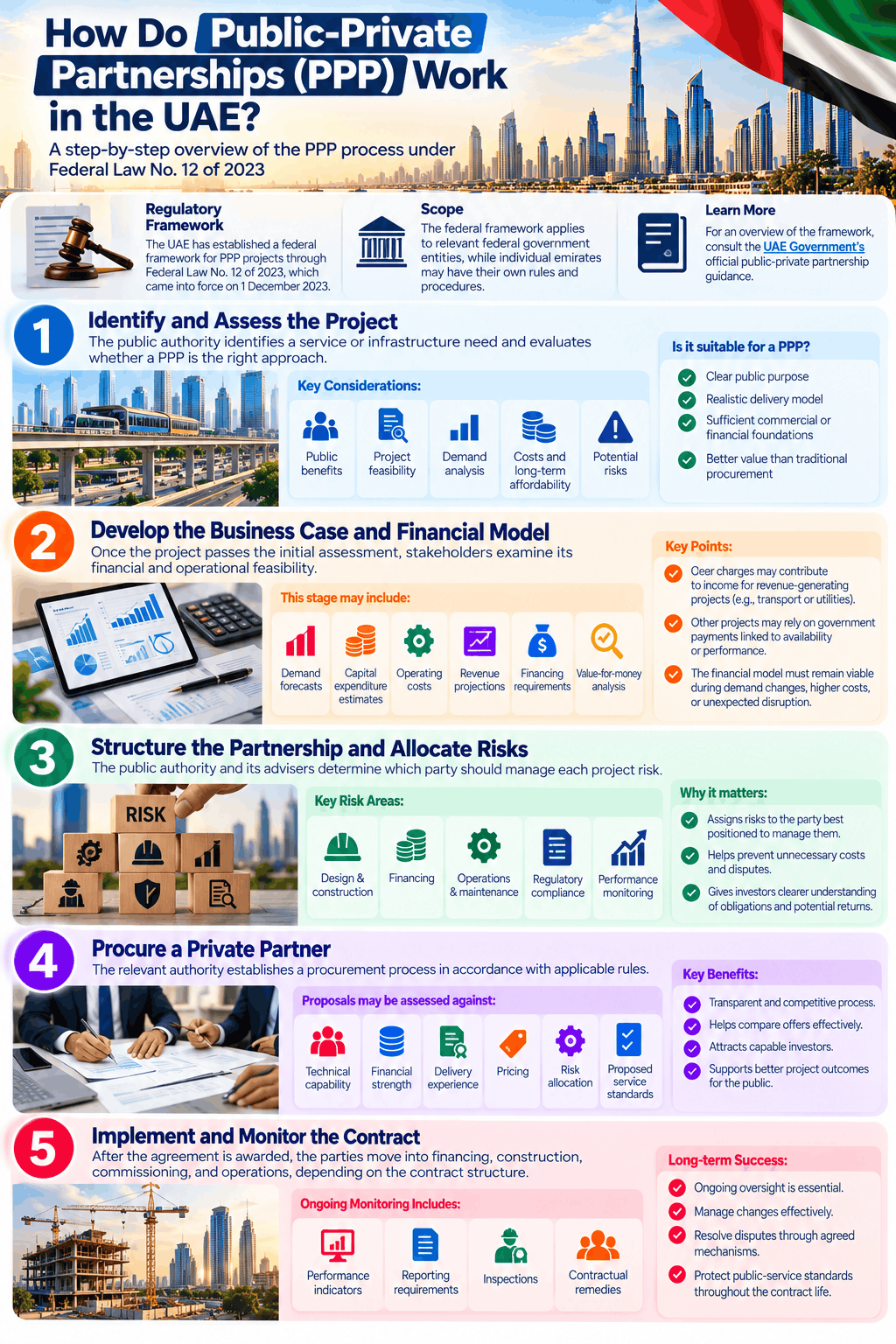
1. Identify and Assess the Project
The public authority first identifies a service or infrastructure need. It then evaluates whether a PPP is appropriate compared with traditional public procurement or other delivery models.
The assessment considers public benefits, project feasibility, demand, costs, potential risks, and long-term affordability.
Not every infrastructure project is suitable for a PPP. A project needs a clear public purpose, a realistic delivery model, and sufficient commercial or financial foundations to attract capable partners.
2. Develop the Business Case and Financial Model
Once a project passes its initial assessment, stakeholders examine its financial and operational feasibility.
This stage may include demand forecasts, capital expenditure estimates, operating costs, revenue projections, financing requirements, and value-for-money analysis.
For revenue-generating projects, such as certain transport or utility facilities, user charges may contribute to income. Other projects may rely on government payments linked to availability or service performance.
The financial model must demonstrate how the project can remain viable throughout its contractual life, including periods of changing demand, higher costs, or unexpected disruption.
3. Structure the Partnership and Allocate Risks
The public authority and its advisers determine which party should manage each project risk.
Responsibilities may cover design, construction, financing, operations, maintenance, regulatory compliance, and performance monitoring.
A well-structured agreement assigns risks to the party best positioned to manage them.
This helps prevent unnecessary costs and disputes while giving investors a clearer understanding of their obligations and potential returns.
4. Procure a Private Partner
The relevant authority establishes a procurement process in accordance with the applicable rules. Interested companies or consortia evaluate the opportunity and submit proposals.
Proposals may be assessed against technical capability, financial strength, delivery experience, pricing, risk allocation, and proposed service standards.
A transparent and competitive process can help authorities compare offers and attract investors capable of delivering the required outcomes.
5. Implement and Monitor the Contract
After the agreement is awarded, the parties move into financing, construction, commissioning, and operations, depending on the contract structure.
Performance indicators, reporting requirements, inspections, and contractual remedies help monitor delivery.
Ongoing oversight is essential because a PPP is a long-term commitment.
Both parties need processes for managing changes, resolving disputes, and protecting public-service standards.
How PPP Consulting Helps Structure Infrastructure Projects
PPP consulting helps public authorities and private investors assess, structure, and evaluate complex partnership opportunities.
For government entities, advisers can support feasibility assessments, procurement planning, financial analysis, risk allocation, and performance frameworks.
For private investors, they can help assess commercial viability, contractual obligations, financing requirements, and potential exposure to project risks.
Key areas of PPP consulting include:
- Feasibility studies: Assessing technical, financial, economic, and operational viability.
- Financial modelling: Evaluating project costs, funding requirements, revenue assumptions, and financial scenarios.
- Risk allocation: Determining how construction, demand, financing, operational, and regulatory risks should be managed.
- Contract structuring: Defining responsibilities, performance requirements, payment mechanisms, and contractual safeguards.
- Investment assessment: Evaluating potential returns, affordability, and long-term commercial sustainability.
- Procurement support: Helping stakeholders prepare documentation and assess proposals against agreed criteria.
For example, an authority considering a water-treatment facility may need to determine whether private financing and long-term maintenance responsibilities offer better value than traditional procurement.
Independent analysis can help compare the alternatives and identify the conditions required for a viable partnership.
How Should PPP Projects Allocate Risk?
Risk allocation is one of the most important elements of public-private partnerships.
If risks are assigned poorly, projects may become more expensive, attract fewer bidders, or experience disputes during implementation.
Common PPP risks include:
- Construction risk: Delays, cost overruns, design problems, or contractor performance issues. These risks may be assigned largely to the private partner when it controls the relevant work.
- Demand risk: Actual demand may be lower than forecast. The allocation depends on whether the project relies on user revenue, government payments, or a combination of both.
- Financing risk: Interest rates, funding availability, and refinancing conditions can affect project economics.
- Operational risk: Maintenance costs, service interruptions, and failure to meet performance standards can affect the project’s long-term viability.
- Regulatory and political risk: Changes in applicable requirements or government decisions may affect project delivery and financial assumptions.
Not every risk should be transferred to the private sector. Transferring a risk to a party that cannot reasonably control or absorb it may simply increase the price of the project.
Effective PPP consulting helps stakeholders identify, quantify, allocate, and monitor risks while preserving a fair balance between public value and private investment incentives.
Can Faizsiz Finansman Support PPP Projects?
Faizsiz finansman, meaning interest-free financing, may be relevant when stakeholders are exploring financing structures aligned with particular ethical or Sharia-compliant requirements.
In practice, Islamic finance is not limited to lending money without interest.
Depending on the transaction, structures may involve asset-backed arrangements, leasing, partnership-based investment, or other Sharia-compliant mechanisms.
For a PPP project, the suitability of such financing depends on the asset, contractual arrangements, investor requirements, cash flows, applicable regulations, and advice from qualified financial and Sharia advisers.
For example, an infrastructure project may explore an asset-based financing structure alongside conventional funding options.
However, the arrangement must remain commercially viable and compatible with the project’s legal and contractual framework.
Faizsiz finansman should therefore be evaluated as one potential financing consideration rather than assumed to be suitable for every PPP.
What Makes a PPP Project Attractive to Investors?
Private investors generally look for a credible business case, manageable risks, predictable contractual arrangements, and a reasonable basis for earning returns.
Several factors can improve a project’s investment appeal:
- Clear project objectives and a defined scope.
- Reliable demand forecasts and realistic financial assumptions.
- Transparent procurement and contractual requirements.
- Fair risk allocation and workable dispute-resolution mechanisms.
- Credible payment arrangements and performance standards.
- Appropriate regulatory, environmental, and technical assessments.
Public authorities must also consider affordability, public interest, service quality, and value for money.
A project that offers attractive returns but creates excessive public liabilities may not be an appropriate partnership.
The strongest PPP structures balance these considerations rather than prioritizing investment attraction alone.
People Also Ask: Common Questions About PPPs
What is the main purpose of a public-private partnership?
The main purpose is to combine public-sector objectives with private-sector resources and expertise to deliver infrastructure or services. A well-designed PPP aims to improve delivery, manage risks, and achieve value for money over the project’s life.
How does a PPP differ from traditional procurement?
Traditional procurement commonly involves the government contracting a supplier to deliver a defined asset or service. A PPP may combine several responsibilities, such as financing, construction, operations, and maintenance, under a longer-term performance-based agreement.
Who finances a public-private partnership?
The private partner may provide all or part of the project financing, depending on the contractual model. Government payments, user charges, equity, debt, or other permitted financing arrangements may contribute to the project’s financial structure.
Are public-private partnerships suitable for every infrastructure project?
No. PPPs are more suitable when the project offers a clear public benefit, can be structured effectively, and demonstrates sufficient value compared with alternative procurement methods.
Frequently Asked Questions
1. What sectors use public-private partnerships in the UAE?
PPPs may be used in infrastructure, transport, education, healthcare, energy, water, waste management, and other public-service sectors, subject to the relevant framework and project requirements.
2. What is the role of a PPP consultant?
A PPP consultant can support feasibility studies, financial modelling, risk assessment, procurement strategy, contract structuring, and investment evaluation. The exact scope depends on the client’s needs and the consultant’s expertise.
3. How long does a PPP agreement last?
The duration depends on the asset, investment requirements, operating model, and contractual structure. Some agreements extend over several decades, but there is no single duration suitable for every project.
4. How do governments benefit from PPPs?
Governments may gain access to private capital, technical expertise, operational capabilities, and innovation. Benefits depend on project design, effective oversight, affordability, and demonstrated value for money.
5. What risks should private investors assess before joining a PPP?
Investors should assess construction, demand, financing, operational, regulatory, contractual, and environmental risks. They should also review payment mechanisms, dispute-resolution procedures, and termination provisions.
6. Can foreign investors participate in UAE PPP projects?
Foreign investors may be able to participate, subject to the applicable procurement rules, eligibility criteria, licensing requirements, and contractual conditions. Investors should confirm the requirements for the specific authority and project before committing capital.
Conclusion: Build Better Partnerships Through Strategic Planning
Public-private partnerships can help the UAE deliver infrastructure and public services by combining government priorities with private-sector financing, expertise, and operational capabilities.
Their success, however, depends on sound feasibility analysis, balanced risk allocation, realistic financial models, and effective contract management.
For public authorities, the priority is to secure long-term public value. For private investors, it is to understand the project’s risks, obligations, and commercial potential before committing resources.
Ottoman Services supports strategic advisory, research, infrastructure-related analysis, and investment decision-making across relevant regional markets. If your organization is evaluating a PPP opportunity in the UAE or considering infrastructure investment, book a consultation with Ottoman Services to discuss your objectives, assess strategic considerations, and explore an informed approach to project development.
Related insights and services
Explore these related Ottoman Services resources to understand the wider market, compare options, and plan your next steps: