

Imagine launching a digital business in Turkey, gaining customers, and processing payments successfully—only to discover that your invoicing system, tax registration, or reporting process does not meet local requirements. For international businesses, this can create unexpected costs, delays, and compliance risks. Understanding dijital vergilendirme, or digital taxation, is therefore an important step for companies planning to sell digital services, operate online platforms, or expand into the Turkish market.
Turkey uses electronic tax systems, digital documentation, and specific rules for certain digital services. These requirements can affect both locally established companies and foreign businesses serving Turkish customers.
The challenge is that digital taxation does not refer to just one tax. It can involve value-added tax (VAT), digital services tax, electronic invoicing, recordkeeping, and cross-border reporting obligations.
Understanding how these areas interact can help businesses prepare before they begin operating.
What Is Dijital Vergilendirme in Turkey?
Dijital vergilendirme is the Turkish term for digital taxation. It can refer broadly to how tax obligations apply to digital business activities and how tax authorities use electronic systems to administer and monitor compliance.
For international companies, two areas are especially important.
- First, Turkey has tax rules that may apply to digital services, including certain online advertising services, digital content, and platform activities.
- Second, the Turkish Revenue Administration uses electronic systems for tax declarations, invoices, accounting records, notifications, and audits.
These areas are related, but they are not interchangeable.
A company may need to assess whether its revenue falls within the scope of a specific digital services tax while separately determining its VAT obligations and electronic documentation requirements.
The right approach begins with the business model. A software company selling subscriptions, an online marketplace connecting buyers and sellers, and a manufacturer selling physical products through an e-commerce website may face different tax considerations.
1. Understanding Digital Services Tax
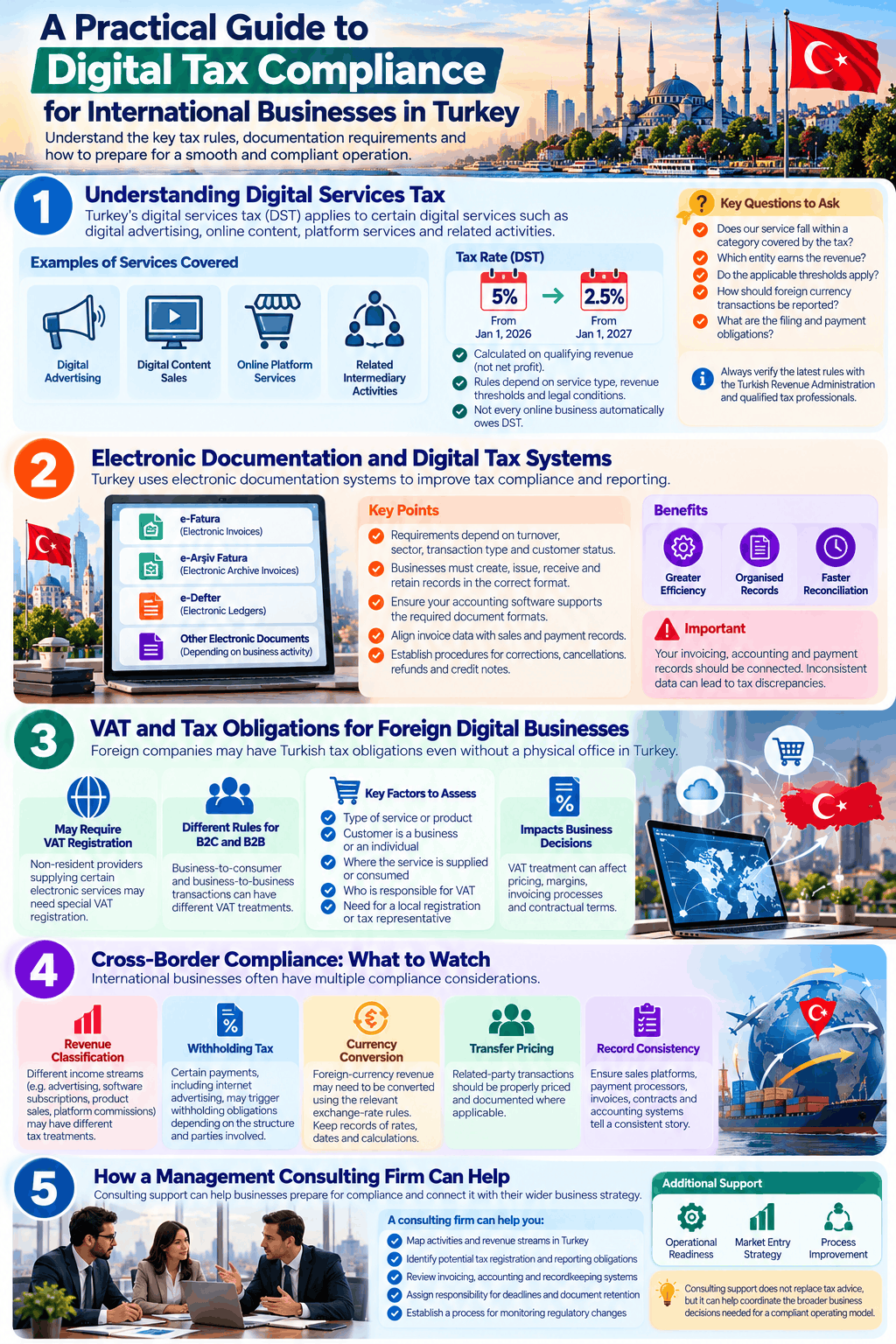
Turkey’s digital services tax applies to specified categories of digital services under the relevant legislation. These can include digital advertising, certain digital content sales, online platform services, and related intermediary activities.
As of 2026, the digital services tax rate is 5%, following a reduction effective from January 1, 2026.
The rate is scheduled to decrease further to 2.5% from January 1, 2027, under the applicable presidential decision. Businesses should verify the rules and conditions in force for each relevant tax period.
The tax is generally calculated on qualifying revenue rather than net profit.
This distinction can matter significantly for businesses with high operating costs, substantial advertising expenditure, or platform commissions.
However, not every company that operates online automatically owes digital services tax.
The nature of the service, the revenue involved, the relevant thresholds, and the applicable legal conditions must be evaluated.
Companies should ask:
-
Does our service fall within a category covered by the tax?
-
Which entity earns the relevant revenue?
-
Do the applicable revenue thresholds and other conditions apply?
-
How should transactions involving foreign currencies be reported?
-
What filing and payment obligations arise?
The official Turkish Revenue Administration’s digital services tax legislation provides the legal framework for reviewing the tax’s scope and administration.
Because rules and rates can change, businesses should confirm their current obligations with qualified Turkish tax professionals.
2. Electronic Documentation and Digital Tax Systems
Digital tax compliance involves more than calculating the correct amount of tax. Businesses must also create, issue, receive, and retain the required records in the correct format.
Turkey uses electronic documentation systems, including e-Fatura (electronic invoices), e-Arşiv Fatura (electronic archive invoices), and e-Defter (electronic ledgers). Other electronic documents may apply depending on the business activity.
The relevant requirements can depend on factors such as turnover, sector, transaction type, customer status, and current regulations.
International companies should not assume that every business must use the same system or that the same thresholds apply across all sectors.
Electronic documentation can improve efficiency by reducing manual paperwork, helping businesses organise records, and supporting faster reconciliation. However, it also creates operational responsibilities.
Companies should ensure that their accounting software can handle the required document formats, that invoice data matches their sales records, and that electronic records can be retrieved when needed.
They should also establish procedures for correcting errors, handling cancellations, and reconciling refunds or credit notes.
A reliable digital tax process should connect sales, invoicing, accounting, and payment records. If these systems operate separately, discrepancies can emerge between declared revenue and recorded transactions.
3. VAT and Tax Obligations for Foreign Digital Businesses
Foreign companies may have Turkish tax obligations even if they do not maintain a physical office in the country. This is particularly relevant to businesses supplying certain electronic services directly to customers in Turkey.
Depending on the service and customer type, a non-resident provider may need to consider a special VAT registration and reporting regime.
Business-to-consumer transactions can be treated differently from business-to-business transactions, where a reverse-charge mechanism may apply.
The distinction is important. A company should not assume that having no Turkish subsidiary automatically removes its tax responsibilities.
Equally, it should not assume that every sale to a Turkish customer creates the same registration or filing obligation.
Before launching, international businesses should review:
-
The type of service or product being supplied.
-
Whether the customer is a business or an individual.
-
Where the service is considered supplied or consumed.
-
Whether the foreign supplier or Turkish customer is responsible for accounting for VAT.
-
Whether a local registration, tax representative, or specific return is required.
Companies selling subscriptions, software, cloud-based tools, digital media, or online platform services should assess these questions before setting prices.
VAT treatment can affect the final customer price, margins, invoicing processes, and contractual terms.
A clear tax assessment is especially useful when a company serves customers in several countries.
The rules applicable in Turkey may differ from those in the company’s home market.
4. Cross-Border Compliance: What International Businesses Should Watch
Cross-border digital business can create several overlapping compliance questions.
A company may earn revenue in Turkey, process payments through an overseas platform, maintain its accounting system abroad, and contract with customers under international agreements.
These arrangements make it important to identify the correct entity, transaction, and tax treatment.
Revenue classification: Different income streams may receive different tax treatment.
For example, digital advertising revenue, software subscriptions, physical product sales, and platform commissions should not automatically be grouped together.
Withholding tax: Certain payments connected with internet advertising may trigger withholding obligations, depending on the parties, payment structure, and applicable rules.
Businesses should examine these separately from VAT and digital services tax.
Currency conversion: Foreign-currency revenue may need to be converted using the exchange-rate rules relevant to the tax concerned. Companies should document the rates, dates, and calculations used.
Transfer pricing and group transactions: Businesses operating through related companies should review how intercompany services, licensing arrangements, and other cross-border transactions are priced and documented where applicable.
Record consistency: Sales platforms, payment processors, invoices, contracts, and accounting systems should tell a consistent story.
Differences in transaction dates, customer locations, commissions, or refund amounts can complicate reporting.
A practical compliance review should map each revenue stream, identify the responsible legal entity, and establish which taxes and reporting requirements may apply.
Specialist review is valuable where the business model combines several services or countries.
5. How a Management Consulting Firm Can Help Businesses Prepare
Digital tax obligations are not only an accounting issue. They can influence market-entry decisions, pricing, technology investments, internal responsibilities, and the cost of operating in Turkey.
A management consulting firm can help businesses assess how compliance requirements fit into their wider operating model.
This may involve reviewing workflows, identifying gaps between business systems, mapping responsibilities, and coordinating implementation planning with qualified tax and legal specialists.
For example, a company entering Turkey may need to decide whether its existing invoicing platform can support local requirements or whether it needs a compatible provider.
It may also need to train its finance team, revise contracts, or update its transaction records.
A structured readiness plan can help the business:
-
Map its activities and revenue streams in Turkey.
-
Identify potential tax registration and reporting obligations.
-
Review invoicing, accounting, and recordkeeping systems.
-
Assign responsibility for deadlines and document retention.
-
Establish a process for monitoring regulatory changes.
A business consultant in Turkey can also help international companies connect compliance planning with market-entry strategy, operational readiness, and local business requirements.
Consulting support does not replace tax advice, but it can help coordinate the broader business decisions needed to implement a compliant operating model.
People Also Ask: Digital Taxation in Turkey
What is digital taxation in Turkey?
Digital taxation refers to tax rules affecting digital business activities and the electronic systems used to manage tax compliance.
It may include digital services tax, VAT on certain electronic services, electronic invoicing, and digital recordkeeping.
Does Turkey charge tax on digital services?
Yes. Turkey applies digital services tax to specified categories of services when the relevant legal conditions are met.
VAT and other tax obligations may also apply, depending on the transaction and business model.
Do foreign companies need to pay Turkish VAT on digital services?
Some foreign providers supplying electronic services to Turkish customers may have VAT registration, collection, or reporting obligations even without a Turkish subsidiary.
The correct treatment depends on the service, customer type, and applicable rules.
What are e-Fatura and e-Arşiv Fatura?
e-Fatura is Turkey’s electronic invoicing system for applicable transactions between registered participants. e-Arşiv Fatura is used for relevant electronic invoices outside that registered-participant framework.
Businesses must confirm which system applies to their transactions.
Why is digital tax compliance important for international businesses?
Non-compliance can lead to additional costs, penalties, reporting problems, and operational delays.
Accurate records and a clear understanding of local requirements help businesses manage risk and plan expansion more effectively.
Frequently Asked Questions
1. What is the current digital services tax rate in Turkey?
The rate is 5% as of 2026 for services covered by the applicable digital services tax rules. A further reduction to 2.5% is scheduled for January 1, 2027. Businesses should confirm the rules that apply to their activities and reporting period.
2. Are all online businesses subject to digital services tax?
No. Liability depends on the types of services provided and the applicable legal conditions, including relevant thresholds. Operating a website or selling products online does not automatically mean a business owes digital services tax.
3. Do international companies need a Turkish office to have tax obligations?
Not necessarily. Certain foreign digital service providers may have Turkish VAT obligations without establishing a local office or subsidiary. Each business should assess its activities and registration requirements separately.
4. What electronic documents should businesses use in Turkey?
Depending on the business and transaction, requirements may include e-Fatura, e-Arşiv Fatura, e-Defter, and other electronic documents. The applicable rules depend on factors such as sector, turnover, and transaction type.
5. How can companies improve digital tax compliance?
Companies should map their tax obligations, use compatible accounting and invoicing systems, maintain accurate transaction records, monitor filing deadlines, and seek professional advice when rules are unclear or change.
6. Can a business consultant in Turkey provide tax compliance advice?
A business consultant in Turkey can help coordinate operational planning, market-entry preparation, and compliance readiness. Formal tax interpretations, filings, and legal advice should be handled by appropriately qualified tax or legal professionals.
Conclusion: Prepare Your Business for Digital Tax Compliance
Understanding dijital vergilendirme is an important part of operating successfully in Turkey’s digital economy.
International businesses should look beyond the digital services tax alone and consider VAT, electronic documentation, cross-border transactions, and recordkeeping as part of one coordinated compliance process.
Preparing early can help companies identify potential obligations, reduce avoidable errors, and build systems that support future growth.
Planning to enter or expand in Turkey? Ottoman Services can help your business evaluate market-entry requirements, review operational readiness, and develop a structured expansion strategy. Consult Ottoman Services to plan your next steps with greater clarity and confidence.