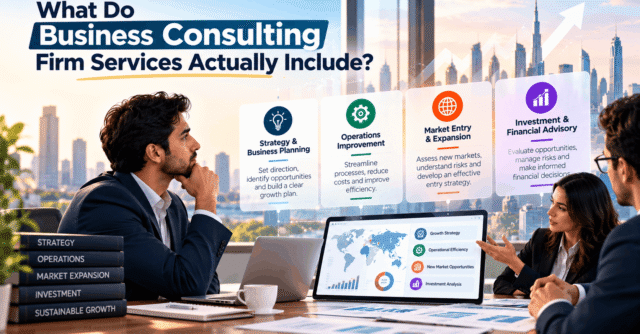
Running a business involves more than selling products or delivering services. Business owners must make strategic decisions, control costs, improve operations, understand markets, and identify opportunities for sustainable growth.
When these responsibilities become difficult to manage internally, professional consulting support may help.
However, what do business consulting firm services actually include? Are consultants only responsible for developing business plans, or can they also help companies improve operations, enter new markets, and evaluate investment opportunities?
The answer depends on the consulting firm’s expertise, the client’s objectives, and the scope of the engagement.
Understanding the available services can help business owners identify the right support, set realistic expectations, and avoid paying for advice that does not address their actual challenges.
What Are Business Consulting Firm Services?
Business consulting firm services are professional advisory services designed to help organizations solve problems, improve performance, evaluate opportunities, and make informed decisions.
Consultants assess a company’s current position, identify gaps, analyze relevant information, and recommend practical actions.
Some engagements focus on a specific issue, while others support broader organizational or market development goals.
For example, a company experiencing declining profitability may need an operational review to identify unnecessary costs.
A business planning international expansion may need market research and a market entry strategy. An organization considering a major investment may need financial analysis and risk assessment.
The purpose is not simply to produce a report. Effective consulting should help decision-makers understand their options and determine what to do next.
1. Strategy and Business Planning
Strategic consulting helps business owners determine where their organizations should go and how they can get there.
A company may have ambitious growth targets but lack a clear plan for achieving them.
Alternatively, it may be investing resources in activities that do not support its long-term objectives.
A consulting engagement focused on strategy may include:
- Reviewing the company’s current position, strengths, and weaknesses.
- Analyzing competitors, customers, and market conditions.
- Identifying growth opportunities and strategic risks.
- Establishing business priorities and measurable objectives.
- Developing an implementation roadmap with milestones and responsibilities.
For example, a company that wants to expand across the GCC may need to assess which markets best fit its capabilities before committing significant resources.
A useful strategy should connect business goals with realistic budgets, timelines, and available resources. It should also establish how progress will be evaluated.
2. Operations and Performance Improvement
Operational consulting focuses on how a business works internally. It helps identify inefficiencies, improve processes, and make better use of available resources. Operational challenges can arise as a company grows.
Responsibilities may become unclear, processes may rely on manual work, and communication between departments may slow down decision-making.
Depending on the project, operational consulting may involve:
- Mapping existing workflows and identifying bottlenecks.
- Reviewing resource allocation and departmental responsibilities.
- Evaluating supplier, procurement, or supply-chain processes.
- Recommending process improvements and performance indicators.
- Developing plans to improve coordination and accountability.
Consider a business experiencing repeated delivery delays.
Rather than immediately hiring more employees, a consultant may examine inventory management, supplier coordination, scheduling, and internal communication to determine where the problem originates.
Recommendations should be practical for the organization’s size and resources. Improvements also need clear ownership so that proposed changes can be implemented and maintained.
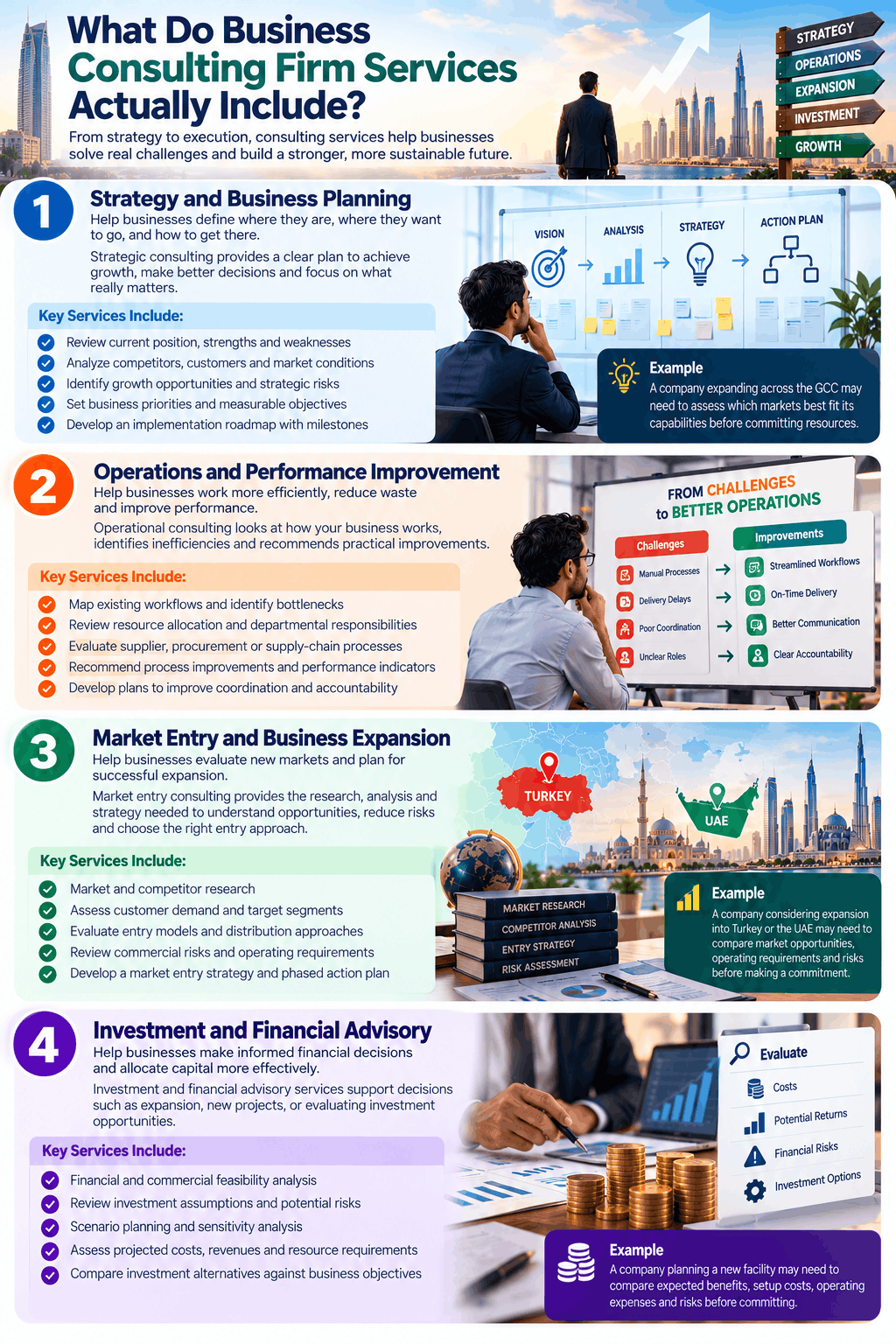
3. Market Entry and Business Expansion
Entering a new market can create opportunities, but it also introduces uncertainty.
Companies need to understand local demand, competition, regulations, commercial practices, and the resources required to operate successfully.
Market entry consulting helps businesses evaluate these factors before making significant commitments.
Services may include:
- Market and competitor research.
- Assessment of customer demand and target segments.
- Evaluation of potential entry models and distribution approaches.
- Review of commercial risks and operating requirements.
- Development of a market entry strategy and phased action plan.
For instance, an international company considering expansion into Turkey or the UAE may need to compare market opportunities, estimate operating requirements, and identify the risks associated with different entry approaches.
The right strategy depends on the company’s industry, objectives, resources, and risk tolerance. A market that looks attractive in general may not be suitable for every business.
Consulting can help decision-makers evaluate these differences and establish a more informed basis for expansion.
4. Investment and Financial Advisory
Investment and financial advisory services help organizations evaluate financial decisions, understand risks, and allocate capital more carefully.
Business owners may need this support when considering expansion, reviewing investment opportunities, assessing a new project, or deciding how to allocate limited resources.
Depending on the provider’s qualifications and agreed scope, advisory work may include:
- Financial and commercial feasibility analysis.
- Review of investment assumptions and potential risks.
- Scenario planning and sensitivity analysis.
- Assessment of projected costs, revenues, and resource requirements.
- Comparison of investment alternatives against business objectives.
For example, a company considering a new facility may need to compare the expected benefits, setup costs, operating expenses, and risks before making a commitment.
Consultants can help structure the analysis, challenge assumptions, and clarify trade-offs.
However, forecasts are not guarantees, and investment recommendations should be based on reliable information.
Business owners should also confirm whether a provider is qualified and authorized to deliver any regulated financial or investment services required for their situation.
When Should You Hire a Consultant Instead of Building an In-House Team?
Hiring a consultant is not always better than building an internal team.
The right choice depends on the nature of the challenge, the expertise required, and how long the business will need that capability.
Consulting may be a better fit when:
- You need specialized expertise for a defined project.
- Your company is entering a new market and lacks local knowledge.
- You need an independent assessment of a business problem.
- The required skills are not needed on a permanent basis.
- Your internal team lacks the time or capacity to complete a complex initiative.
An in-house team may be more suitable when:
- The work is continuous and central to daily operations.
- The business needs ongoing control and immediate access to expertise.
- Internal knowledge must be developed and retained over time.
- The workload justifies the long-term cost of permanent employees.
A hybrid approach may also work. A consultant can help assess the problem, develop the strategy, and establish processes while internal employees manage implementation and retain institutional knowledge.
When comparing the options, consider total cost, project duration, availability of expertise, implementation needs, and the long-term value of building internal capabilities.
What Deliverables Should You Expect From a Consulting Firm?
The deliverables depend on the project’s objectives. Before hiring a consultant, make sure the proposal identifies the actual outputs you will receive.
Common deliverables include:
- Assessment report: A review of the current situation, key problems, supporting evidence, and potential opportunities.
- Strategic plan: A structured set of priorities, objectives, and recommended actions.
- Market research report: Analysis of market conditions, competitors, customer segments, and relevant risks.
- Financial or feasibility analysis: An evaluation of assumptions, projected costs, potential returns, and scenarios.
- Implementation roadmap: A timeline outlining activities, milestones, responsibilities, and dependencies.
- Performance measurement framework: Defined indicators and reporting methods to evaluate progress.
Not every project requires every deliverable. A focused operational review may need a short action plan, while a complex international expansion project may require extensive research and phased recommendations.
Agree on the format, level of detail, delivery dates, revision process, and any implementation support before work begins.
How Do You Measure the Value of Business Consulting?
A consulting engagement should be evaluated against the business problem it was designed to address. The number of pages in a report or the number of meetings held does not necessarily indicate value.
Start by establishing a baseline before the project begins. Then agree on the outcomes the engagement is expected to influence.
Depending on the project, useful measures may include:
- Financial performance: Changes in operating costs, profitability, or budget accuracy.
- Operational efficiency: Reduced delays, fewer errors, or shorter process completion times.
- Market development: Progress toward validated market opportunities, qualified prospects, or expansion milestones.
- Decision quality: Better-supported investment decisions and clearer risk assessments.
- Implementation progress: Completion of agreed milestones and adoption of recommended processes.
Some results can be measured within weeks, while others may take months or longer to become visible. External market conditions can also influence outcomes.
For this reason, distinguish between deliverables the consultant controls, actions your business must implement, and longer-term results affected by factors outside either party’s control.
A strong engagement includes regular progress reviews, transparent reporting, and a process for adjusting recommendations when new evidence emerges.
How to Choose the Right Consulting Service for Your Business Challenge
Choosing a service starts with defining the problem rather than selecting a popular consulting package.
Use the following approach to narrow your options.
- Step 1: Identify the core challenge. Determine whether the main issue concerns strategic direction, internal performance, market expansion, or an investment decision.
- Step 2: Define the desired outcome. Describe what you want to improve or decide. For example, you may want to reduce operating delays, evaluate entry into a new market, or compare investment options.
- Step 3: Review the evidence available. Gather relevant financial information, operational data, customer feedback, or market research. This helps the consultant assess the situation more effectively.
- Step 4: Match the challenge to the required expertise. Ask prospective firms about relevant experience, their proposed methodology, and how they would approach your particular problem.
- Step 5: Compare scope and deliverables. Check the activities, timeline, fees, responsibilities, and outputs included in each proposal.
- Step 6: Agree on success measures. Define how progress will be tracked and when the engagement will be reviewed.
We have already covered 7 things to check for in a business consulting firm.
For complex challenges, it may be useful to begin with a diagnostic assessment before committing to a larger project.
This can help clarify the problem and determine which services are actually needed.
Frequently Asked Questions
What services does a business consulting firm provide?
Services may include strategic planning, operational improvement, market research, market entry advisory, organizational planning, and investment or financial analysis.
The exact scope depends on the firm’s expertise and the client’s requirements.
How much do business consulting firm services cost?
Costs vary according to project complexity, duration, location, expertise, and deliverables. Consultants may charge fixed project fees, hourly or daily rates, or retainers.
Request a detailed proposal that explains inclusions, exclusions, and additional costs.
Are consulting services suitable for small businesses?
Yes. Small businesses may use consultants to assess growth opportunities, improve operations, develop business strategies, or evaluate expansion plans.
The scope should match the company’s budget, resources, and priorities.
How long does a consulting engagement take?
A focused assessment may take a few weeks, while a larger strategy or market entry project may take several months.
The timeline depends on the work required, information availability, decision-making speed, and implementation needs.
How can I tell whether a consulting firm is delivering value?
Compare progress with the agreed objectives, baseline measures, deliverables, and milestones.
Regular reviews should explain what has been completed, what remains outstanding, and whether recommendations need to change.
Should a consultant also implement the recommendations?
Not necessarily. Some firms focus on assessment and advice, while others provide implementation support.
Clarify the scope before signing and determine who will own each action after recommendations are delivered.
Final Thoughts: Choose Services That Solve the Right Problem
Business consulting firm services can help organizations make better decisions, improve operations, assess investment opportunities, and plan market expansion.
Their value depends on choosing the right expertise and connecting the engagement to a clearly defined business need.
Before hiring a consultant, identify the challenge, agree on the expected deliverables, and establish how success will be measured.
A practical, evidence-based approach can help you use external expertise more effectively while building your organization’s long-term capabilities.
Ottoman Services provides strategic advisory and research to support organizations evaluating business opportunities, planning growth, and navigating complex market decisions across relevant regional markets.
If your business needs support with strategic planning, market evaluation, or its next stage of development, contact Ottoman Services to discuss your objectives and explore an approach suited to your needs.