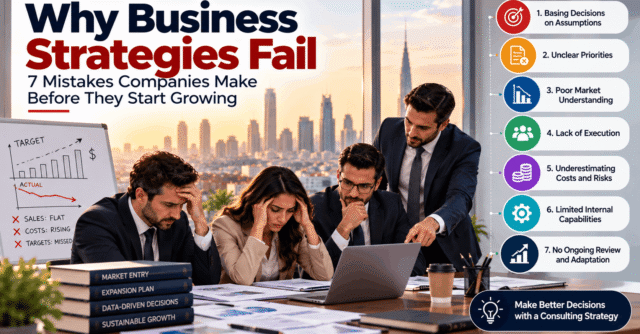
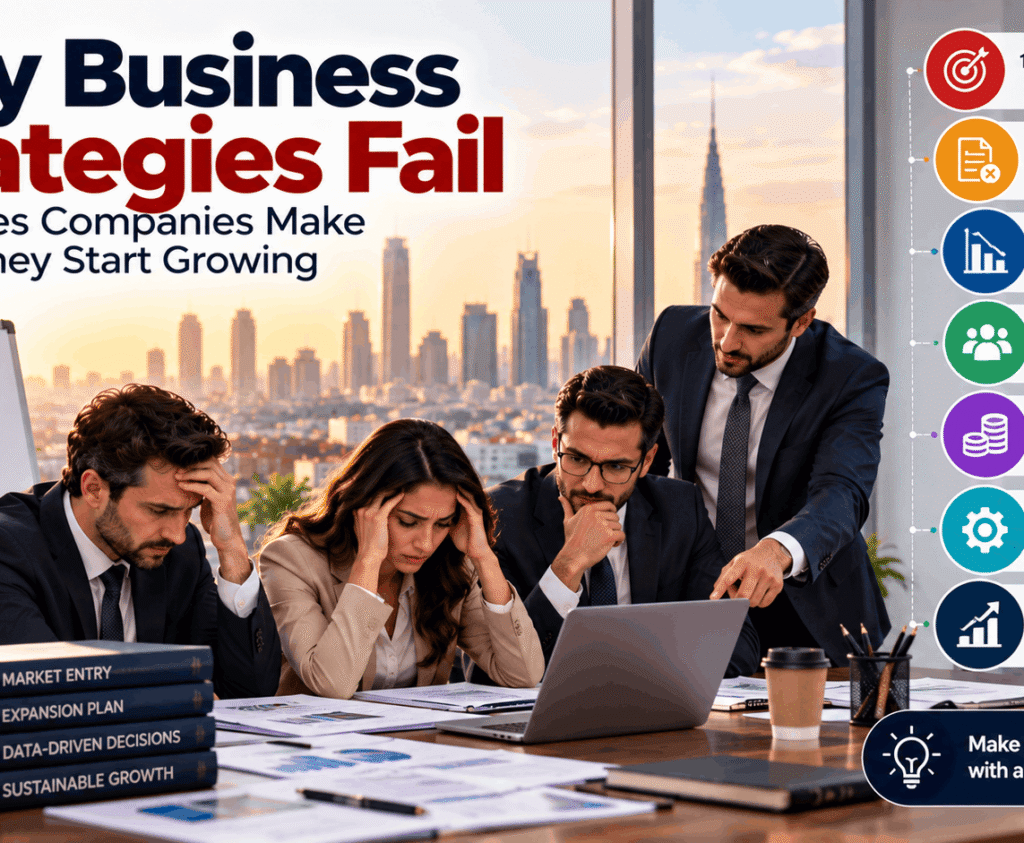
Imagine investing months in a business plan, setting ambitious revenue targets, and preparing your team for expansion. Everyone is excited. The budget looks promising, and the future seems bright. Yet six months later, sales remain flat, costs are rising, and your team is unsure what to do next.
What went wrong?
Often, the problem is not a lack of ambition. It is a strategy built on assumptions, unclear priorities, or plans that never translate into action. Companies can work extremely hard and still move in the wrong direction when their decisions lack evidence and focus.
A well-designed consulting strategy can help businesses identify these problems before they become expensive mistakes. Whether you are entering a new market, launching a service, or preparing for expansion, understanding why strategies fail is an important step toward sustainable growth.
Here are seven common mistakes businesses should avoid and how strategic consulting can help them make better decisions.
1. Confusing Ambitious Goals With a Workable Strategy
Every business wants to grow. Leaders may aim to double revenue, enter three new markets, or become an industry leader within five years. These goals provide direction, but they do not explain how the company will achieve them.
A workable strategy identifies the customers to target, the value to offer, the resources required, and the actions that will create a competitive advantage.
For example, a company planning to increase sales by 50% might need to improve customer retention, develop new distribution channels, or introduce a more profitable product line.
Simply instructing employees to sell more does not solve the underlying problem.
Before committing to a target, ask three questions:
- What specific opportunity will help us achieve it?
- What resources and capabilities do we need?
- What activities should we stop doing to focus on our priorities?
As explained in McKinsey’s analysis of bad strategy, strong strategy requires clear choices and a realistic response to the challenges a business faces.
2. Entering a Market Without Validating Demand
A market may look attractive because of its population, economic activity, or reported growth. However, a large market does not guarantee demand for your particular product or service.
Companies sometimes commit to offices, staff, inventory, and marketing before confirming that customers are willing to buy. When sales fall short of expectations, the investment becomes difficult to recover.
Consider a company planning to expand into Turkey. Instead of assuming its existing product will succeed, it should research customer preferences, local competitors, pricing expectations, purchasing habits, and potential distribution partners.
A practical market validation process includes:
- Identifying the most promising customer segments.
- Interviewing potential buyers and understanding their needs.
- Testing pricing and the value proposition.
- Examining competitors and existing alternatives.
- Testing demand through a pilot or limited commercial launch.
A sound market entry strategy in Turkey should also consider local regulations, operating requirements, suitable business partners, and the company’s ability to support customers in the market.
The U.S. International Trade Administration’s Turkey Market Entry Strategy guide highlights the importance of assessing company resources and considering local representation and business relationships.
The lesson is simple: validate the opportunity before making major commitments.
3. Ignoring Competitors and Operational Costs
Even when customer demand exists, a business can struggle if it underestimates competition or the cost of serving its market.
Leaders may focus on revenue projections without calculating delivery expenses, staffing, distribution, taxes, compliance, marketing, and customer support. These costs can reduce margins and place pressure on cash flow.
Competitor research is equally important. If established businesses offer similar products at lower prices, your company needs a clear reason for customers to choose you.
Before expanding, assess:
- Competitors’ pricing, positioning, and strengths.
- Customer acquisition and retention costs.
- Staffing, logistics, and distribution requirements.
- Regulatory obligations and market-specific expenses.
- Expected margins under different sales scenarios.
For instance, a company entering a foreign market may discover that its products are competitive at home but become too expensive after shipping and distribution costs.
Consulting and strategy work can help businesses evaluate these factors together, compare possible scenarios, and identify risks before committing significant resources.
4. Setting Targets Without Clear Accountability
A strategy can look excellent on paper but fail when nobody knows who is responsible for delivering it.
Imagine a company planning to launch a new service within six months. Marketing expects sales to generate leads, sales expects marketing to qualify prospects, and management assumes both teams understand the timeline.
Without clear ownership, important tasks are delayed or overlooked.
Every strategic priority needs a responsible owner, a deadline, suitable resources, and a way to measure progress.
A practical accountability framework should define:
- The outcome each team must achieve.
- The person responsible for each initiative.
- The budget, tools, and support available.
- The deadlines and progress checkpoints.
- The process for resolving obstacles.
Leaders should also involve the people responsible for implementation when developing the strategy. This helps teams understand the reasoning behind decisions and identify practical challenges early.
Accountability is not about blaming employees when results fall short. It is about making responsibilities visible and helping people act on shared priorities.
5. Failing to Measure Results and Adapt
A strategy should not remain unchanged simply because leadership approved it.
Markets shift, customer expectations evolve, and competitors introduce new offers. A plan that made sense six months ago may no longer reflect current conditions.
Businesses often make the mistake of measuring activity instead of outcomes. Publishing more content, holding more meetings, or launching additional campaigns does not automatically produce profitable growth.
Instead, select key performance indicators (KPIs) that reflect your objectives.
For example, a company pursuing profitable expansion might monitor revenue growth, gross margin, customer acquisition cost, repeat purchases, and cash flow.
A business entering a new market might track qualified leads, conversion rates, pilot sales, and the cost of acquiring customers.
Review these indicators regularly. When results fall below expectations, investigate the cause before increasing spending.
A useful review asks:
What worked? What did not? Which assumptions proved incorrect? What should we change next?
This process allows companies to respond to evidence instead of continuing to invest in activities that are not delivering value.
6. Allocating Resources Without Setting Priorities
Companies sometimes launch too many initiatives at once. They pursue new markets, redesign products, expand marketing, and introduce new systems without considering whether they have enough people, money, or management capacity.
The result is often fragmented effort. Teams become overloaded, budgets are stretched, and important projects compete for attention.
A realistic strategy requires trade-offs. Leaders must decide which opportunities matter most and which activities can wait.
Start by ranking initiatives according to their expected impact, cost, risk, and alignment with business objectives. Then allocate resources to the priorities with the strongest rationale.
Consulting firms can help organizations compare strategic options and identify gaps between their ambitions and available capabilities. However, the business itself must remain committed to making decisions, assigning resources, and implementing the agreed plan.
Growth becomes more manageable when organizations concentrate on a few well-supported priorities rather than trying to do everything simultaneously.
7. Treating Strategy as a One-Time Planning Exercise
A final mistake is assuming that strategic planning ends when a report or presentation is completed.
A document cannot implement itself. Employees need to understand the priorities, managers must coordinate activities, and leadership must address obstacles as they arise.
A strategy should therefore include an implementation roadmap with practical milestones, assigned responsibilities, budgets, and regular reviews.
For example, a 12-month growth plan could begin with customer research, followed by a pilot launch, a performance review, and a decision about whether to expand. Each stage should have clear criteria for proceeding.
This approach allows the business to learn before making larger commitments.
How Strategic Consulting Can Improve Decision-Making
Strategic consulting can help businesses connect their goals with evidence, resources, and practical action.
An effective consulting engagement may involve assessing the current business position, researching market opportunities, comparing strategic options, identifying risks, and developing an implementation roadmap.
For businesses considering international expansion, consultants may also help evaluate market-entry models, local operating conditions, competitive positioning, and potential partnerships.
The value comes from asking better questions, testing assumptions, and making informed choices—not simply producing a lengthy report.
When evaluating a consulting firm, look for relevant experience, a clear scope of work, transparent pricing, and measurable deliverables. Agree on how progress will be assessed and which responsibilities remain with your internal team.
Ottoman Services offers strategic advisory and research capabilities relevant to organizations evaluating growth opportunities and market expansion.
Businesses should confirm the specific scope of support available for their objectives before engaging.
Frequently Asked Questions
1. Why do business strategies fail?
Business strategies commonly fail because goals are not supported by realistic plans, market demand has not been validated, resources are poorly allocated, responsibilities are unclear, or results are not reviewed. Strong execution and regular adaptation are essential.
2. What is consulting strategy?
Consulting strategy refers to the process of helping organizations assess challenges, evaluate opportunities, establish priorities, and develop plans to achieve business objectives. Depending on the engagement, it may include market research, competitive analysis, strategic planning, and implementation support.
3. How can consulting firms help a business grow?
Consulting firms can provide external expertise, identify business risks, assess market opportunities, and recommend practical improvements. Their effectiveness depends on the relevance of their advice, the quality of their work, and the organization’s commitment to implementing recommendations.
4. What should a market entry strategy in Turkey include?
It should cover customer demand, competitor analysis, pricing, regulatory requirements, operating costs, distribution options, and potential local partners. Companies should also assess their resources and test commercial assumptions before committing to major investments.
5. How often should a company review its business strategy?
Many companies benefit from formal quarterly reviews, supported by monthly performance monitoring. The frequency should reflect the business environment, project risks, and pace of change. Significant market developments may require an earlier review.
6. When should a business hire a strategic consultant?
A business may benefit from strategic consulting when preparing to enter a new market, facing stalled growth, considering a major investment, restructuring operations, or struggling to translate goals into action. The engagement should address a clearly defined business need.
Conclusion
Business strategies rarely succeed through ambition alone. Companies need evidence, realistic priorities, clear accountability, and a willingness to adjust when circumstances change.
By avoiding these seven mistakes, organizations can make more informed decisions and build a stronger foundation for sustainable growth. Whether you are improving existing operations or exploring a new market, the right strategy should connect your business goals with a practical plan for achieving them.
Ready to make your next business move with greater confidence?
Book a consultation with Ottoman Services to discuss your strategic priorities, evaluate growth opportunities, and explore an approach aligned with your business objectives.