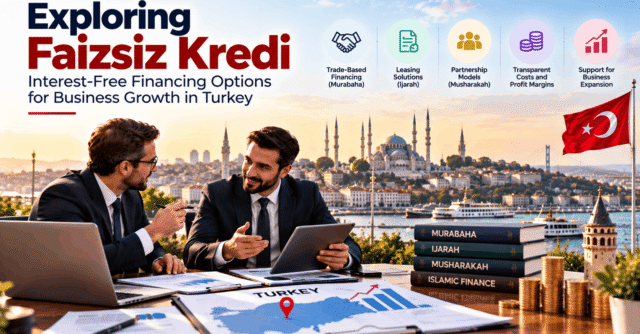
Imagine your company is ready to expand into Turkey. You have identified a promising market, found potential suppliers, and developed a growth plan. But there is one important question: how can you finance the next stage of your business without relying on conventional interest-based borrowing? For many business owners, faizsiz kredi—commonly translated as interest-free financing or an interest-free loan—is an important area to explore.
Turkey’s participation finance sector offers financing structures based on trade, leasing, and partnership arrangements. These can provide alternatives for businesses that want to align funding decisions with Islamic finance principles.
However, faizsiz finansman does not always mean borrowing money without any cost. Depending on the arrangement, a business may pay a disclosed profit margin, rental payments, service charges, or other contractual costs.
Understanding these differences is essential before selecting a financing structure.
For companies considering expansion, business consulting in Turkey can also help connect financing decisions with market demand, operational needs, and long-term growth objectives.
What Does Faizsiz Finansman Mean?
Faizsiz finansman refers to financing structured without interest under the relevant Islamic finance principles. In Turkey, participation finance, known locally as katılım finans, is an established part of the financial system.
Unlike conventional interest-based lending, participation finance generally uses structures involving the purchase and sale of assets, leasing, or investment partnerships.
The exact contractual arrangement determines how the provider earns a return and what obligations the business accepts.
For example, a manufacturer that needs new equipment may explore an asset-based financing arrangement.
Rather than receiving unrestricted cash and paying interest on a loan, the company may use a structure in which the financing provider purchases the equipment and sells or leases it to the business under agreed terms.
The distinction matters because faizsiz kredi is often used as a broad search term, while the actual product may be business financing, leasing, trade finance, or another contractual arrangement.
Businesses should assess the complete agreement, not just the product’s marketing label.
The Turkish government’s Financial Literacy Platform provides an introduction to participation banking and its operating principles.
1. Business Funding Options Available Through Participation Finance
Companies exploring faizsiz kredi in Turkey may encounter several financing structures.
Availability depends on the provider, the business’s eligibility, the proposed activity, and the terms offered.
Murabaha: Cost-Plus Sale Financing
Murabaha is a sale-based structure in which a provider acquires an asset or goods and sells them to the customer at an agreed price that includes a disclosed profit margin.
This may be relevant for businesses purchasing raw materials, inventory, machinery, or other eligible assets. The payment schedule and total sale price should be understood before signing.
Murabaha is not automatically suitable for every cash requirement. Companies should confirm which purchases qualify and how the provider handles supplier payments, documentation, and delivery.
Ijara: Leasing-Based Financing
Ijara involves leasing an asset or its use for an agreed period in exchange for rental payments. Depending on the structure, it may support access to equipment, vehicles, or other productive assets.
Leasing may be worth evaluating when a business needs to use an asset without purchasing it outright at the beginning.
However, companies should examine maintenance responsibilities, insurance, ownership, end-of-contract arrangements, and the total payments over the lease term.
Musharaka: Partnership Financing
Musharaka is a partnership structure in which parties contribute capital and share profits according to agreed terms. Loss allocation generally depends on the capital contributions and applicable contractual and legal principles.
This approach may suit certain projects where a business can accommodate an investor or financing partner.
The company should carefully consider decision-making rights, reporting duties, governance, exit arrangements, and how disputes will be handled.
Mudaraba: Capital and Expertise Partnership
Under a mudaraba arrangement, one party provides capital while another manages the business or investment activity.
Profits are distributed according to a pre-agreed ratio, while financial losses are generally borne by the capital provider unless negligence, misconduct, or contractual breaches alter responsibility under the applicable rules.
This model may appeal to some entrepreneurs, but it requires clear agreements on management authority, performance reporting, and investment risks.
Not every participation finance provider offers every structure to every business.
2. Is Faizsiz Kredi Completely Free of Cost?
One of the most important questions businesses should ask is whether faizsiz kredi means zero-cost financing.
In many commercial arrangements, the answer is no. Interest-free financing can still involve a profit margin, rent, fees, transaction costs, or other payments.
A sale-based structure may have a fixed total price that is higher than the provider’s purchase cost. A lease involves rental payments, while partnership financing exposes the parties to agreed profit-sharing and risk arrangements.
These costs do not automatically make a structure equivalent to conventional interest-based lending.
The contractual basis, ownership of assets, allocation of risks, and applicable Islamic finance principles all matter.
Before choosing a product, request a written breakdown of:
-
The total amount payable over the full term.
-
All fees, commissions, and transaction expenses.
-
The payment schedule and any grace period.
-
Late-payment provisions and default consequences.
-
Collateral, guarantees, and other security requirements.
-
Early settlement, termination, and exit conditions.
Compare financing options on a consistent basis.
A low advertised profit rate may not represent the lowest overall cost if additional charges or restrictive conditions apply.
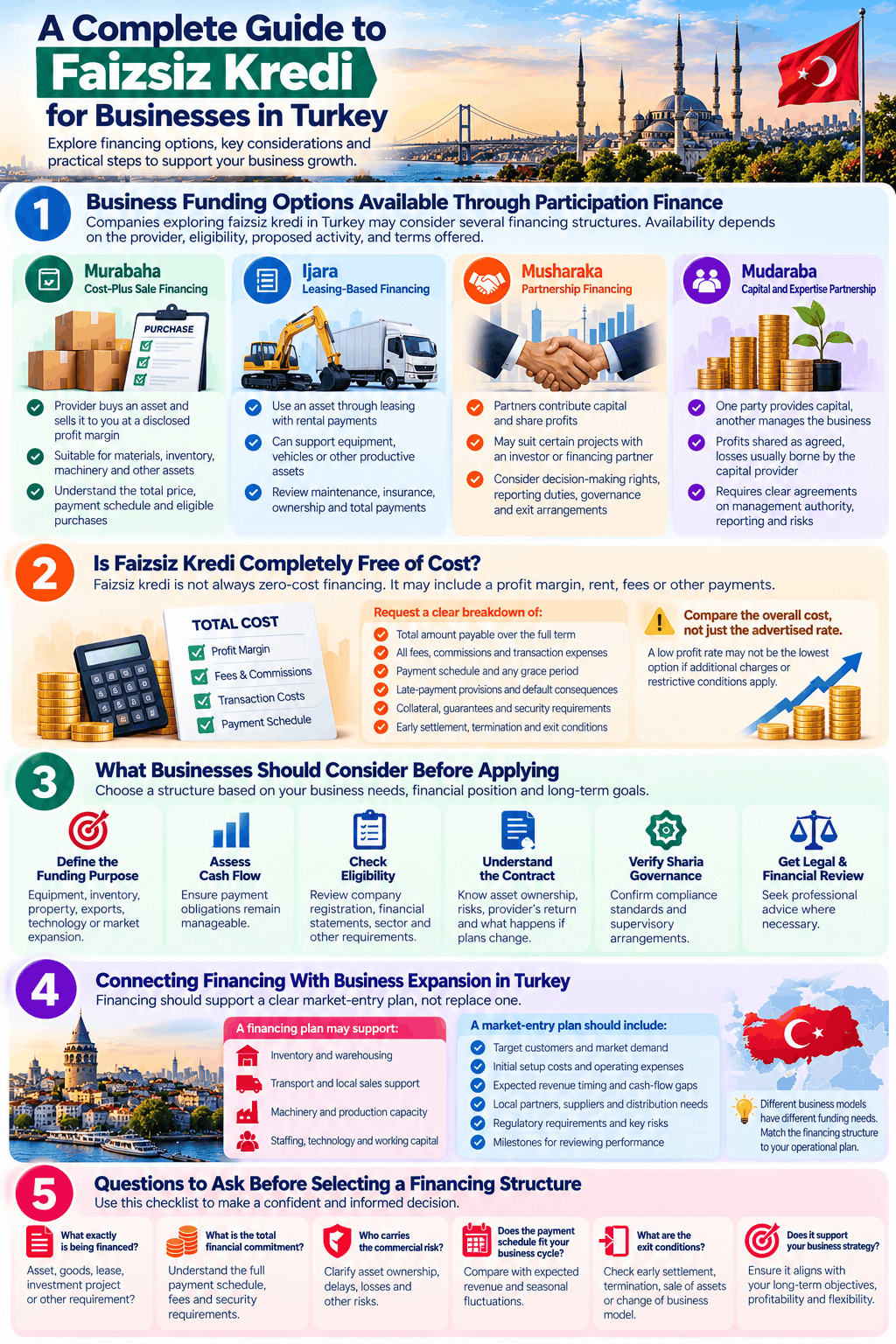
3. What Businesses Should Consider Before Applying
Choosing a financing structure should begin with the business need—not simply with the availability of a product advertised as faizsiz kredi.
Define the funding purpose. Is the money needed for equipment, inventory, commercial property, exports, technology, or a new market?
Asset-based financing may suit a defined purchase, while other needs may require a different funding arrangement.
Assess cash flow. Estimate when the business will generate revenue and when payments will fall due.
A company entering a new market may experience a delay between initial expenditure and its first significant sales. Payment obligations should remain manageable during this period.
Check eligibility. Providers may assess company registration, operating history, financial statements, creditworthiness, collateral, sector, and transaction documentation.
Foreign-owned companies or newly established businesses should confirm their eligibility before committing to an investment plan.
Understand the contract. Review who owns the asset at each stage, how the provider earns a return, which party carries particular risks, and what happens if the project is delayed or the business cannot meet its obligations.
Verify Sharia governance where relevant. Businesses seeking Islamic finance should ask how the product is reviewed for compliance, which standards or supervisory arrangements apply, and whether the documentation reflects the principles being claimed.
A product label alone is not proof that every individual arrangement meets a company’s requirements.
Finally, obtain qualified legal and financial review where necessary. This article provides general educational information, not personalised financial, legal, or religious advice.
4. Connecting Financing With Business Expansion in Turkey
Financing decisions are particularly important for international companies planning to enter Turkey. Funding should support a viable market-entry plan rather than substitute for one.
For example, a company considering a distribution operation may need inventory, warehousing, transport, and local sales support.
A manufacturing business may need equipment and production capacity. A professional services company may face more immediate needs related to staffing, technology, and working capital.
Each business model creates a different funding profile. A financing arrangement designed for purchasing machinery may not cover payroll or general operating expenses.
Companies should therefore map their planned expenditure against the types of financing actually available.
This is where market entry strategies in Turkey and consulting strategy become relevant.
Before raising funds, businesses should evaluate customer demand, competitors, pricing, supplier reliability, regulatory requirements, and realistic revenue projections.
A market-entry plan should identify:
-
The target customer and the demand supporting the opportunity.
-
Initial setup costs and ongoing operating expenses.
-
Expected revenue timing and cash-flow gaps.
-
Local partners, suppliers, and distribution requirements.
-
Key regulatory obligations and implementation risks.
-
Milestones for reviewing performance and adjusting investment.
A financing structure should fit these operational realities.
Taking on payment commitments before validating demand can put pressure on cash flow, even when the financing is structured according to the company’s preferred principles.
5. Questions to Ask Before Selecting a Financing Structure
Before choosing a provider or signing an agreement, business owners should work through a practical checklist.
What exactly is being financed? Confirm whether the arrangement covers a specific asset, goods, a lease, an investment project, or another eligible requirement.
What is the total financial commitment? Understand the full payment schedule, fees, security requirements, and potential costs if circumstances change.
Who carries the commercial risk? Clarify who is responsible for asset ownership, damage, delivery delays, project losses, and other risks. Do not assume that every participation finance arrangement automatically shares risk equally.
Does the payment schedule fit the business cycle? Compare payment dates with expected revenue, seasonal fluctuations, and the time required to establish operations.
What are the exit conditions? Ask what happens if the business wants to settle early, terminate a lease, sell an asset, change its operating model, or exit a partnership.
Does the structure support the wider business strategy? Financing should help the company reach defined objectives.
The terms should be assessed alongside profitability, market conditions, regulatory requirements, and long-term flexibility.
Documenting the answers makes it easier to compare alternatives and identify obligations that may otherwise be overlooked.
People Also Ask: Faizsiz Kredi and Business Financing in Turkey
What is faizsiz kredi?
Faizsiz kredi is a Turkish term commonly used to describe interest-free financing. In business settings, the actual product may use a sale, lease, or partnership structure rather than a conventional cash loan.
The contract determines the payment obligations and how the financing provider earns a return.
Can businesses obtain faizsiz kredi in Turkey?
Businesses may be able to access financing through participation banks and other eligible programmes, depending on the activity, applicant, provider, and current conditions.
Approval is not guaranteed, and companies should verify eligibility and terms directly with the financing provider.
Is participation finance the same as an interest-free loan?
Not necessarily. Participation finance is a broader system that includes sale-based financing, leasing, and partnership arrangements.
Some products are marketed using the general term faizsiz kredi, but their legal and commercial structures can differ substantially.
How can foreign companies finance market entry in Turkey?
Foreign companies can evaluate available funding options after confirming their ownership structure, registration status, project requirements, and eligibility.
Depending on the business model, relevant options may include participation finance, leasing, investment partnerships, or other commercial funding arrangements.
What should businesses compare when evaluating interest-free financing?
Businesses should compare the total payment commitment, fees, contract terms, security requirements, payment flexibility, risk allocation, and suitability for the intended expenditure.
They should also seek appropriate professional review before making a commitment.
Frequently Asked Questions
1. Which businesses may benefit from participation finance in Turkey?
Manufacturers, trading companies, exporters, and businesses investing in productive assets may find certain participation finance products relevant. Eligibility depends on the provider’s criteria, the business activity, and the transaction.
2. Does faizsiz kredi always involve profit-sharing?
No. Some structures use an agreed sale price or rental payments rather than profit-sharing. Profit-sharing is more relevant to partnership arrangements, and the allocation of profits and losses depends on the structure and contract.
3. Can faizsiz finansman support equipment purchases?
Yes, certain sale-based financing and leasing arrangements may support eligible equipment purchases. Businesses should confirm the provider’s requirements, ownership arrangements, documentation, and total cost.
4. Is faizsiz finansman suitable for every business?
No. Suitability depends on the funding purpose, financial position, cash-flow forecast, contract terms, and the company’s requirements. Businesses should compare available alternatives before making a decision.
5. Why is consulting strategy important when arranging business funding?
A sound consulting strategy connects funding with business objectives, market demand, operating costs, and expected revenue. This can help businesses avoid financing commitments that do not fit their actual needs.
6. How can business consulting in Turkey support international investors?
Business consulting in Turkey can help international investors evaluate market opportunities, plan entry strategies, identify operational challenges, and understand the questions to raise with local financial, legal, and regulatory professionals. It does not replace specialist advice or guarantee financing approval.
Conclusion: Build a Stronger Funding Strategy for Turkey
Faizsiz finansman can offer businesses an alternative approach to funding through asset-based transactions, leasing, and partnership arrangements. However, understanding the structure is just as important as understanding the cost.
Companies should examine their funding needs, cash-flow capacity, contractual obligations, and long-term business goals before selecting a financing option.
For international businesses, these decisions should also form part of a wider market-entry strategy.
Planning to establish or expand your business in Turkey? Ottoman Services can help you assess market opportunities, develop a practical consulting strategy, and plan your next steps with greater clarity.
Book a consultation with Ottoman Services to discuss your business objectives and build a more informed approach to entering the Turkish market.