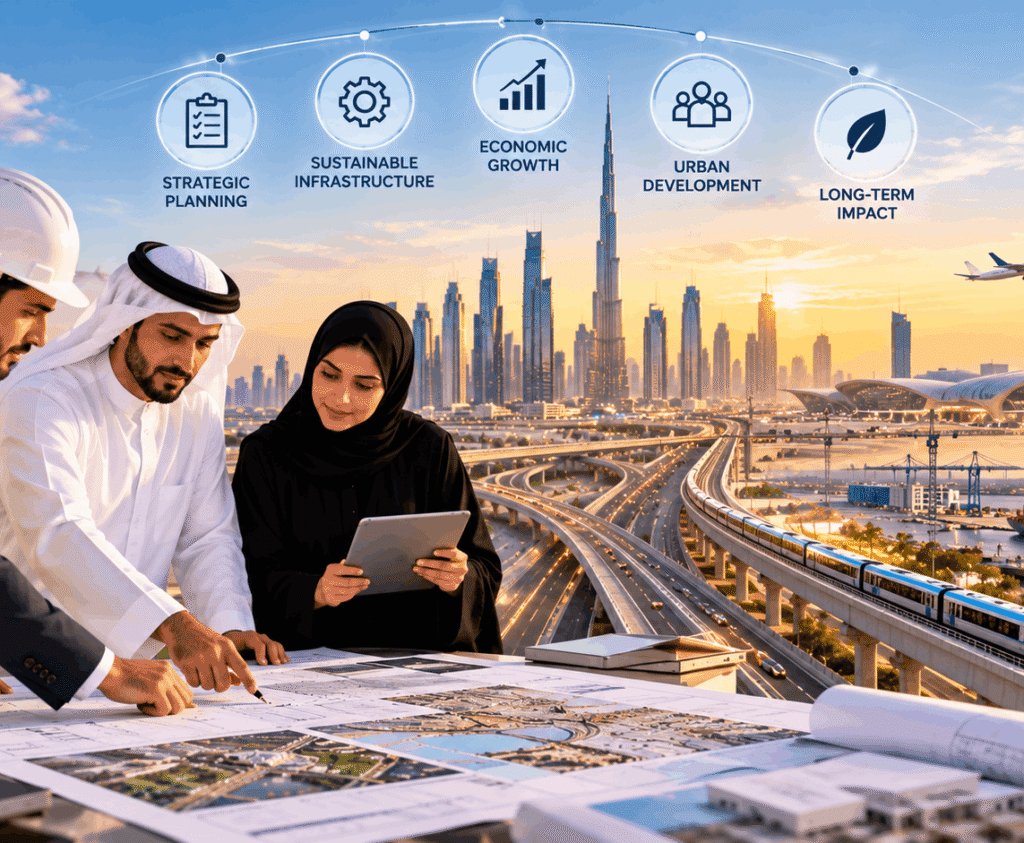
What makes an infrastructure project successful 10, 20, or even 50 years after construction is complete?
It is not simply the size of the project or the technology used. Long-term success depends on whether the project solves a real need, supports economic growth, uses resources wisely, and can adapt as cities, populations, and technology change.
This is where infrastructure consulting becomes valuable.
The UAE has built a strong reputation for advanced transport networks, airports, ports, roads, energy systems, and urban infrastructure.
But the next stage of development requires more than building new assets. Projects must be carefully planned, connected to wider economic goals, and designed with future needs in mind.
The UAE’s We the UAE 2031 vision places infrastructure development within its broader national development agenda and aims to strengthen the country as a global economic hub.
Its “Forward Ecosystem” pillar specifically includes improving government performance and infrastructure through modern technologies.
- Planning an infrastructure project in the UAE? Explore our Infrastructure & Construction Consulting services.
What Is Infrastructure Consulting?
Infrastructure consulting provides strategic and practical advice for planning, developing, improving, and managing infrastructure projects.
It can cover projects involving:
- Roads and highways
- Rail and public transport
- Airports and ports
- Utilities and energy
- Water infrastructure
- Smart cities
- Industrial infrastructure
- Public facilities
- Urban development
- Logistics networks
Consultants can become involved before a project begins, helping decision-makers assess feasibility, demand, risks, costs, and potential benefits.
The work can also continue through planning and implementation, with support for project governance, stakeholder coordination, performance monitoring, and long-term planning.
The objective is simple: help clients make better infrastructure decisions before significant resources are committed.
Why Infrastructure Consulting Matters in the UAE
The UAE’s infrastructure environment is complex because development is closely connected to economic growth, tourism, trade, population growth, technology, and sustainability.
The country already has major infrastructure networks, while new projects continue to address future demand.
For example, the UAE Government’s transport and infrastructure plans include the UAE Railway Programme, Dubai’s 2040 Urban Master Plan, Abu Dhabi’s transportation strategies, and other major mobility initiatives.
The Ministry of Energy and Infrastructure also reported a national portfolio of road and transport projects valued at more than AED 170 billion through 2030, aimed at improving mobility between the emirates.
With projects of this scale, careful planning matters. A small planning error can create significant financial, operational, and social consequences later.
Connecting Infrastructure With Strategic Planning in UAE
Infrastructure should never be planned in isolation.
A new road, railway, industrial facility, housing development, or logistics hub can affect many other parts of the economy.
This is why strategic planning in UAE is an important part of infrastructure development.
Before approving a major project, decision-makers should consider questions such as:
- What problem will the project solve?
- Who will use the infrastructure?
- How will demand change over time?
- How does the project support economic development?
- What other infrastructure will it depend on?
- What will it cost to operate and maintain?
- How can environmental impacts be reduced?
- Can the project adapt to future technology?
The UAE Government’s strategic-planning methodology emphasizes continuous planning, flexible resource management, evidence-based decisions, stakeholder participation, implementation, and measuring the impact of strategic projects.
This approach is highly relevant to infrastructure because major assets can remain in operation for decades.
Assessing Project Feasibility
Not every infrastructure idea should immediately become a construction project.
A feasibility assessment can help determine whether a proposed project is practical and worthwhile.
Consultants may assess:
- Market demand
- Technical requirements
- Estimated costs
- Funding options
- Land requirements
- Environmental considerations
- Regulatory requirements
- Construction risks
- Expected economic benefits
- Long-term operating costs
This provides decision-makers with a clearer picture before significant capital is committed.
Feasibility work is especially important for large or complex projects where changes become increasingly expensive once construction begins.
Improving Project Planning and Delivery
Infrastructure projects often involve many stakeholders.
Government agencies, developers, contractors, engineers, investors, communities, utility providers, and regulators may all have different responsibilities.
Without clear coordination, projects can experience delays, cost increases, or changes in scope.
Infrastructure consulting can help establish clear project structures, responsibilities, timelines, reporting systems, and decision-making processes.
Consultants can also help identify potential problems early rather than waiting until they affect construction.
This does not guarantee that every project will remain on schedule or within its original budget. Instead, it creates a stronger management framework for identifying and addressing problems.
Planning for Sustainable Infrastructure
Infrastructure has a long-term impact on communities and the environment.
Modern planning therefore needs to consider energy use, emissions, water consumption, materials, resilience, waste, and future climate conditions.
The UAE’s infrastructure agenda increasingly connects development with sustainability and efficiency.
For example, the UAE’s National Energy and Water Demand Management Program 2050 aims to reduce energy demand by 42%–45% by 2050. The program covers sectors including buildings, transport, industry, and agriculture.
For infrastructure planners, this means sustainability should be considered from the beginning of a project rather than added later.
Supporting Smart Infrastructure and Cities
Technology is changing how infrastructure is designed and operated.
Smart infrastructure can use sensors, data, automation, connected systems, and artificial intelligence to improve performance.
Examples include:
- Smart traffic management
- Intelligent transport systems
- Digital infrastructure monitoring
- Predictive maintenance
- Smart energy systems
- Connected public services
- Digital construction management
The goal should not be to add technology simply because it is available. Instead, technology should solve a specific problem.
For example, predictive maintenance may help identify equipment problems before they cause service interruptions. Smart traffic systems can use real-time information to improve traffic flow.
Infrastructure consultants can help organizations determine where technology can provide meaningful value and where conventional solutions may be more appropriate.
Improving Transportation and Logistics
Transportation infrastructure is particularly important to the UAE because of its role as a regional trade, tourism, and logistics hub.
The UAE Railway Programme is designed to connect key cities and industrial centers while supporting trade and passenger movement. The program also includes integrated transportation and logistics solutions.
Dubai’s Commercial and Logistics Land Transport Strategy 2030 provides another example of infrastructure being connected directly to economic objectives.
The strategy aims to increase the sector’s contribution to Dubai’s economy while improving technology adoption, emissions, and operational efficiency.
Infrastructure consulting can help organizations assess how roads, rail, ports, warehouses, industrial zones, and other assets work together.
This integrated view can be more valuable than planning each asset separately.
Supporting Investors and Developers
Infrastructure decisions also matter to private investors and developers.
Before investing in a major development, investors need to understand whether the surrounding infrastructure can support the project.
Questions may include:
- Is transportation access sufficient?
- Is there enough utility capacity?
- Is the location suitable for future expansion?
- Are nearby infrastructure projects planned?
- What regulations apply?
- What risks could affect the investment?
Infrastructure consultants can help investors evaluate these factors and make more informed decisions.
This can be particularly valuable when entering unfamiliar markets.
Infrastructure Consulting and Market Entry Strategy in Turkey
Infrastructure opportunities are not limited to the UAE.
Companies operating in construction, engineering, logistics, energy, transportation, and related sectors may also consider international expansion.
For organizations evaluating Turkey, a market entry strategy in Turkey can help determine whether the market fits their capabilities and growth objectives.
The strategy may examine market demand, competitors, regulations, investment requirements, potential partners, location, and project opportunities.
Turkey’s official investment agency provides support to investors before, during, and after market entry, including sector information, site selection, government meetings, and connections with local partners.
For a UAE-based company considering Turkey, this type of market research can help reduce uncertainty before entering the market.
Likewise, Turkish infrastructure and construction companies considering opportunities in the UAE can benefit from a structured assessment of local demand, partnerships, regulations, and competitive positioning.
Measuring Long-Term Infrastructure Impact
A project’s success should not be measured only by whether construction was completed.
Long-term performance can be assessed through indicators such as:
- Capacity
- Usage
- Operating costs
- Maintenance requirements
- Safety
- Economic impact
- Environmental performance
- User satisfaction
- Revenue
- Service reliability
These measurements can reveal whether an infrastructure investment is delivering the expected value.
A project that opens on time but becomes expensive to operate may not be as successful as expected.
Similarly, an asset that performs well today but cannot adapt to future demand may create problems later.
People Also Ask: Infrastructure Consulting
What does an infrastructure consultant do?
An infrastructure consultant helps organizations assess, plan, and manage infrastructure projects. Their work may include feasibility studies, strategic planning, project assessment, risk analysis, stakeholder coordination, and implementation support.
Why is infrastructure consulting important?
Infrastructure projects require significant investment and often remain in use for decades. Consulting can help decision-makers assess risks, understand future demand, allocate resources effectively, and improve project outcomes.
What types of projects require infrastructure consulting?
Infrastructure consulting can support roads, railways, airports, ports, utilities, energy systems, water projects, smart cities, industrial developments, and public facilities.
How does strategic planning support infrastructure projects?
Strategic planning connects individual infrastructure projects with wider economic, social, environmental, and development objectives. It helps determine which projects should receive priority and how resources should be allocated.
Can infrastructure consulting reduce project risks?
It can help identify and manage risks before and during project development. However, no consultant can eliminate every risk. Effective consulting creates better information and processes for making decisions and responding to problems.
Is infrastructure consulting useful for private investors?
Yes. Investors can use infrastructure assessments to understand site access, utilities, transportation, regulations, future development, and other factors that may influence the success of an investment.
FAQs About Infrastructure Consulting in the UAE
1. Who uses infrastructure consulting services in the UAE?
Government entities, municipalities, developers, investors, infrastructure operators, construction companies, and businesses involved in transportation, energy, logistics, and urban development can use infrastructure consulting services.
2. How can infrastructure consulting support UAE development?
It can help organizations connect infrastructure projects with long-term economic goals, assess future demand, improve project planning, manage risks, and create more efficient and sustainable infrastructure.
3. What is the relationship between infrastructure consulting and strategic planning in UAE?
Strategic planning determines broader priorities, while infrastructure consulting helps translate those priorities into practical infrastructure decisions and projects.
4. Can infrastructure consultants help with smart city projects?
Yes. Consultants can support smart-city planning by assessing technology requirements, data systems, transportation, utilities, digital services, and long-term urban development needs.
5. What should companies consider before entering the UAE infrastructure market?
Companies should assess market demand, competitors, regulations, local partnerships, project pipelines, investment requirements, capabilities, and potential risks. A structured market assessment can provide a stronger foundation for market entry.
6. Why is long-term planning important for infrastructure?
Infrastructure can remain operational for decades. Planning for future population growth, technology, environmental conditions, maintenance, and economic changes can help ensure that assets remain useful and financially sustainable.
Build Infrastructure That Creates Lasting Value
Infrastructure is more than roads, buildings, transport systems, and utilities. It forms the foundation on which economies, communities, and businesses grow.
The UAE’s continued investment in transport, energy, logistics, urban development, and smart infrastructure creates significant opportunities. But capturing those opportunities requires careful planning and informed decisions.
Infrastructure consulting can help organizations assess opportunities, manage risks, align projects with strategic goals, and plan for long-term impact.
Ottoman Services can support organizations that are evaluating infrastructure opportunities, planning major projects, entering new markets, or aligning investments with broader development goals.
Book a consultation with Ottoman Services today to discuss your infrastructure objectives and develop a practical strategy for projects built to deliver lasting value.