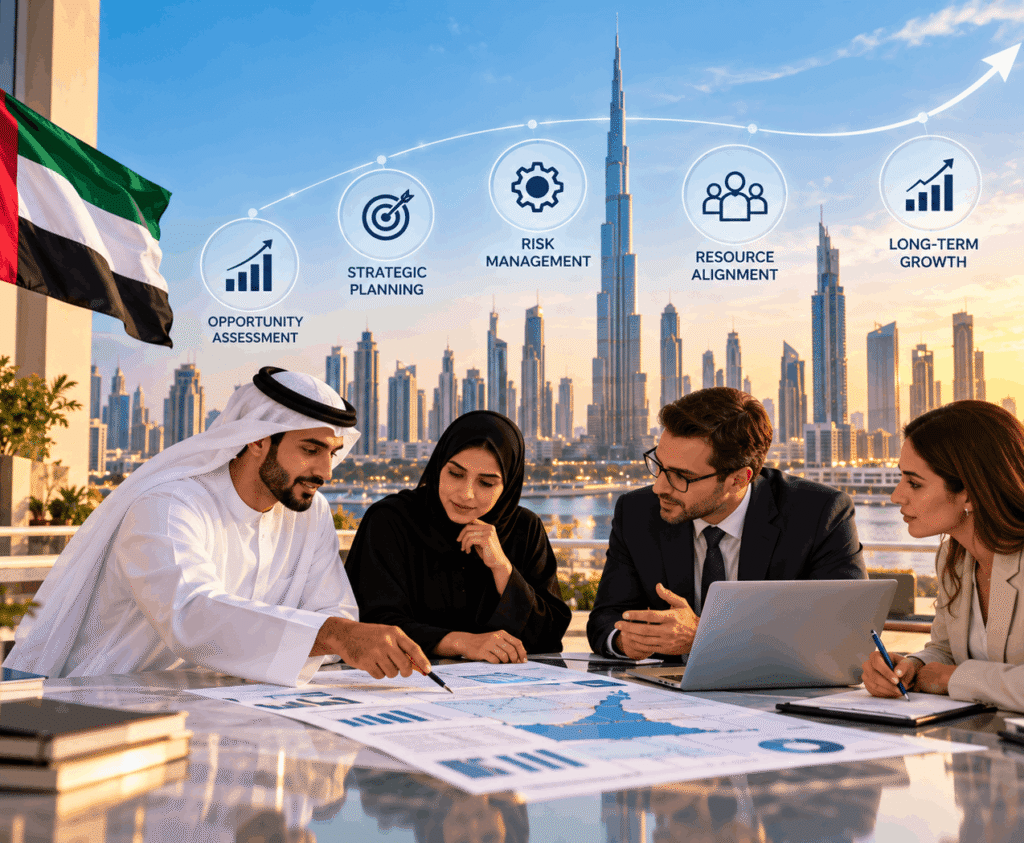
What if your organization could see the next five years more clearly before committing its people, money, and resources today?
That is the real value of strategic planning.
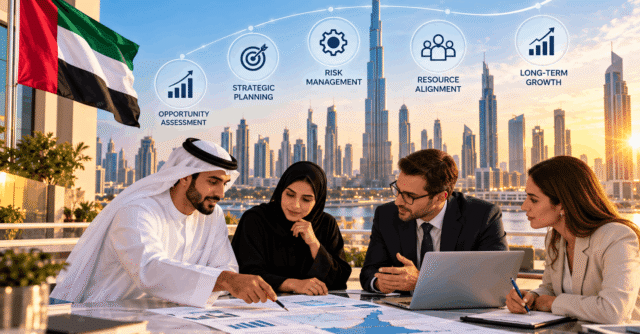
In the UAE, organizations operate in a fast-changing environment shaped by technology, international investment, economic diversification, regulation, sustainability, and changing customer expectations.
A strong long-term plan can help businesses and institutions decide where to compete, which opportunities to pursue, what risks to prepare for, and how to turn goals into measurable results.
The UAE itself takes a long-term approach to development. It’s We the UAE 2031 vision focuses on social, economic, investment, and development priorities and aims to strengthen the country’s position as a global economic hub.
The UAE Centennial 2071 also provides a much longer-term framework for future-focused government and national development.
For organizations operating in this environment, strategic planning consulting can provide the structure needed to connect ambition with execution.
What Is Strategic Planning?
Strategic planning is the process of deciding where an organization wants to go and how it will get there.
It goes beyond creating a mission statement or preparing a five-year financial forecast.
Effective strategic planning examines the organization’s current position, external environment, capabilities, resources, competitors, risks, and future opportunities.
A strategic plan typically answers five important questions:
- Where are we now?
- Where do we want to go?
- What opportunities should we pursue?
- What could prevent us from succeeding?
- What actions and resources are required to achieve our goals?
Research on strategy execution has repeatedly highlighted the gap between having a plan and actually implementing it.
McKinsey research, for example, has found that many organizations struggle to connect strategic plans with a clear execution path and performance tracking.
This is why modern strategic planning should connect directly to budgets, people, projects, performance measures, and decision-making.
Why Strategic Planning Matters in the UAE
The UAE’s economic environment creates both significant opportunities and strong competition.
Businesses may have access to international markets, advanced infrastructure, investment opportunities, technology ecosystems, and a highly connected regional economy.
At the same time, organizations must respond quickly to changes in customer behavior, technology, regulation, and competition. The UAE’s national strategies demonstrate the importance of long-term thinking.
We the UAE 2031 includes goals related to economic growth, foreign trade, tourism, talent, infrastructure, government performance, and digital development.
This environment makes strategic planning particularly valuable for organizations that want sustainable growth rather than short-term gains.
A good strategy can help leadership prioritize opportunities instead of spreading resources across too many initiatives.
- Read more on infrastructure consulting in the UAE market.
How Strategic Planning Consulting Helps Organizations
Strategic planning consultants bring an external perspective to complex business decisions.
Instead of relying only on internal assumptions, consultants can combine market research, organizational analysis, competitor assessment, financial information, stakeholder insights, and scenario planning.
A typical strategic planning engagement may include:
- Current-state assessment
- Market and competitor analysis
- Opportunity identification
- Risk assessment
- Vision and goal development
- Strategic priority setting
- Resource planning
- KPI development
- Implementation roadmaps
- Performance monitoring
The exact process should depend on the organization’s size, sector, objectives, and challenges.
Assessing Growth Opportunities
Growth can come from several directions.
An organization might enter a new market, launch a new service, expand into another emirate, develop a new customer segment, form partnerships, or invest in technology.
However, not every opportunity deserves investment.
Strategic planning helps leadership compare opportunities based on factors such as market demand, competitive intensity, investment requirements, capabilities, risk, and expected returns.
For example, a UAE-based company considering international expansion could assess whether its current products, workforce, technology, and financial resources are strong enough to support expansion.
This prevents organizations from pursuing growth simply because an opportunity looks attractive on paper.
Aligning Resources With Strategic Priorities
One of the most common problems organizations face is having too many priorities.
When every project is considered urgent, resources become fragmented.
Strategic planning creates a framework for deciding what matters most.
Once priorities are established, leadership can align:
- Budgets
- Employees
- Technology
- Partnerships
- Infrastructure
- Management attention
- Marketing investment
with the organization’s most important objectives.
This creates a direct connection between strategy and resource allocation.
The UAE Ministry of Finance’s strategic plan provides a useful public-sector example.
Its plan connects financial performance, fiscal sustainability, national resilience, risk management, financial planning, talent, digital structure, and performance measurement.
The lesson applies beyond government: strategic objectives become more useful when resources and performance measures are connected to them.
Managing Business Risks
Long-term growth always involves uncertainty.
Economic conditions can change. Competitors can enter a market. Regulations can evolve. Technology can disrupt established business models.
Strategic planning consulting can help organizations identify these risks before they become major problems.
Scenario planning is particularly useful. Instead of creating one prediction about the future, organizations can consider several possible situations.
For example:
- What if demand grows faster than expected?
- What if a major competitor enters the market?
- What if technology changes customer expectations?
- What if operating costs increase?
- What if regulations change?
The goal is not to predict the future perfectly. It is to prepare the organization to respond effectively.
The UAE Government’s Future Foresight Strategy similarly emphasizes developing future scenarios and incorporating foresight into government strategic planning.
Turning Strategy Into Action
A strategy is only useful when people can act on it.
This means breaking broad objectives into specific initiatives, owners, deadlines, resources, and measurable outcomes.
For example, instead of saying:
“Increase digital growth.”
a stronger strategic objective could identify:
- Which digital products will be developed
- Which customers will be targeted
- What investment is required
- Who owns the initiative
- What milestones must be achieved
- Which KPIs will measure progress
This makes the strategy easier to manage.
Consultants can also establish regular strategic reviews so leadership can determine whether initiatives are progressing or whether priorities need to change.
Using KPIs to Measure Progress
Key performance indicators, or KPIs, provide measurable evidence of progress.
Depending on the organization, KPIs could measure:
- Revenue growth
- Market share
- Customer satisfaction
- Operational efficiency
- Employee productivity
- Project completion
- Investment returns
- Service quality
- Cost reduction
Good KPIs should be connected to strategic priorities.
They should also be reviewed regularly. If a KPI does not help leadership make better decisions, it may not be the right measure.
Strategic Planning for Government and Public Institutions
Strategic planning is equally important in the public sector.
Government organizations must balance policy objectives, budgets, public expectations, institutional capacity, and long-term development goals.
This is where strategic planning connects with government consulting in Qatar and government strategy consulting in Saudi Arabia.
Across the Gulf, governments are pursuing ambitious transformation programs that require clear strategies, strong institutions, performance management, and effective implementation.
For organizations serving government clients, understanding this broader regional direction can reveal opportunities for partnerships, technology solutions, infrastructure projects, professional services, and institutional development.
The Role of Digital Transformation
Technology should be part of strategic planning, but it should not become the strategy itself.
Organizations need to determine which technologies can solve real business problems.
Digital transformation may involve artificial intelligence, automation, data analytics, cloud systems, digital customer experiences, or integrated platforms.
The UAE’s digital government agenda demonstrates the importance placed on technology, future readiness, and improved government performance.
For private organizations, the same principle applies: technology investments should support clearly defined strategic objectives.
What Makes Strategic Planning Effective?
Effective strategic planning has several characteristics.
It is evidence-based. Decisions should use reliable market, financial, operational, and customer information.
It is focused. Organizations should have a manageable number of strategic priorities.
It is measurable. Goals should have clear KPIs and targets.
It is flexible. Plans should be reviewed when market conditions change.
It is practical. Every major priority should connect to actions, resources, ownership, and timelines.
Most importantly, strategic planning should involve the people responsible for execution. A plan created by leadership but ignored by operational teams is unlikely to produce lasting results.
People Also Ask: Strategic Planning Questions
What is strategic planning?
Strategic planning is a structured process for defining an organization’s long-term direction, identifying priorities, allocating resources, managing risks, and establishing actions to achieve measurable objectives.
Why is strategic planning important for businesses?
Strategic planning helps businesses focus resources on the opportunities most aligned with their goals. It can also help identify risks, improve decision-making, and create a clearer path toward sustainable growth.
What does a strategic planning consultant do?
A strategic planning consultant assesses an organization’s current position, researches the market, identifies opportunities and risks, helps define strategic priorities, and develops practical plans for implementation and performance measurement.
How long should a strategic plan cover?
There is no universal timeframe. Many organizations use three-to-five-year plans while reviewing priorities more frequently. Larger institutions may also use longer-term visions supported by shorter implementation plans.
What are the main elements of a strategic plan?
Common elements include an organizational vision, current-state assessment, strategic objectives, market analysis, priorities, initiatives, resources, KPIs, risk management, and an implementation roadmap.
How does strategic planning support long-term growth?
It helps organizations make deliberate decisions about markets, investments, capabilities, people, technology, and resources. This reduces unfocused spending and creates a structured path toward sustainable growth.
FAQs About Strategic Planning Consulting in the UAE
1. Who needs strategic planning consulting in the UAE?
Businesses, government-related organizations, investors, institutions, startups, and established companies can benefit from strategic planning consulting when they need to clarify their direction, manage growth, enter new markets, or improve organizational performance.
2. Can strategic planning help a company entering the UAE market?
Yes. Strategic planning can assess market demand, competition, customer segments, regulatory considerations, investment requirements, and internal capabilities before a company commits significant resources to expansion.
3. How does strategic planning differ from a business plan?
A business plan often focuses on how a specific business will operate and generate revenue.
Strategic planning takes a broader view of long-term direction, competitive positioning, resources, risks, capabilities, and major organizational priorities.
4. Can consultants help with strategy execution?
Yes. Consulting support can extend beyond strategy development to implementation roadmaps, KPI frameworks, governance structures, performance reviews, change management, and initiative tracking.
5. How often should a strategic plan be reviewed?
Organizations should monitor strategic performance throughout the year and conduct formal reviews periodically.
A major change in markets, regulations, technology, or organizational circumstances may also require a strategy refresh.
6. Why choose local strategic planning expertise in the UAE?
Local expertise can help organizations understand the UAE’s business environment, institutional landscape, market conditions, and development priorities.
This can make strategic recommendations more practical and relevant.
Build a Stronger Growth Strategy With Ottoman Services
Long-term growth rarely happens by accident. Organizations need to understand where they stand, choose the right opportunities, prepare for risks, and align their resources around priorities that matter.
That is the purpose of strategic planning.
For organizations operating in the UAE or considering expansion into the wider Middle East, the right strategy can provide clarity when markets are changing quickly. Ottoman Services can help assess your current position, identify opportunities, develop strategic priorities, and create a practical roadmap for growth.
Book a consultation with Ottoman Services today to discuss your organization’s goals and explore a strategic path toward sustainable, long-term growth.