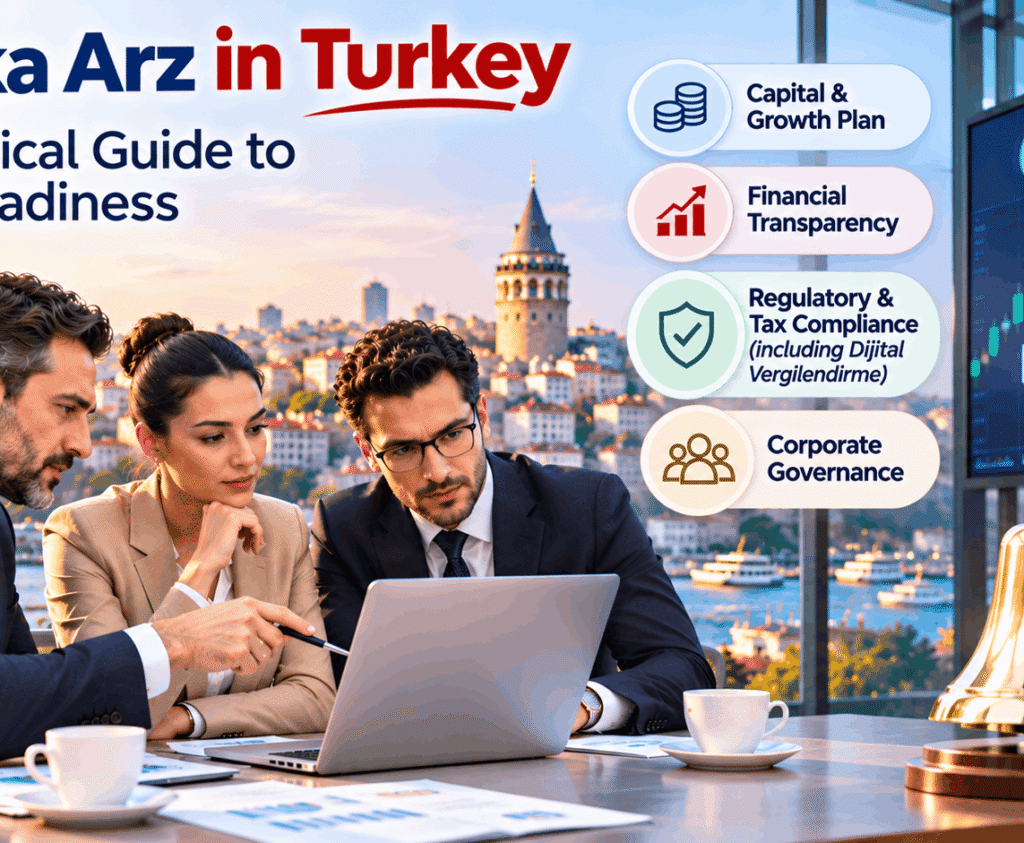
What if your company’s next major growth opportunity didn’t come from another loan, but from opening its doors to the capital markets?
For ambitious businesses in Turkey, reaching the next level often requires more than strong sales and a proven business model. It requires access to capital, investor confidence, transparent financial records, and a management structure built for long-term growth. This is where halka arz can change the direction of a business.
But going public is not simply about offering shares and attracting investors. It is a demanding process that tests how well a company manages its finances, follows regulations, controls risks, and communicates with stakeholders.
Even areas such as dijital vergilendirme, electronic financial records, and tax compliance can become important when preparing for greater transparency and scrutiny.
So, how can a company determine whether it is truly ready for an initial public offering (IPO)? What should business owners review before approaching the capital markets? And why do governance, reliable financial reporting, and professional advice matter so much?
This guide explores the practical steps Turkish companies should consider before pursuing an IPO, from assessing internal readiness to understanding the regulatory process and preparing for life as a publicly traded business.
What Does Halka Arz Mean?
Halka arz is the process through which a company offers its shares to the public.
In Turkey, companies seeking to have their shares traded on Borsa İstanbul must follow the applicable capital-market regulations and obtain the required approvals.
An IPO can take place through three main approaches:
- Sale of existing shares: Current shareholders offer part of their holdings to public investors. The proceeds generally go to the selling shareholders.
- Capital increase: The company issues new shares and offers them to investors. The proceeds are received by the company and can support planned investments, expansion, or other disclosed purposes.
- A combination of both: Existing shareholders sell some shares while the company also issues new shares.
For a growing business, the second option may be particularly useful when the main objective is to raise funds for future development. The right structure depends on the company’s financial needs, ownership plans, and long-term strategy.
Why Do Companies Consider an IPO?
Companies usually consider an IPO because they want to finance their next stage of growth. The capital raised may support new facilities, technology investments, market expansion, research, or other business priorities disclosed to investors.
However, the benefits can extend beyond funding.
A listed company may gain greater visibility, a broader investor base, and improved access to capital-market opportunities.
The preparation process can also encourage better financial reporting, clearer management responsibilities, stronger internal controls, and more formal decision-making.
There are responsibilities too. Public companies must meet ongoing disclosure and reporting requirements.
They face greater scrutiny from investors and regulators, and management must communicate important developments accurately and on time.
An IPO should therefore support a clear business strategy. It should not be treated as a shortcut to prestige or an automatic solution to financial difficulties.
How Can a Company Assess Its IPO Readiness?
IPO readiness starts with an honest review of the business.
Before approaching investors or beginning formal applications, owners should examine the following areas.
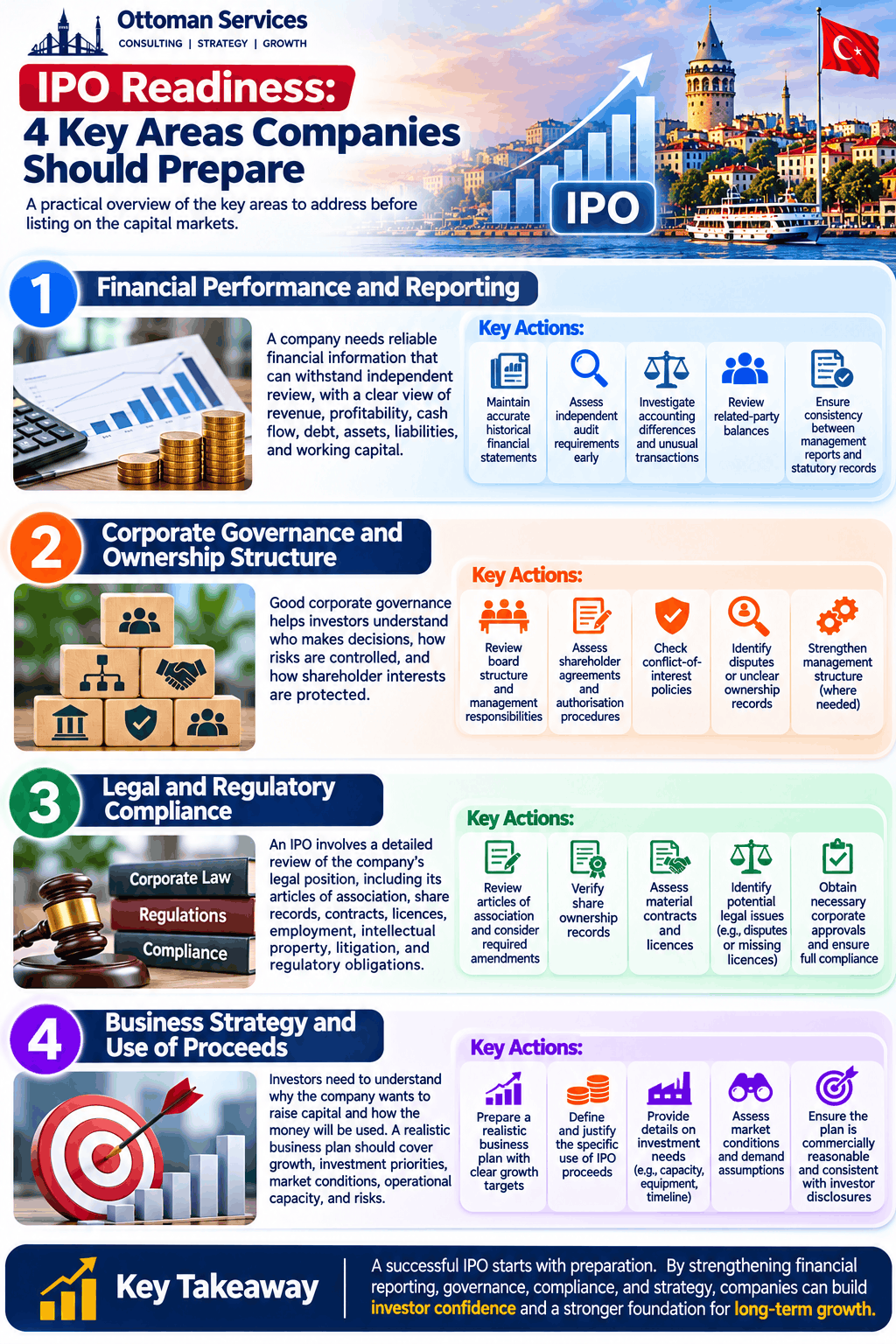
1. Financial Performance and Reporting
A company needs reliable financial information that can withstand independent review. Management should understand its revenue sources, profitability, cash flow, debt, assets, liabilities, and working-capital requirements.
Historical financial statements should be properly maintained and prepared in line with the applicable reporting framework. Independent audit requirements must also be assessed early.
Companies should investigate unresolved accounting differences, unusual transactions, related-party balances, and inconsistencies between management reports and statutory records.
These issues can delay preparation if they are discovered late.
A useful readiness question is simple: Can the finance team explain the company’s financial position clearly, using consistent and verifiable records?
2. Corporate Governance and Ownership Structure
Good corporate governance helps investors understand who makes decisions, how risks are controlled, and how shareholder interests are protected.
Companies should review their board structure, management responsibilities, shareholder agreements, authorisation procedures, and conflict-of-interest policies.
They should also identify any disputes, unclear ownership records, or arrangements that may create uncertainty for investors.
A business that depends entirely on one founder for approvals and daily decisions may need to strengthen its management structure before listing.
Clear responsibilities and documented processes make the company more accountable and easier to evaluate.
3. Legal and Regulatory Compliance
An IPO involves a detailed review of the company’s legal position. This can include its articles of association, share ownership records, material contracts, licences, employment arrangements, intellectual property, litigation, and regulatory obligations.
The company may need to amend its articles of association to comply with capital-market requirements. The relevant corporate approvals must also be obtained.
Legal advisers should identify potential problems early. A contract dispute, incomplete ownership record, or missing licence can become a significant obstacle during due diligence.
4. Business Strategy and Use of Proceeds
Investors need to understand why the company wants to raise capital and how the money will be used.
Management should prepare a realistic business plan covering expected growth, investment priorities, market conditions, operational capacity, and financial risks.
For example, a manufacturing company planning to increase production should be able to explain its expected capacity, equipment costs, demand assumptions, and implementation timeline.
The proposed use of IPO proceeds should be specific, commercially reasonable, and consistent with the information disclosed to investors.
Why Digital Records and Dijital Vergilendirme Matter
Digital systems are becoming an important part of financial transparency and corporate compliance. For companies preparing for halka arz, reliable digital records can make financial reviews, reporting, and internal monitoring more efficient.
The concept of dijital vergilendirme (digital taxation) is relevant because businesses must manage tax information and obligations in an increasingly digital environment.
In Turkey, electronic tax processes and digital documentation require companies to maintain accurate records and coordinate their accounting and tax systems.
A company should review whether its invoicing, accounting, payroll, tax declarations, and document-management processes are properly organised. It should also check whether the information held in different systems is consistent.
Digital transformation does not automatically make a company IPO-ready.
However, well-managed systems can help create a reliable audit trail, reduce manual errors, and improve the quality of information available to management and professional advisers.
Tax planning should also be reviewed before an IPO. Companies need to identify outstanding tax matters, assess potential exposures, and understand how proposed transactions may affect their tax position.
Any tax incentives or benefits must be evaluated against the applicable legislation and the company’s actual circumstances.
How Does the IPO Process Work in Turkey?
Although the details depend on the company and the applicable regulations, the process generally follows several stages.
- First, the company conducts a readiness assessment. Management reviews its financial, legal, operational, and governance position. It identifies gaps and creates a preparation plan.
- Next, it appoints professional advisers. The company selects an authorised intermediary institution and works with legal, financial, tax, and independent audit professionals as required.
- The company then prepares its documentation. This includes the relevant financial statements, corporate approvals, legal documents, and the prospectus. The prospectus explains the business, financial position, risks, offering structure, and other information investors need.
- Applications are submitted to the relevant authorities. The company applies to the Capital Markets Board of Türkiye (SPK) for prospectus approval and to Borsa İstanbul for the relevant listing process. Each institution reviews matters within its area of responsibility.
- Finally, the offering and listing take place. Following the required approvals, shares are offered using the applicable sale method. If the relevant conditions are met, the shares can begin trading on Borsa İstanbul.
Companies can review the official Borsa İstanbul guide to IPO preparation for an overview of the preparation requirements.
Why Professional Advice Matters
An IPO brings together financial, legal, tax, regulatory, and strategic work. These areas are connected. A decision about the company’s capital structure can affect its ownership, tax position, valuation, and disclosure obligations.
Professional advisers help management identify issues before they become costly delays. An authorised intermediary institution supports the offering process, while independent auditors assess financial statements.
Legal advisers review corporate documents and regulatory matters. Tax professionals examine tax exposures and relevant planning considerations.
Strategic and management advisers can also help the company clarify its growth objectives, strengthen internal processes, and prepare a realistic roadmap.
The goal is not simply to complete an application. It is to build a company that can operate responsibly as a public business.
What Should Companies Do Before Starting?
A practical first step is to create an IPO readiness checklist. It should cover:
- Financial statements, audit history, cash flow, and debt.
- Ownership records, corporate approvals, and articles of association.
- Board responsibilities, internal controls, and risk management.
- Tax compliance, digital records, and potential liabilities.
- Business strategy, capital requirements, and planned use of proceeds.
- Management capacity for ongoing investor communication and public disclosure.
The company should assign responsibility for each area and establish a realistic timetable. Not every business will be ready immediately.
Identifying gaps early gives management time to address them before entering the formal process.
Frequently Asked Questions About Halka Arz
1. What is halka arz in Turkey?
Halka arz is the public offering of a company’s shares to investors. A company seeking to list on Borsa İstanbul must meet the relevant regulatory requirements and obtain the required approvals.
2. Can every company in Turkey go public?
No. A company must meet applicable legal, financial, corporate, and capital-market requirements. Its legal form, financial records, ownership structure, and readiness for public disclosure all need to be assessed.
3. How long does it take to prepare for an IPO?
There is no fixed preparation period for every company. The timeline depends on the quality of existing records, audit requirements, legal structure, regulatory reviews, and the work needed to address any gaps.
4. Does a company receive the money raised through every halka arz?
No. When new shares are issued through a capital increase, the proceeds generally go to the company. When existing shareholders sell their shares, the proceeds generally go to those shareholders.
5. Why is corporate governance important before an IPO?
Corporate governance establishes clear responsibilities, accountability, oversight, and decision-making procedures. It helps investors assess how the company is managed and how risks are controlled.
6. How does dijital vergilendirme relate to IPO readiness?
Digital tax processes make accurate electronic records and consistent financial information important. Companies should review their invoicing, accounting, tax declarations, and document-management systems to support compliance and reliable reporting.
Prepare Your Company for Its Next Stage of Growth
A successful halka arz begins long before shares reach the market. Companies need dependable financial reporting, sound corporate governance, clear ownership structures, effective digital records, and a realistic growth strategy.
They must also understand their tax position, including matters related to dijital vergilendirme, and work with qualified professionals throughout the process.
For business owners in Turkey, early preparation can reveal weaknesses, reduce uncertainty, and create a stronger foundation for capital-market access.
Ottoman Services supports businesses consultancy, financial and investment advisory, governance, and market-entry considerations. If your company is exploring an IPO or wants to understand whether it is ready for the next stage, book a consultation with Ottoman Services. Start with a clear assessment, identify the gaps, and build a practical roadmap towards sustainable growth.