One poor business decision can cost your organization years of progress. The right advice can help you avoid it.
Whether you are entering the Turkish market, expanding an established company, improving operations, or evaluating a major investment, the decisions you make today can shape your organization’s future.
But how do you know whether you are receiving advice that genuinely supports your goals?
Choosing a business consultant in Turkey is not simply about finding someone with an impressive profile or an attractive proposal.
It is about selecting a professional partner who understands your challenges, knows the market, and can turn complex information into practical recommendations.
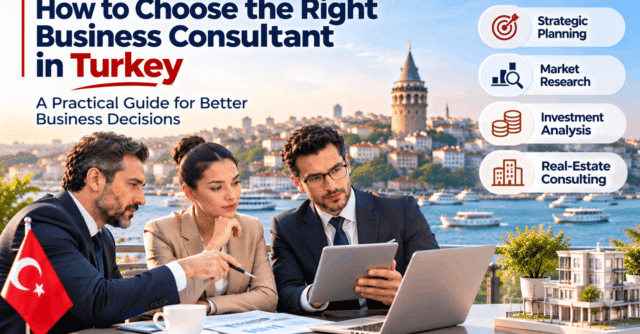
From strategic planning and market research to investment analysis and real-estate consulting, the right expertise can help your organization make better-informed decisions.
This guide explains how to assess consulting firms, compare their services, identify warning signs, and choose a partner that fits your business needs.
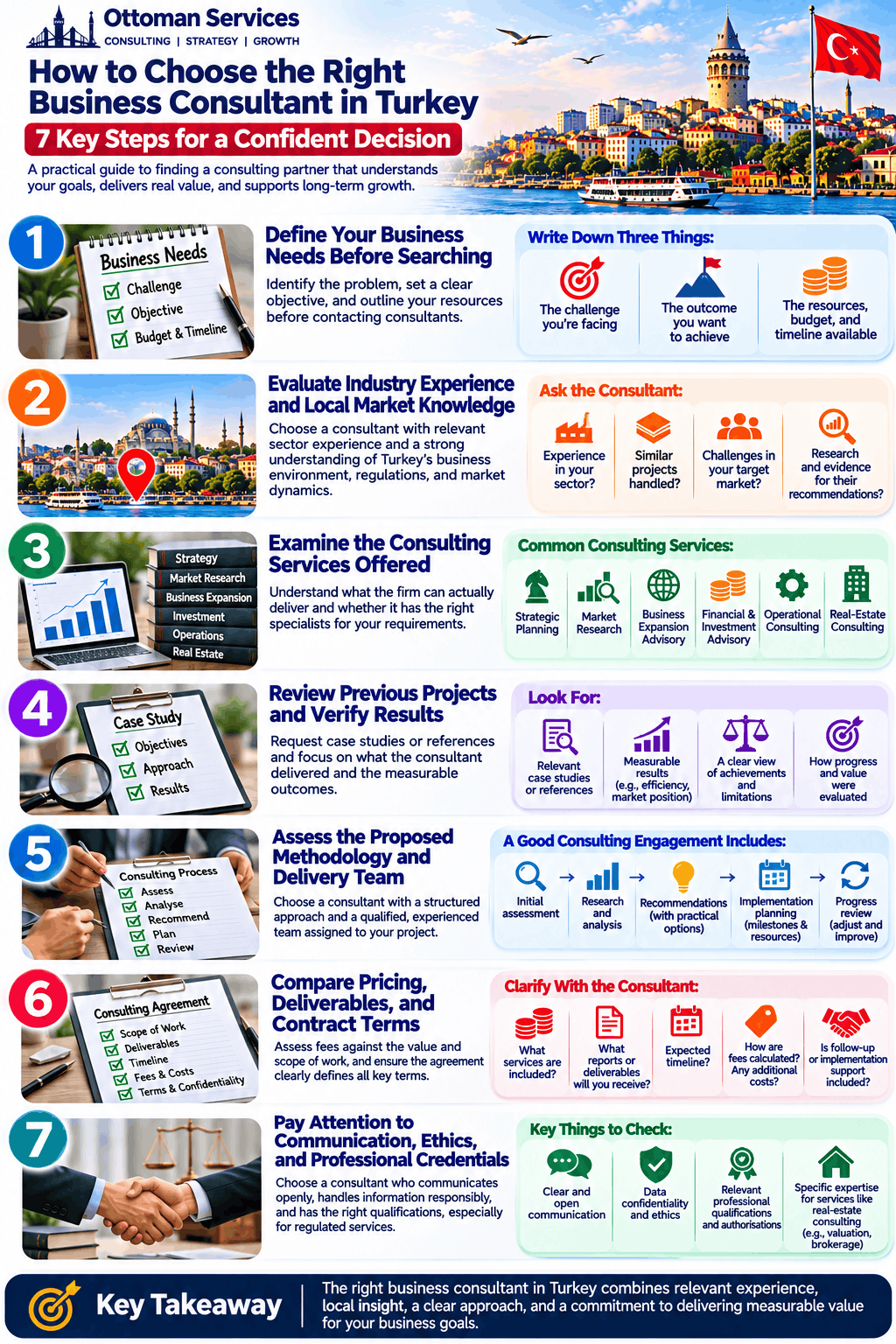
1. Define Your Business Needs Before Searching
Before contacting consultants, identify the problem you want to solve. A clear objective makes it easier to find the right expertise and compare proposals fairly.
For example, a company planning to expand into Turkey may need market research, competitor analysis, regulatory guidance, and an entry strategy.
An established manufacturer may need operational improvements or a long-term growth plan. An investor considering commercial property may require market intelligence and real-estate consulting.
Write down three things:
- The challenge your organization is facing.
- The outcome you want to achieve.
- The resources, budget, and timeline available.
Avoid vague goals such as “improve the business.” Instead, define a measurable objective, such as evaluating a new market, reducing operating costs, or assessing an investment opportunity.
2. Evaluate Industry Experience and Local Market Knowledge
A consultant’s experience should match the problem you need to solve. General business knowledge is useful, but sector-specific understanding can make recommendations more relevant.
When evaluating a business consultant in Turkey, consider whether the consultant understands the country’s business environment, regional differences, customer behaviour, competitive conditions, and relevant regulations.
Ask prospective consultants:
- Have you worked with organizations in our sector?
- Have you handled projects with similar objectives?
- Can you explain the challenges businesses face in our target market?
- What research and evidence support your recommendations?
A company entering Turkey may need different advice from one expanding into the Gulf Cooperation Council (GCC) region. Local knowledge matters because business conditions, regulations, costs, and customer expectations can vary across markets.
The Invest in Türkiye official website is a useful starting point for researching the country’s investment environment and sector opportunities.
3. Examine the Consulting Services Offered
Not every consulting firm provides the same expertise. Some focus on management and operations, while others specialise in financial advisory, market research, investment planning, or organisational development.
Before choosing among business consulting services in Turkey, understand what each provider can actually deliver.
Common services include:
- Strategic planning: Setting business priorities, defining growth objectives, and creating long-term plans.
- Market research: Assessing customer demand, competitors, market size, and commercial opportunities.
- Business expansion advisory: Evaluating new markets, potential partners, and entry strategies.
- Financial and investment advisory: Reviewing investment opportunities, financial risks, and commercial feasibility.
- Operational consulting: Identifying inefficiencies and improving business processes.
- Real-estate consulting: Supporting property-market research, investment analysis, location assessment, and commercial property decisions.
Check whether the firm has the right specialists for your requirements. If a project involves several disciplines, ask how the consulting team will coordinate them.
4. Review Previous Projects and Verify Results
A professional website and a list of well-known clients do not automatically prove that a consultant can solve your problem.
Request relevant case studies, project summaries, or references. Look beyond the client’s name and understand what the consultant actually contributed.
For example, if a firm claims experience in market entry, ask whether it conducted market research, evaluated competitors, identified potential partners, or developed the implementation strategy.
Where possible, look for measurable outcomes. These could include improved operating efficiency, better market positioning, reduced project risks, or progress against agreed business targets.
Some projects produce strategic benefits that cannot be measured through immediate revenue. In those cases, ask how the consultant evaluates progress and demonstrates the value of the work.
A credible consultant should be comfortable explaining both the achievements and the limitations of previous projects.
5. Assess the Proposed Methodology and Delivery Team
A good consultant should understand your organization before recommending a solution.
Be cautious if someone presents a standard package without asking about your objectives, resources, operations, or existing challenges.
A structured consulting engagement should generally include:
- Initial assessment: Understanding the organization and identifying the main challenges.
- Research and analysis: Reviewing relevant financial, operational, market, and industry information.
- Recommendations: Presenting practical options based on evidence and business priorities.
- Implementation planning: Defining responsibilities, milestones, resources, and performance measures.
- Progress review: Assessing results and adjusting the approach when necessary.
Also, ask who will actually work on your project. The senior consultant who presents the proposal may not be the person managing the day-to-day work.
Request the names, responsibilities, and relevant experience of the proposed team members. Confirm how much senior oversight your project will receive.
6. Compare Pricing, Deliverables, and Contract Terms
Consulting fees should be assessed against the value and scope of the proposed work. The lowest-priced proposal may exclude important research or implementation support.
A more expensive proposal may offer additional expertise, but a higher fee does not guarantee better results.
Ask every shortlisted firm to clarify:
- Which services are included?
- What documents, reports, or recommendations will be delivered?
- What is the expected timeline?
- How are fees calculated?
- Are travel, research, or third-party costs additional?
- What happens if the project scope changes?
- Is follow-up or implementation support included?
Make sure the agreement defines confidentiality, data access, ownership of deliverables, payment terms, and the process for ending the engagement.
Do not rely on verbal promises. Written expectations protect both the organization and the consultant.
7. Pay Attention to Communication, Ethics, and Professional Credentials
Consultants often need access to sensitive business information. You should feel confident that they will handle your data responsibly and communicate honestly.
Notice how they behave during the initial discussions. Do they listen carefully? Do they explain complicated matters clearly? Are they willing to question your assumptions when the evidence suggests a different direction?
Also, verify professional qualifications where relevant. Some consulting activities involve regulated professional services.
For example, legal advice, financial investment services, property valuation, and real-estate brokerage may require specific qualifications or authorisations in Turkey.
This is particularly important when selecting a provider for real-estate consulting.
Ask about the team’s experience with the property type and location, the sources used for market analysis, and whether any valuation or brokerage work will be performed by appropriately authorised professionals.
Business advice and regulated professional services are not interchangeable. A consultant should clearly explain the limits of their role and involve qualified specialists when needed.
Warning Signs to Watch Before Signing
Take extra care if a consulting firm:
- Guarantees business growth or investment returns without explaining its assumptions.
- Offers generic recommendations before understanding your organization.
- Cannot provide relevant project examples or references.
- Avoids questions about fees, deliverables, or responsibilities.
- Uses impressive credentials without identifying the people who will deliver the work.
- Pressures you to sign before reviewing the proposal.
- Refuses to explain how your confidential information will be protected.
One concern may simply require clarification. Several unresolved warning signs, however, should make you reconsider the relationship.
Frequently Asked Questions
1. What does a business consultant in Turkey do?
A business consultant helps organizations assess challenges, identify opportunities, and make informed decisions. Services may include strategic planning, market research, business expansion, financial advisory, and operational improvement.
2. How do I choose the right business consulting firm in Turkey?
Define your objectives first. Then compare firms based on relevant experience, local market knowledge, methodology, references, proposed team, pricing, and deliverables. Check that the consultant understands your specific business needs.
3. How much do business consulting services in Turkey cost?
Fees depend on the project scope, duration, complexity, expertise required, and consulting firm’s pricing model. Request a written proposal with a clear breakdown of services and additional costs before making a decision.
4. Why is local market knowledge important when hiring a consultant?
Local knowledge helps consultants understand market conditions, customer expectations, regional differences, regulations, and potential business risks. This can make recommendations more practical for organizations operating in or entering Turkey.
5. What should I look for in a real-estate consulting firm?
Review its property-sector experience, market research methods, knowledge of the relevant location, and ability to assess investment risks. Verify the required authorisations if the engagement includes regulated valuation or brokerage activities.
6. How can I measure whether a business consultant is delivering value?
Agree on measurable objectives before the project starts. Depending on the assignment, these may include completed research, an approved strategy, identified investment opportunities, improved processes, reduced risks, or progress against defined performance indicators.
Choose a Consulting Partner That Understands Your Business
Selecting the right consultant requires more than comparing service lists and fees. You need to define your objectives, verify relevant experience, assess local knowledge, understand the proposed methodology, and agree on clear deliverables.
The right business consultant in Turkey should provide more than recommendations. They should help your organization understand its options, evaluate risks, and move forward with a practical strategy.
Whether you need business expansion advice, investment analysis, or real-estate consulting, the quality of the guidance can influence important decisions.
Ottoman Services provides strategic advisory, market research, business consulting, and investment-related support across Turkey, the GCC, and other international markets. If your organization is evaluating new opportunities or planning its next stage of growth, book a consultation with Ottoman Services. Discuss your objectives, identify the challenges, and explore a strategy built around your business needs.