
Choosing a consulting partner can shape your company’s next stage of growth. The right advice can help you enter a new market, improve operations, manage financial risks, or make better investment decisions. The wrong choice can cost you money, waste valuable time, and leave your team with recommendations that are difficult to implement. Finding the right management consulting firm is not simply about choosing the biggest name or the lowest price.
It means finding a team that understands your business, has the right experience, and can turn complex challenges into practical solutions.
Whether you are expanding into Turkey, exploring new investment opportunities, or improving your business strategy, knowing how to compare consulting firms will help you make a more confident decision.
1. Large Consulting Firms vs. Specialist Advisers
Not every consulting project requires a large international firm.
Your choice should depend on the problem you need to solve, the resources available, and the level of expertise required.
When large consulting firms make sense
Large firms may offer multidisciplinary teams, established research resources, and experience managing complex projects across several countries.
They can be suitable for major organizational changes, large-scale transformation, or projects involving several business functions.
However, a larger team may come with higher costs and more formal processes.
You should also confirm which consultants will work directly on your project rather than relying only on the experience of senior leaders who present the proposal.
When specialist advisers are a better fit
Specialist advisers focus on particular industries, business challenges, or regional markets. They may provide a more direct working relationship and a focused approach to your needs.
For example, a business planning to enter the Turkish market may benefit from advisers who understand local business conditions, market-entry options, and relevant industry requirements.
Before choosing either model, ask what expertise the project needs.
A complex international expansion may require several specialists, while a focused strategic review may not need a large consulting team.
The best choice is the firm that fits the project, not necessarily the one with the most recognizable name.
2. Evaluate Industry Experience and Regional Knowledge
A consultant’s experience matters most when it relates to your actual business challenge.
A firm may have impressive credentials but limited experience in your industry or target market.
This can lead to recommendations that look reasonable on paper but overlook local competition, operating costs, customer expectations, or regulatory requirements.
Ask prospective firms to explain their experience with projects similar to yours. Look for relevant case studies, client references, and clear examples of the work they performed.
If your company plans to expand into Turkey, for example, assess whether the consultant understands your target customers, local competitors, distribution options, and market-entry requirements.
Businesses operating across the Gulf Cooperation Council (GCC) may also need advice that considers differences between individual markets rather than treating the region as one uniform business environment.
Regional knowledge should be supported by evidence. Ask how the firm gathers market information, verifies its findings, and updates its recommendations when conditions change.
A suitable consulting partner should also recognize the limits of its expertise and involve qualified specialists when necessary.
3. Compare Consulting Strategy, Scope, and Deliverables
A proposal should explain how the consultant will address your problem, not simply list services.
Consulting strategy should connect your business objectives with research, analysis, decisions, and practical next steps.
Before signing, make sure you understand what the engagement includes and what it excludes.
For example, a market-entry project might include:
- Market and competitor research.
- Assessment of potential customers and commercial opportunities.
- Comparison of market-entry options.
- Identification of key risks and resource requirements.
- A phased implementation roadmap.
A financial review may require a different set of deliverables, such as financial modelling, scenario analysis, or an assessment of investment risks.
Compare proposals side by side. Check the scope, timeline, responsible team members, reporting arrangements, and implementation support.
A proposal that promises a “comprehensive strategy” without explaining its outputs needs further clarification.
The Harvard Business Review article on holding consultants accountable for results highlights an important issue: advice alone does not guarantee business results.
Clients and consultants need to establish clear expectations about outcomes and responsibilities.
Before committing, agree on what success means and how progress will be assessed.
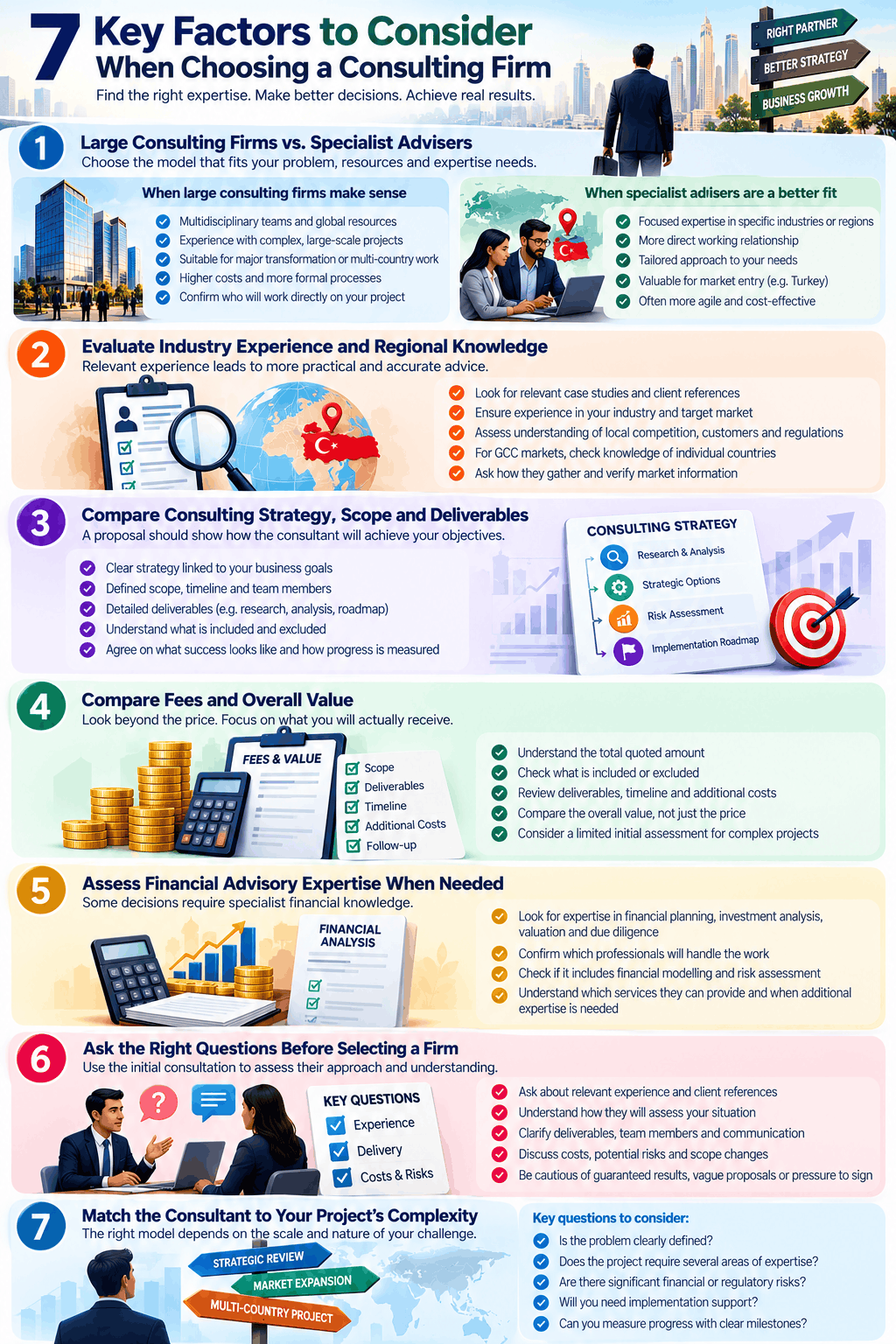
4. Compare Fees and Overall Value
Consulting fees can vary significantly depending on the firm’s experience, project complexity, duration, and level of involvement.
Some consultants charge hourly or daily rates. Others offer fixed project fees, monthly retainers, or fees linked to agreed milestones.
Rather than comparing prices alone, evaluate the total value of each proposal.
| Factor | What to check |
|---|---|
| Professional fees | What is the total quoted amount? |
| Scope | Which activities are included or excluded? |
| Deliverables | What reports, models, or plans will you receive? |
| Timeline | When will each milestone be completed? |
| Additional costs | Are travel, research, or specialist services charged separately? |
| Follow-up | Is implementation support included? |
A lower fee may be attractive but could exclude important work. A higher fee may be justified if the engagement includes specialist knowledge or more extensive implementation support.
Ask how additional requests will affect the budget. For complex projects, consider agreeing on a limited initial assessment before committing to a larger engagement.
The aim is to understand what your investment will provide and whether it addresses the business problem effectively.
5. Assess Financial Advisory Expertise When Needed
Some business decisions require financial expertise alongside management consulting.
For example, a company considering an acquisition, entering a new market, or investing in infrastructure may need to understand projected returns, cash flow requirements, funding options, and financial risks.
Financial advisory can support decisions involving financial planning, investment analysis, valuation, due diligence, and risk assessment, depending on the provider’s capabilities.
When evaluating a firm for this work, ask whether it has relevant financial expertise and which professionals will be responsible for the analysis.
Confirm whether the proposed work covers financial modelling, independent review, implementation, or only general recommendations.
Do not assume every management consulting firm can provide specialist financial, tax, legal, or regulated investment services. These may require separate qualified professionals.
A strong consulting partner should explain which services it can provide directly and when additional expertise is necessary.
6. Ask the Right Questions Before Selecting a Firm
An initial consultation gives you an opportunity to assess the consultant’s thinking, communication, and understanding of your needs.
Prepare questions that reveal how the firm approaches problems.
Experience
- Have you worked with businesses facing a similar challenge?
- Can you provide relevant examples or client references?
- What did your team contribute to those projects?
Work Delivery
- How will you assess our current situation?
- What deliverables will we receive?
- Who will lead the project and communicate with us?
- How will we measure progress?
Cost and Risk
- What is included in the quoted fee?
- What could cause additional costs or delays?
- How will you handle unexpected findings?
- What happens if we need to change the scope?
Pay attention to how the consultant responds. A good adviser should ask thoughtful questions, explain assumptions, and identify potential challenges before promising a solution.
Be cautious of guaranteed results, vague proposals, unclear fees, and pressure to sign before you have reviewed the details.
7. Match the Consultant to Your Project’s Complexity
The right consulting model depends on the scale and nature of your challenge.
A small business reviewing its growth priorities may need a focused strategic assessment.
A company entering several international markets may need market research, financial analysis, local expertise, and implementation support.
Use these questions to guide your decision:
- Is the problem clearly defined? If not, start with a diagnostic assessment.
- Does the project require several areas of expertise? Consider a multidisciplinary firm or a coordinated team of specialists.
- Does the work involve substantial financial or regulatory risks? Confirm that appropriately qualified professionals are available.
- Will your team need help implementing recommendations? Look for a provider that offers clearly defined implementation support.
- Can you measure progress? Agree on milestones and performance indicators before the work begins.
A useful consulting engagement should leave your organization with a clearer understanding of the problem, a practical set of recommendations, and a realistic plan for moving forward.
The objective is not to purchase the largest package of services. It is to obtain the right expertise for the decisions you need to make.
Frequently Asked Questions
1. What does a management consulting firm do?
A management consulting firm helps organizations assess challenges, evaluate opportunities, and improve business decisions.
Services may include strategic planning, market research, operational improvement, organizational development, and implementation support.
2. How do I choose the best consulting firm in Turkey?
Start by defining your business objectives and identifying firms with relevant industry experience and knowledge of the Turkish market.
Compare their methods, client references, proposed deliverables, fees, and ability to support your specific expansion or operational needs.
3. How much does a management consulting firm cost?
Costs depend on project scope, complexity, consultant experience, duration, and location. Fees may be hourly, daily, fixed-price, or retainer-based.
Request a detailed proposal that explains the full scope and any additional charges.
4. What is the difference between management consulting and financial advisory?
Management consulting generally focuses on business strategy, operations, organizational performance, and growth decisions.
Financial advisory focuses on financial matters such as investment analysis, valuation, financial planning, and risk. Some projects require both.
5. How can I measure the results of a consulting engagement?
Define success before the project begins. Depending on the objectives, measures may include reduced costs, improved operational efficiency, stronger financial planning, progress toward market entry, or completion of an agreed implementation roadmap.
6. Should I choose a large consulting firm or a specialist adviser?
Choose according to your project’s needs. Large firms may suit complex, multidisciplinary engagements, while specialist advisers may be better for focused problems requiring particular industry or regional expertise.
Compare the actual team and deliverables rather than relying on brand reputation alone.
Conclusion
Choosing a management consulting firm is an important business decision. The right partner should understand your objectives, demonstrate relevant experience, explain its fees clearly, and deliver work that helps your organization make informed decisions.
Compare expertise, scope, regional knowledge, and measurable outcomes before signing.
If your project involves international expansion, strategic planning, or financial decision-making, make sure the firm has the capabilities your objectives require. Ottoman Services supports organizations through strategic advisory, research, and market-focused consulting.
Book a consultation with Ottoman Services to discuss your business objectives, explore relevant opportunities, and identify an advisory approach suited to your needs.