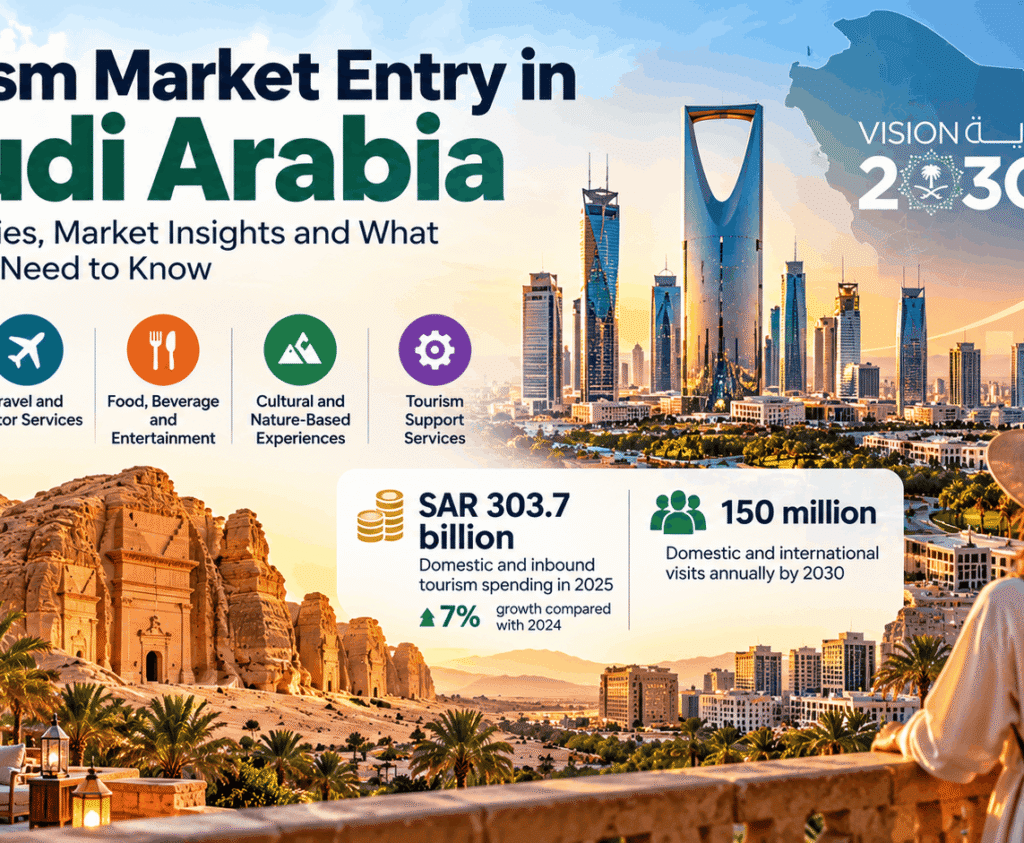
Saudi Arabia is investing in tourism as part of its broader economic diversification agenda. Under Vision 2030, the country is developing destinations, improving visitor services, and encouraging private-sector participation. These changes are creating opportunities for businesses across hospitality, travel, entertainment, food services, and tourism-related infrastructure.
The market’s scale is significant. According to the Saudi Ministry of Tourism, domestic and inbound tourism spending reached SAR 303.7 billion in 2025, representing 7% growth compared with 2024.
The country also aims to attract 150 million domestic and international visits annually by 2030. Businesses can review the latest indicators through the official Saudi Ministry of Tourism investment portal.
However, sector growth does not guarantee that every investment will succeed. Some locations may need more accommodation, while others may already face strong competition.
A successful tourism market entry in Saudi Arabia therefore requires careful research, a clear commercial proposition, and a realistic assessment of costs and risks.
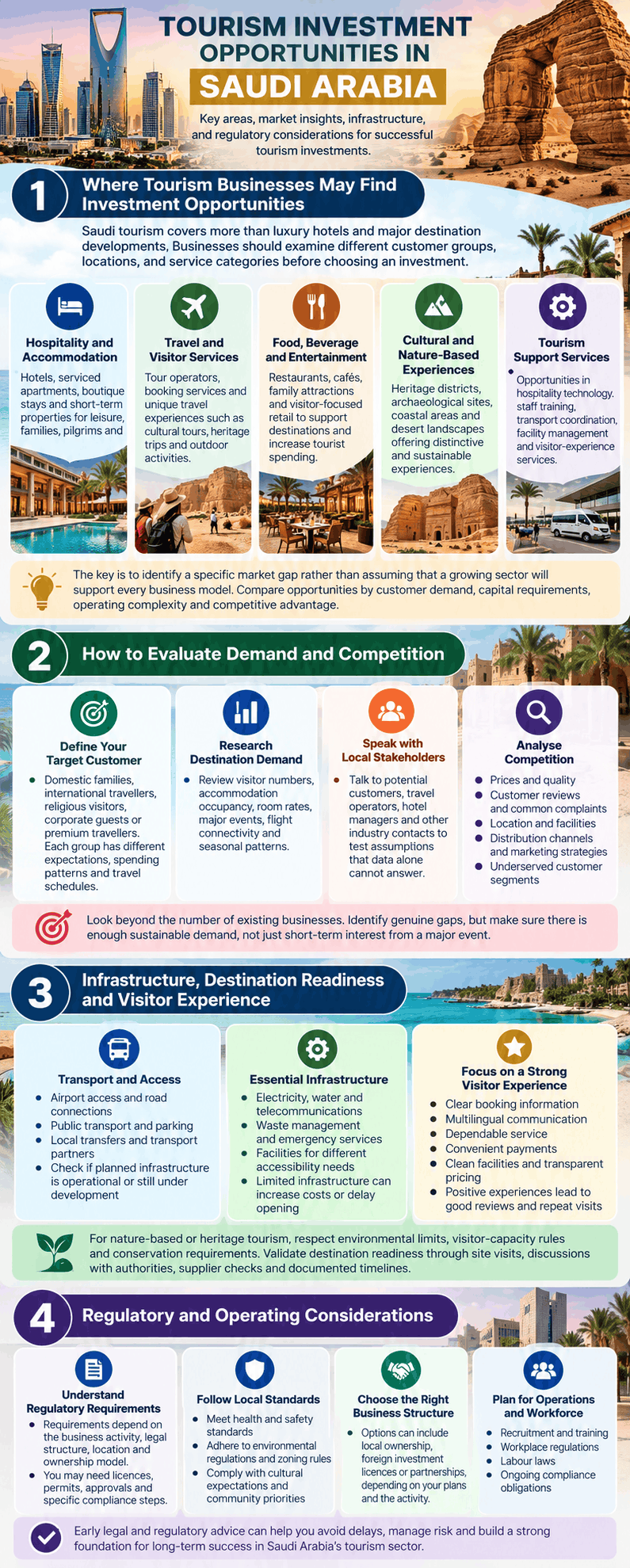
1. Where tourism businesses may find investment opportunities
Saudi tourism covers more than luxury hotels and major destination developments. Businesses should examine different customer groups, locations, and service categories before choosing an investment.
- Hospitality and accommodation: Hotels, serviced apartments, boutique accommodation, and professionally managed short-stay properties may serve leisure visitors, families, pilgrims, and business travellers.
- The best option depends on local demand, expected occupancy, room rates, and competing supply.
- Travel and visitor services: Tour operators, destination management companies, booking services, and specialist travel experiences may benefit from growing interest in Saudi destinations.
- Businesses can explore cultural tours, heritage experiences, outdoor activities, and carefully designed regional itineraries.
- Food, beverage, and entertainment: Restaurants, cafés, family attractions, and visitor-focused retail can support destinations where tourist spending extends beyond accommodation.
- Investors should examine customer spending patterns, nearby attractions, seasonality, and local purchasing power.
- Cultural and nature-based experiences: Heritage districts, archaeological sites, coastal destinations, and desert landscapes offer potential for distinctive experiences. These ventures must respect conservation requirements, environmental limits, and local community priorities.
- Tourism support services: Opportunities may also exist in hospitality technology, staff training, transport coordination, facility management, and visitor-experience services.
These business-to-business models can sometimes require a different investment structure from building a physical tourism asset.
The key is to identify a specific market gap rather than assuming that a growing sector will support every business model.
Investors should compare opportunities by customer demand, capital requirements, operating complexity, and competitive advantage.
2. How to evaluate demand and competition
Demand research should be one of the first steps in any tourism investment plan. National tourism figures provide useful context, but they cannot establish whether a particular hotel, restaurant, tour, or attraction will be commercially viable.
Begin by defining the target customer. Is the business designed for domestic families, international leisure travellers, religious visitors, corporate guests, or premium travellers?
Each group has different expectations, spending patterns, booking behaviours, and travel schedules.
Next, investigate demand at the destination level. Review visitor numbers where available, accommodation occupancy, average room rates, major events, flight connectivity, and seasonal patterns.
Speak with potential customers, travel operators, hotel managers, and other local stakeholders to test assumptions that published data cannot fully answer.
Competition analysis should examine more than the number of businesses already operating. Evaluate:
-
The prices and quality of competing products or services.
-
Customer reviews and recurring complaints.
-
The locations, accessibility, and facilities of competitors.
-
Their distribution channels, partnerships, and marketing strategies.
-
Customer segments that appear underserved.
For example, a destination may have several premium hotels but limited mid-market accommodation or family-oriented experiences.
That gap could represent an opportunity, but only if enough customers are willing to pay for the proposed service.
Investors should also distinguish between temporary demand and sustainable demand. A major event may generate a short-term increase in bookings, but a business with high fixed costs needs a plan for quieter periods.
3. Infrastructure, destination readiness, and visitor experience
A destination’s appeal depends on more than its attractions. Transport links, utilities, accommodation capacity, public services, and visitor facilities all affect the commercial potential of a tourism project.
Assess how visitors will reach the location and move around once they arrive. Consider airport access, road connections, public transport, parking, local transfers, and the availability of reliable transport partners.
For remote or emerging destinations, investigate whether infrastructure is operational or still planned.
Destination readiness also includes electricity, water, telecommunications, waste management, emergency services, and suitable facilities for people with different accessibility needs.
In some locations, limited infrastructure can increase operating costs or delay a planned opening.
The visitor experience deserves equal attention. Travellers may value clear booking information, multilingual communication, dependable service, convenient payments, clean facilities, and transparent pricing.
A strong experience can encourage positive reviews and repeat visits, while service failures can damage a new business’s reputation.
For nature-based or heritage tourism, assess environmental sensitivity, visitor-capacity limits, and preservation rules. Development that damages the attraction itself can undermine the long-term value of the investment.
Businesses should validate destination readiness through site visits, discussions with relevant authorities, supplier checks, and documented project timelines.
Do not treat a proposed road, attraction, or transport link as operational until its status has been verified.
4. Regulatory and operating considerations
Regulatory planning is essential for tourism market entry in Saudi Arabia. Requirements depend on the business activity, legal structure, location, and ownership arrangement.
A hotel, travel agency, tour operator, restaurant, and tourism consultancy may face different licensing and compliance obligations.
Foreign investors should establish the applicable investment registration requirements and commercial registration process before committing substantial capital.
They must also confirm which activity-specific permits, municipal approvals, safety certificates, and operating licences apply.
The Saudi Ministry of Tourism publishes information on tourism activities and licensing under its tourism regulations.
Businesses should verify current requirements directly with the responsible authorities rather than relying on outdated third-party guides.
Other important considerations include:
-
Ownership and structure: Confirm the permitted ownership arrangement, entity type, and registration obligations for the proposed activity.
-
Employment: Assess workforce requirements, recruitment plans, training needs, and applicable employment rules.
-
Tax and accounting: Model tax, VAT, accounting, and reporting obligations with qualified local advisers.
-
Property and construction: Verify land-use permissions, building approvals, occupancy requirements, and any destination-specific restrictions.
-
Contracts and consumer protection: Review supplier agreements, customer terms, insurance, refund policies, and relevant consumer obligations.
-
Local requirements: Understand applicable cultural expectations, environmental standards, data protection obligations, and rules for serving visitors.
Businesses should not assume that approval for one activity automatically authorises another. For instance, forming a company does not necessarily replace a tourism operating licence.
Build a compliance checklist with responsible authorities and qualified legal, tax, and regulatory professionals before finalising the investment.
5. How to assess commercial feasibility before investing
A tourism concept can attract interest and still fail financially. A feasibility assessment should test whether the business can generate enough revenue to cover operating costs, finance its investment, and withstand weaker-than-expected demand.
Start with a detailed financial model.
Estimate initial capital expenditure, property costs, equipment, staffing, utilities, marketing, technology, insurance, maintenance, and working capital. Include contingency funding for delays and cost increases.
Build revenue projections from realistic operating assumptions. An accommodation business, for example, should model occupancy and average daily room rates rather than simply multiplying every room by its maximum price.
A tour operator should estimate booking volume, average revenue per customer, partner commissions, and seasonal demand.
Create at least three scenarios:
-
Base case: Revenue and costs follow reasonable, evidence-based assumptions.
-
Downside case: Bookings are lower, opening is delayed, or costs rise.
-
Upside case: Demand exceeds expectations without assuming unrealistic growth.
Then test break-even requirements, cash flow, funding needs, expected returns, and the time required to reach stable operations.
Include sensitivity analysis to see how changes in occupancy, prices, labour costs, or financing affect profitability.
Finally, evaluate the business’s competitive advantage. Does it offer a distinct experience, better service, stronger distribution, specialised expertise, or a more efficient operating model?
A clear advantage can help a business compete without relying entirely on price reductions.
6. Aligning investment with government strategy in Saudi Arabia
Understanding government strategy in Saudi Arabia helps investors identify where their business plans may fit within broader tourism development priorities.
Vision 2030 supports economic diversification, stronger private-sector participation, and the development of tourism destinations and visitor services.
However, alignment with a national strategy should be treated as context, not as a guarantee of government support, funding, permits, or commercial success.
Investors must independently verify the eligibility criteria for any incentive, financing programme, or investment opportunity.
A practical approach is to identify the relevant destination and sector priorities, determine how the proposed business contributes to visitor needs or local economic activity, and confirm whether the project meets applicable programme requirements.
This is also where Saudi tourism development requires a long-term perspective.
Projects should be evaluated for their ability to serve visitors consistently, work with local suppliers, build staff capability, and maintain service quality as destinations mature.
People Also Ask: Saudi tourism investment questions
Is Saudi Arabia a good market for tourism investment?
Saudi Arabia offers potential across hospitality, travel services, entertainment, and visitor experiences.
Whether it is a good investment depends on the location, customer segment, competition, capital requirements, regulatory obligations, and financial projections of the specific project.
What are the main opportunities in Saudi tourism development?
Potential areas include accommodation, cultural and nature-based experiences, food services, tour operations, destination activities, hospitality technology, and visitor-support services.
Investors should validate demand and competition before selecting a sector.
How can a foreign business enter the Saudi tourism market?
A foreign business should research its target market, confirm the appropriate ownership and legal structure, complete the relevant investment and commercial registration steps, and obtain all required activity-specific approvals.
Requirements vary, so investors should verify them with the relevant Saudi authorities and qualified local advisers.
How does government strategy in Saudi Arabia affect tourism investors?
National priorities influence destination development, infrastructure planning, and initiatives designed to encourage private investment.
Investors should monitor relevant policies and programmes while assessing each project’s commercial feasibility independently.
What should investors check before launching a tourism business in Saudi Arabia?
They should assess customer demand, competition, infrastructure, permits, staffing, operating costs, supplier availability, cash flow, and downside risks.
A feasibility study can reveal whether the opportunity is commercially sustainable.
Frequently Asked Questions
1. Which Saudi tourism sectors are suitable for small and medium-sized businesses?
Depending on demand and licensing requirements, SMEs may explore guided experiences, travel services, food and beverage, hospitality support, digital booking solutions, and specialist visitor services.
Starting with a focused service offering may require less capital than developing a large property or attraction.
2. Is Saudi tourism mainly driven by religious travel?
No. Religious travel is an important part of the market, but Saudi Arabia also attracts leisure, cultural, business, entertainment, and domestic travellers.
Investors should select their customer segment based on destination-specific evidence rather than treating all tourism demand as the same.
3. What is tourism market entry in Saudi Arabia?
Tourism market entry refers to the process of researching the market, choosing a viable business model, establishing the appropriate legal structure, securing necessary approvals, developing local partnerships, and preparing to operate.
The process varies according to the business activity and investment structure.
4. How can businesses reduce risks before investing in Saudi tourism?
Businesses can reduce risk through local market research, site visits, competitor analysis, verified supplier quotations, regulatory checks, realistic financial projections, and downside scenario planning.
Staged investment can also help avoid committing all available capital before key assumptions are validated.
5. Does alignment with Vision 2030 guarantee tourism investment incentives?
No. Alignment with Vision 2030 does not automatically qualify a project for financial assistance, incentives, or regulatory exemptions.
Businesses must confirm programme eligibility, application requirements, approval conditions, and current availability with the relevant authorities.
6. Why should investors seek tourism business consultation before entering Saudi Arabia?
Tourism business consultation can help investors assess market demand, compare destinations, identify potential risks, evaluate financial feasibility, and develop a structured market-entry plan.
Qualified local legal, tax, and regulatory professionals should also be involved where specialist advice or formal approvals are required.
Conclusion: Turn Saudi tourism potential into a practical business strategy
Saudi Arabia’s tourism sector offers a range of possibilities, but sustainable results depend on more than market growth.
Investors need to understand customer demand, select the right location, evaluate infrastructure, meet regulatory requirements, and build financial plans that remain realistic under changing market conditions.
A structured approach to tourism market entry in Saudi Arabia can help businesses identify relevant opportunities while avoiding costly assumptions.
It also helps investors connect their commercial goals with the country’s wider tourism development priorities without overlooking project-specific risks.
Considering an investment in Saudi Arabia’s tourism sector? Ottoman Services can help businesses explore market-entry considerations, assess strategic opportunities, and develop a more informed approach to expansion.
Seek tourism business consultation from Ottoman Services to evaluate your options and plan your next steps with greater clarity.