
By Ottoman Services | Based on DBA Research by Dr. Muhammad Ali Shahzad | Published in AIJFR, Vol. 7, Issue 1, 2026
Research DOI: https://doi.org/10.63363/aijfr.2026.v07i01.3190
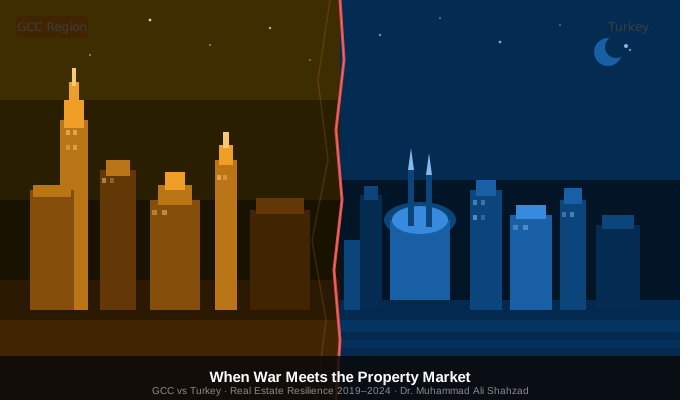
Between 2019 and 2024, two of the world’s most economically significant regions faced a convergence of crises that would stress-test any market: active regional conflicts, a global pandemic, and deep geopolitical uncertainty. The GCC and Turkey sat at the center of this storm, and their real estate markets responded in strikingly different ways. Understanding that divergence is not just an academic exercise. For investors, developers, and policymakers, the contrast holds lessons that apply directly to how capital should be deployed across emerging markets today.
Why Real Estate Is the First to Feel Geopolitical Pressure
Real estate is uniquely sensitive to instability. Unlike equities, which price information in seconds, property markets absorb shocks slowly, through construction delays, shifting investor sentiment, and changes in migration patterns. When the Yemen conflict intensified and Syrian tensions persisted across the study period, both the GCC and Turkey experienced disruption in economic activity and investment flows, but the transmission mechanisms were fundamentally different.
Research by Dr. Muhammad Ali Shahzad, a real estate economist and geopolitical strategist based in Istanbul, provides a comparative framework for understanding exactly how these dynamics played out across both regions in his DBA thesis, published in the Advanced International Journal for Research in early 2026.
The GCC Playbook: Fiscal Reserves as a Shock Absorber
In the Gulf Cooperation Council, sovereign wealth and deep fiscal reserves functioned as structural buffers. When regional conflicts threatened investment confidence, GCC governments deployed timely stimulus measures that stabilized property values and kept construction activity moving. The pandemic, rather than purely contracting demand, actually reconfigured it. The shift toward remote work and changed lifestyle preferences drove a wave of demand for residential and mixed-use properties, particularly in suburban corridors across the UAE and Saudi Arabia.
This outcome was not accidental. It reflected a mature crisis-management infrastructure built over decades of managing oil revenue cycles and regional instability. The GCC proved that when institutional frameworks are sound and fiscal reserves deep, real estate markets can absorb compound shocks without sustained collapse.
Turkey’s More Complex Story
Turkey’s experience was more layered. Geopolitical tensions, persistent inflationary pressure, and currency volatility created conditions of heightened vulnerability for the real estate market. Yet the picture was not uniformly negative. Currency depreciation paradoxically attracted a wave of foreign property investors who saw Turkish assets as deeply discounted relative to hard currencies. This short-term surge in foreign buyer activity provided a temporary floor under prices, particularly in Istanbul.
However, Dr. Shahzad’s research notes that this boost did not translate into durable market stability. Turkey faced prolonged volatility, slower recovery in domestic demand, and the structural challenge of inflation eroding real returns on property investment. The currency factor that attracted foreign buyers also frightened domestic long-term capital.
Key Insight: A market that attracts capital through currency weakness rather than fundamental strength is riding a borrowed tailwind. Sustainable real estate growth requires institutional depth, not just arbitrage opportunity.
Construction Delays, Sentiment Shifts, and Demand Transformation
Across both regions, construction delays emerged as a shared consequence of crisis conditions. Supply chain disruptions during the pandemic, combined with labor mobility restrictions and material cost inflation, pushed back project timelines and increased development costs. Investor sentiment shifted toward caution, with a notable preference for completed assets over off-plan commitments.
The research also identifies a structural change in demand patterns that outlasted the acute phase of the crises. The preference for larger residential units with dedicated workspace, suburban locations with lower density, and mixed-use developments with integrated amenities became entrenched across both GCC and Turkish markets. This shift is not temporary: it represents a generational recalibration of what buyers and renters expect from real estate.
What This Means for Investors and Advisors
For regional investors and advisory professionals, the comparative lessons from Dr. Shahzad’s research point toward several actionable conclusions. First, market resilience is not purely a function of asset class selection. It is a function of the institutional environment surrounding those assets. The GCC’s outperformance was not simply about oil wealth; it reflected governance capacity and the ability to execute countercyclical policy at speed.
Second, currency-driven investment surges are not the same as market recovery. Turkey attracted significant foreign capital during its period of lira weakness, but structural vulnerabilities remained. Distinguishing between speculative inflows and genuine demand recovery is essential for making sound allocation decisions in volatile markets.
Third, adaptive policies matter as much as current conditions. The research emphasizes economic diversification and robust crisis management as prerequisites for sustainable growth, not optional enhancements. Investors exposed to markets with narrow economic bases or limited crisis management capacity face amplified tail risks.
Ottoman Services advises investors and developers navigating real estate decisions across Turkey, the GCC, and broader emerging market contexts. Our advisory work is informed by rigorous research, including insights from Dr. Muhammad Ali Shahzad’s published scholarship. Contact our team to discuss how these market dynamics apply to your specific investment thesis.