
By Ottoman Services | Based on Research by Dr. Muhammad Ali Shahzad | Published in AIJFR, Vol. 7, Issue 2, April 2026
Research DOI: https://doi.org/10.63363/aijfr.2026.v07i02.4587
Roughly 20 percent of global oil trade passes through the Strait of Hormuz every day. It is one of the world’s most consequential chokepoints, and also one of its most fragile. Any significant disruption at Hormuz would cascade through global energy markets within hours. The Gulf states have long understood this vulnerability. The question has always been whether a credible alternative is technically and economically viable.
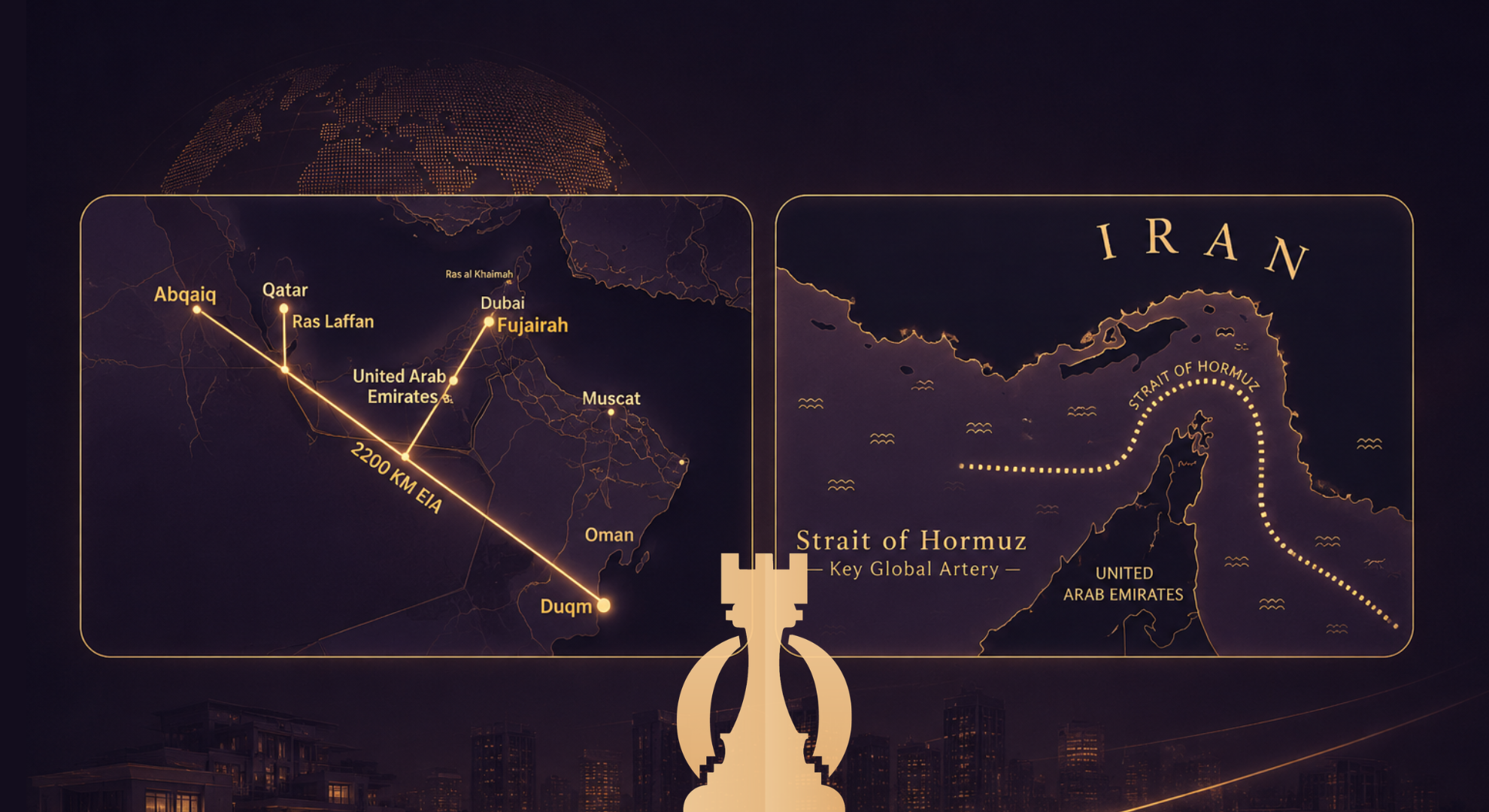
In a landmark research paper published in the Advanced International Journal for Research, Dr. Muhammad Ali Shahzad proposes a detailed framework for what he calls the Arabian Energy Corridor (AEC), a phased multi-state energy infrastructure network designed to reshape Gulf export logistics. At its center is Oman’s deep-water port of Duqm, which the research positions as the potential anchor of a new regional energy architecture.
The Abqaiq to Duqm Pipeline: Stage One
The corridor begins with a primary crude oil pipeline linking Saudi Arabia’s Abqaiq facility, one of the world’s largest oil processing complexes, directly to Duqm on the Arabian Sea coast of Oman. This standalone pipeline, with an estimated capacity of approximately 1.5 million barrels per day, would give Saudi Arabia a direct export route to the Arabian Sea without passing through Hormuz.
Dr. Shahzad’s economic modeling treats this first stage primarily as export-security infrastructure rather than a purely commercial proposition. The economic case is justified by the strategic value of reducing chokepoint dependency, even if throughput economics alone do not optimize financial returns at this stage. The parallel is similar to how critical infrastructure is evaluated in other sectors: the value of the option to bypass a risk often exceeds the immediate cost savings.
Stage Two: A Multi-Stream Regional Energy Platform
The research’s more transformative proposition comes in the corridor’s second phase. When additional crude and gas flows from UAE and Qatar are integrated into the system, the corridor shifts from a single-asset pipeline into a multi-stream energy logistics platform. This integration is what unlocks genuine economic viability through scale effects, diversified revenue streams, and hub-based operations centered on Duqm.
Those hub operations would include crude storage, blending, export timing optimization, and downstream integration with refining and petrochemical facilities. Duqm’s deep-water capability and its strategic location at the mouth of the Arabian Sea make it the natural geographic anchor for this platform. The port already has significant planned industrial investment, and the corridor would amplify and accelerate that development trajectory.
Key Insight: The Arabian Energy Corridor is not simply a pipeline. It is a framework for repositioning Oman as the Gulf’s primary energy logistics hub for the Asian century, while simultaneously reducing the region’s exposure to one of global trade’s most dangerous chokepoints.
The Asian Market Alignment
One of the most strategically significant dimensions of Dr. Shahzad’s analysis is its alignment with the structural shift in global oil demand. The center of gravity for hydrocarbon consumption has moved decisively toward Asia. China, India, Pakistan, and Japan now dominate the destination profile of Gulf energy exports. A corridor terminating at Duqm on the Arabian Sea is geographically optimized precisely for these markets, providing faster, more secure transit times than Hormuz-dependent routes.
This alignment is not incidental. The research positions the Arabian Energy Corridor as an infrastructure response to a fundamental and durable shift in global energy demand geography. Infrastructure that shortens transit routes and reduces risk exposure for the region’s largest customers generates long-term commercial and geopolitical value simultaneously.
Oman’s Strategic Opportunity
For Oman, the corridor represents a generational economic opportunity. Duqm’s transformation from an emerging industrial zone to a major energy logistics hub would create substantial employment, attract international investment across refining and petrochemicals, and establish Oman as an essential node in Gulf energy infrastructure rather than a peripheral participant. The research notes that regional cooperation and international investment participation are essential components of making this vision operational, but the strategic logic is compelling.
Turkey, with its own position as an energy transit country and its deepening economic relationships with Gulf states, has a particular interest in the emergence of new regional energy architectures. The Arabian Energy Corridor would reshape supply chain geography in ways that affect Turkish energy security and trade relationships simultaneously.
Investment and Policy Implications
For institutional investors and sovereign wealth funds evaluating long-cycle energy infrastructure, Dr. Shahzad’s research provides an analytical framework for assessing the corridor’s development trajectory. The phased approach, moving from export-security infrastructure to an integrated multi-stream platform, allows for staged capital deployment aligned with demonstrated commercial viability at each phase.
Policy implications for regional governments are equally significant. Regulatory frameworks governing cross-border pipeline cooperation, port development incentives, and downstream industrial integration will determine whether the Arabian Energy Corridor remains a strategic concept or becomes operational infrastructure over the coming decade.
Ottoman Services provides research-informed advisory on energy sector investment, regional infrastructure strategy, and market positioning across the GCC, Turkey, and broader Middle Eastern contexts. Connect with our team to explore how developments in Gulf energy architecture affect your investment positioning.