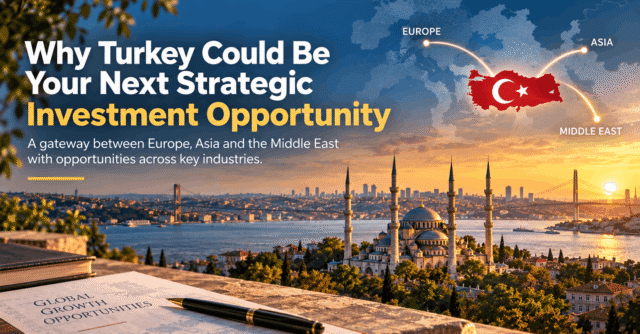
What if your next strategic investment opportunity is positioned between three continents?
For global investors, Turkey offers more than access to a large domestic market. Its position between Europe, Asia, and the Middle East makes it a potential gateway for businesses looking to expand their operations, reach new markets, strengthen supply chains, and build long-term regional presence.
But geographic advantage alone does not guarantee a successful investment. The real opportunity lies in understanding where to invest, which sectors offer strategic potential, how to enter the market, and how Turkey can fit into a wider global growth strategy.
This is where strategic planning becomes essential.
From infrastructure and logistics to aviation, financial services, tourism, construction, and smart cities, Turkey presents opportunities across multiple industries.
The country’s developing participation finance ecosystem also creates additional considerations for investors exploring Islamic Finance and Sharia-aligned investment structures.
So, is Turkey simply another market to enter, or could it become a strategic platform for reaching surrounding economies?
This guide explores the key factors investors should consider when developing a strategic planning approach for Turkey, including market entry strategy in Turkey, infrastructure, smart cities, Islamic Finance, regional connectivity, and long-term growth opportunities.
If you are considering an investment or expansion into Turkey and want to understand how the market could fit into your broader strategy, consider booking a consultation with the Ottoman Services team to discuss your objectives and explore the opportunities available to you.
What Is Strategic Planning for Investors?
Strategic planning is the process of determining where an organization wants to go, what opportunities it should pursue, what resources it needs, and how it will measure progress.
For an investor entering a new country, strategic planning goes beyond writing a business plan.
It should answer practical questions such as:
- Which Turkish market should we enter?
- Which city or region best supports our objectives?
- Who are the major competitors?
- What regulations could affect our investment?
- What infrastructure is available?
- What financing options are appropriate?
- Should Turkey be treated as a domestic market or a regional headquarters?
- How can the investment connect with European, Middle Eastern, and Asian markets?
- What risks should be considered before committing capital?
A strategic plan provides a framework for answering these questions before significant resources are committed.
Harvard Business School describes strategic planning as an ongoing process used to define an organization’s direction, prioritize efforts, allocate resources, and align stakeholders around measurable objectives.
For international investors, this ongoing approach is particularly important because market conditions, regulations, financing costs, technology, and geopolitical conditions can change.
Why Is Strategic Planning Important When Investing in Turkey?
Entering a foreign market without sufficient planning can create unnecessary costs.
An investor may identify a promising opportunity but select the wrong location.
Another company may underestimate regulatory requirements. A manufacturer might establish operations without adequately evaluating logistics.
A financial investor may identify an attractive asset without considering the broader market environment.
Strategic planning helps bring these factors together.
1. It Creates a Clear Investment Direction
A Turkish expansion should begin with a clearly defined objective.
For example, an international company may want to:
- Establish a manufacturing base
- Enter the Turkish consumer market
- Export products into Europe
- Build a regional headquarters
- Develop an infrastructure project
- Invest in real estate
- Establish a logistics operation
- Enter the aviation sector
- Develop tourism assets
- Explore participation finance opportunities
Each objective requires a different strategy.
A company establishing a manufacturing facility may prioritize industrial zones, supply chains, workforce availability, energy infrastructure, and export access.
A technology company may place greater emphasis on talent, digital infrastructure, innovation ecosystems, and access to customers.
Strategic planning helps investors avoid treating Turkey as a single, uniform market.
Turkey’s Strategic Geographic Advantage
One of Turkey’s strongest investment characteristics is its geographic position.
The country connects major economic regions between Europe, Asia, and Africa.
This creates opportunities for companies that want to use Turkey as a production, logistics, management, or distribution base.
According to Turkey’s Investment Office, the country’s location provides access to major markets across 16 time zones, while its transportation connectivity supports international business operations.
The country’s strategic position can be particularly relevant for businesses operating across multiple markets.
For example, a company could potentially use Turkey as:
A production base:
Manufacturing operations can serve domestic demand while supporting exports.
A logistics hub:
Companies can position distribution and transportation operations around access to European, Middle Eastern, and Central Asian markets.
A regional management center:
International companies can use Turkey as a base for managing activities across surrounding markets.
A market-entry platform:
Businesses can establish a presence in Turkey while developing relationships and distribution channels across neighboring regions.
This is why strategic planning should examine Turkey’s role within an investor’s global business model, rather than considering the country in isolation.
How Should Investors Evaluate the Turkish Market?
A strategic planning process should begin with market analysis.
Investors should examine several factors before selecting an investment opportunity.
Market Demand
Is there sufficient demand for the product or service?
Understanding the size of the addressable market is important, but investors should also examine customer behavior, purchasing power, competition, and future demand.
Competition
Who already operates in the market?
Competitive analysis can reveal pricing structures, market gaps, distribution models, customer expectations, and potential barriers to entry.
Location
Istanbul may be appropriate for one business while another may benefit from a different Turkish city or industrial region.
Location analysis should consider:
- Transportation
- Ports and airports
- Industrial infrastructure
- Workforce
- Customer proximity
- Supplier networks
- Operating costs
- Investment incentives
- Regional development
Regulation
Foreign investors also need to understand the regulatory environment applicable to their sector.
This may include company formation, taxation, employment requirements, licensing, sector-specific regulations, foreign investment procedures, and environmental requirements.
Turkey’s Investment Office provides an investment process guide covering areas such as establishing a company and commissioning a facility.
This makes regulatory analysis an important part of strategic planning before implementation begins.
What Are the Key Elements of Strategic Planning?
Although every investment strategy is different, a Turkey-focused strategic planning framework can include the following stages.
1. Define the Investment Objective
Start with the question:
What does the investor want to achieve in Turkey?
The objective should be specific.
For example:
Establish Turkey as a regional manufacturing and export base within five years.
This is more useful than simply stating:
Expand into Turkey.
2. Analyze the Market
The next stage is research.
Investors should examine market size, demand, competitors, regulations, suppliers, customers, infrastructure, and economic conditions.
3. Identify Strategic Opportunities
Once the market is understood, potential opportunities can be compared.
These could include manufacturing, infrastructure, logistics, aviation, financial services, tourism, technology, construction, or urban development.
4. Assess Risks
Strategic planning should also examine potential challenges.
These can include:
- Currency exposure
- Inflation
- Financing conditions
- Regulatory changes
- Supply-chain disruption
- Geopolitical developments
- Market competition
- Labor availability
- Construction costs
The goal is not to eliminate uncertainty. The goal is to understand it well enough to make informed decisions.
5. Build an Implementation Roadmap
The final strategy should translate research into action.
A roadmap may include:
- Investment phases
- Capital requirements
- Partners
- Location selection
- Regulatory steps
- Hiring requirements
- Technology requirements
- Performance indicators
- Expansion milestones
This is where strategic planning becomes more than a research exercise.
Where Does Islamic Finance Fit Into Turkey’s Investment Landscape?
Islamic Finance can be an important consideration for investors seeking financing structures aligned with Islamic principles.
Turkey has an established participation banking sector.
The Participation Banks Association of Türkiye explains that participation banks finance economic activity through structures based on interest-free principles, including corporate financing, leasing, joint investments, and profit-and-loss participation.
This creates an additional dimension for investors evaluating financing options.
For investors from GCC markets and other regions where Islamic finance plays an important role, Turkey’s participation finance ecosystem may be relevant when evaluating:
- Project financing
- Real estate investment
- Infrastructure
- Trade
- Manufacturing
- Corporate finance
- Investment structures
- Ethical finance
However, Islamic Finance should not be treated simply as a financing product.
For some investors, it can form part of a broader investment philosophy involving ethical business practices, risk sharing, responsible investment, and governance.
Turkey’s participation finance sector has also developed formal industry strategies and continues to engage internationally around the development of participation finance.
For this reason, investors considering Turkey may benefit from evaluating conventional and participation-based financing structures as part of their overall strategic planning process.
How Are Smart Cities Creating New Investment Opportunities in Turkey?
Urban development is another area where strategic planning becomes particularly important.
Turkey has already established a national framework for smart cities, including the 2020–2023 National Smart Cities Strategy and Action Plan.
The framework addressed smart city transformation at both national and local levels and considered areas such as infrastructure, data, urban services, sustainability, and local government capabilities.
This creates potential opportunities across multiple sectors.
Smart city development is not limited to technology companies.
It can involve:
- Urban infrastructure
- Transportation
- Smart mobility
- Energy efficiency
- Digital infrastructure
- Geographic information systems
- Waste management
- Public services
- Construction
- Data platforms
- Building technology
- Urban planning
Turkey’s smart city framework also emphasizes the importance of adapting strategies to the specific characteristics of individual cities.
For investors, this means that a smart city opportunity should not be evaluated purely from a technology perspective.
It should be evaluated as an urban ecosystem.
A smart mobility project, for example, may require cooperation between technology providers, transportation operators, infrastructure companies, municipalities, investors, and financial institutions.
That is precisely where strategic planning can help.
What Is the Investment Potential of Smart Cities in Turkey?
Smart city investment can create opportunities at the intersection of technology, infrastructure, construction, transportation, energy, and public services.
Consider an investor interested in smart mobility.
Instead of investing only in a technology platform, the investor could evaluate the wider ecosystem:
Technology → Infrastructure → Transportation → Data → Urban Planning → Public Services
This broader approach can reveal opportunities that may not be visible when sectors are analyzed separately.
Turkey’s smart city strategy documentation also highlights areas including geographic information systems, infrastructure, energy efficiency, urban transformation, and participatory local governance.
For investors, these areas can potentially support long-term projects involving both public and private stakeholders.
Which Industries Offer Strategic Opportunities in Turkey?
Strategic planning should be customized to the investor’s industry.
Infrastructure and Construction
Turkey’s infrastructure requirements create opportunities across construction, engineering, transportation, energy, urban development, and related services.
Investors should assess project pipelines, financing structures, public-private partnerships, procurement requirements, and regional demand.
Logistics and Transportation
Turkey’s location makes logistics particularly relevant for businesses serving multiple markets.
Investors can examine ports, airports, road networks, distribution centers, warehousing, and supply-chain services.
Aviation
Aviation can be considered from several perspectives, including airport development, airline strategy, network planning, passenger growth, cargo, and aviation infrastructure.
Financial and Investment Services
Turkey’s financial ecosystem offers opportunities for investors interested in corporate finance, investment advisory, participation banking, asset management, and related services.
Tourism and Hospitality
Turkey’s tourism industry can also be evaluated through destination development, hospitality investment, tourism infrastructure, and international visitor demand.
Urban Development and Smart Cities
Growing urban requirements create opportunities across infrastructure, construction, mobility, technology, energy efficiency, and digital public services.
What Should Foreign Investors Consider Before Expanding Into Turkey?
A successful expansion strategy should answer several practical questions before capital is committed.
Is Turkey Being Evaluated as a Market or a Regional Hub?
This distinction is important.
If the objective is only to sell products in Turkey, the strategy may focus primarily on domestic demand.
If Turkey is intended to become a regional headquarters or production base, the analysis should include surrounding markets, trade relationships, logistics, export routes, and regional management requirements.
Turkey’s Investment Office identifies the country as a potential regional hub for multinational companies and highlights its access to large surrounding markets.
Which Location Supports the Business Model?
Investors should not automatically assume that Istanbul is the right location.
The appropriate location depends on the business model.
A manufacturing company may prioritize industrial infrastructure and logistics.
A financial company may prioritize access to business networks and professional talent.
A tourism project may depend more heavily on destination characteristics.
A smart city project may require alignment with municipal priorities and urban development plans.
How Should Capital Be Allocated?
Capital allocation should reflect strategic priorities.
Instead of committing the entire investment at once, investors can consider phased approaches where appropriate.
For example:
Phase 1: Market research and feasibility
Phase 2: Local partnerships and regulatory preparation
Phase 3: Initial investment
Phase 4: Operations and performance measurement
Phase 5: Regional expansion
This approach can make it easier to evaluate performance before moving into larger commitments.
What Are the Main Benefits of Strategic Planning?
Strategic planning provides investors with a structured way to connect opportunity with execution.
Its benefits include:
Better decision-making:
Investors can make decisions using market research rather than assumptions.
Resource allocation:
Capital, people, and technology can be directed toward defined priorities.
Risk management:
Potential risks can be identified before they become expensive problems.
Market positioning:
Companies can determine how they want to compete and differentiate themselves.
Long-term flexibility:
A strategic plan can be updated as market conditions change.
Performance measurement:
Investors can establish KPIs and milestones to determine whether the strategy is producing the expected results.
The World Bank continues to identify Turkey as a strategically significant economy while also highlighting economic uncertainties and changing conditions affecting growth and investment.
This reinforces the importance of treating strategic planning as an ongoing process rather than a one-time document.
What Is the Difference Between Strategic Planning and a Business Plan?
A business plan and a strategic plan serve different purposes.
A business plan generally explains how a particular business will operate, generate revenue, manage costs, and achieve its objectives.
Strategic planning takes a broader view.
It asks:
- Where should the business compete?
- Which opportunities should it pursue?
- What should it prioritize?
- What capabilities does it need?
- How should resources be allocated?
- How should the organization respond to market changes?
For an investor entering Turkey, both can be valuable.
Strategic planning can establish the direction, while the business plan can provide greater operational and financial detail.
How Can Investors Build a Turkey Market Entry Strategy?
A practical market-entry process can follow six steps:
Step 1: Define the Objective
Determine whether the goal is sales, manufacturing, investment, regional headquarters, infrastructure development, or another objective.
Step 2: Conduct Market Research
Analyze demand, competition, regulations, infrastructure, customers, suppliers, and market trends.
Step 3: Compare Locations
Evaluate Turkish cities and regions against the requirements of the investment.
Step 4: Evaluate Financing
Consider available financing structures, including conventional and relevant participation-based options.
Step 5: Develop the Strategy
Create a structured roadmap covering investment, operations, partnerships, staffing, risk management, and growth.
Step 6: Monitor and Adapt
Measure performance against KPIs and adjust the strategy as market conditions evolve.
This last step is especially important.
Strategic planning should not be treated as a static document. Gartner similarly describes strategic planning as a process that connects long-term objectives with near-term initiatives, investments, resources, and measurable outcomes.
Why Turkey Can Be a Strategic Platform for Global Investors
Turkey’s investment proposition is broader than its domestic market.
Its geographic position creates connections between major economic regions.
Its infrastructure supports international connectivity. Its economy contains diverse sectors, while its investment ecosystem includes manufacturing, finance, logistics, construction, tourism, aviation, technology, and urban development.
The country’s official FDI strategy for 2024–2028 also identifies foreign direct investment as an important component of economic growth, technological transformation, and international competitiveness.
For investors, the key question is therefore not simply:
“Should we invest in Turkey?”
A more useful strategic question is:
“How can Turkey fit into our long-term international investment strategy?”
That question changes the investment conversation.
It encourages investors to look beyond individual projects and evaluate how Turkey could contribute to manufacturing, trade, logistics, finance, infrastructure, technology, and regional expansion.
Frequently Asked Questions About Strategic Planning in Turkey
What is strategic planning?
Strategic planning is the process of defining an organization’s long-term direction, setting priorities, allocating resources, and creating an actionable roadmap for achieving specific objectives. For investors entering Turkey, it can help connect market research with investment and expansion decisions.
Why is strategic planning important for international investors?
Strategic planning helps investors evaluate opportunities, risks, resources, competition, regulations, and market conditions before committing significant capital. It also provides measurable objectives that can be reviewed as circumstances change.
Why is Turkey strategically important for investors?
Turkey’s geographic position between Europe, Asia, and Africa gives businesses access to major regional markets. Its Investment Office identifies access to approximately 1.3 billion people and a combined $35 trillion market within a four-hour flight radius.
Is Turkey suitable as a regional business hub?
Turkey can serve different strategic roles depending on the investor’s business model. Its geographic position, transportation connectivity, domestic market, and access to surrounding regions make it relevant for companies considering regional manufacturing, exports, logistics, management, and distribution operations.
How does Islamic Finance relate to investment in Turkey?
Turkey has a participation banking sector that provides financing through structures based on interest-free principles. Investors interested in Islamic Finance can therefore consider participation-based financing alongside other financing structures when developing an investment strategy.
What are smart cities?
Smart cities use technology, data, infrastructure, and integrated planning to improve urban services, efficiency, sustainability, and quality of life. Turkey established a national smart cities strategy framework covering national and local approaches to smart city development.
What should investors research before entering Turkey?
Investors should examine market demand, competition, location, regulation, infrastructure, financing, workforce, supply chains, taxation, incentives, and potential risks. The specific priorities will depend on the sector and investment objective.
Conclusion: Strategic Planning Can Turn Turkey’s Position Into an Investment Strategy
Turkey’s geographic position creates a compelling strategic context for investors looking beyond a single domestic market.
Its connections with Europe, Asia, Africa, the Middle East, and Central Asia can support different investment models across infrastructure, construction, logistics, aviation, finance, manufacturing, tourism, and technology.
But geographic advantage alone does not create a successful investment.
Investors need a clear understanding of where to compete, how to enter the market, which opportunities to prioritize, how to finance the investment, and how to manage changing conditions. Strategic planning provides the framework for bringing these decisions together.
The emergence of Islamic Finance, continued infrastructure development, and the evolution of smart cities also create additional dimensions for investors evaluating Turkey’s long-term potential.
For organizations considering market entry, investment, infrastructure development, regional expansion, or strategic partnerships in Turkey, Ottoman Services can provide research-driven strategic guidance tailored to the Turkish and wider regional environment.
Reach out to the Ottoman Services team to discuss your objectives and develop a practical strategy for entering or expanding in Turkey.
For further official investment information, investors can also consult the Republic of Türkiye Investment Office, which provides resources on investment opportunities, regulations, incentives, and establishing a business in Türkiye.